No. BONNEY1884-001
Bungyarlee and Parkungi moola-uncka initiation bullroarer
Australia · Momba Station · Wilcannia · northern River Darling
Restricted
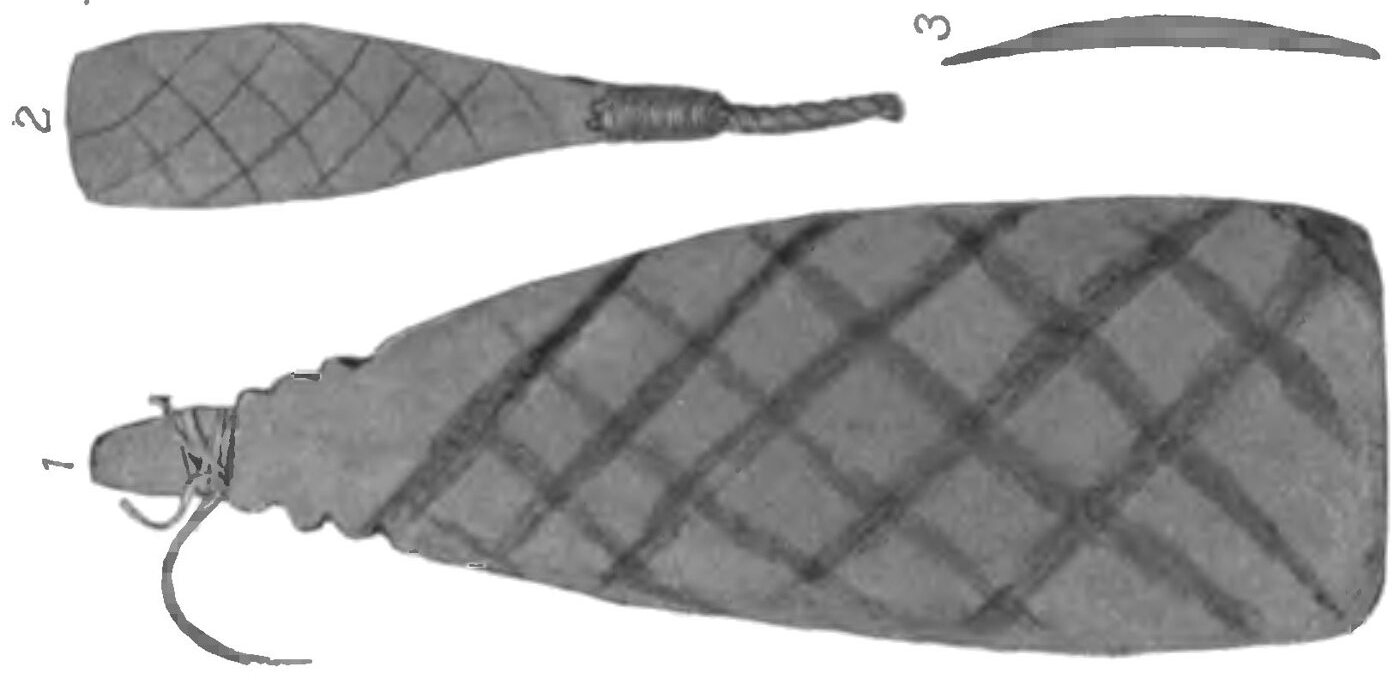
moola-uncka
Source term: wooden instrument
moola-uncka: local name recorded jointly for the Bungyarlee and Parkungi bullroarer; no literal gloss given
Along the Darling, young men swung the moola-uncka near an initiate secluded in the bush. Its flat oval hardwood blade made a loud hum. Women used the sound to know where the party was and keep their distance, making the instrument part of the social geography of initiation. Bonney's unpublished papers carry, from this same country, the myth of the Goolawiru or Coolabooroo — the Kurlawirra, who was a snake and also became a man — making a waterbag out of kangaroo skin, taking up the water of Peri Lake on the Paroo overflow along with the ngatyi, the rainbow serpents who were the supernatural essence of water, and releasing them again at the headwaters of what is now the Darling. George Dutton's telling of the Kurlawirra's journey down onto the Darling has the water mustered with a little bullroarer: the nephew is sent down to Dilburu waterhole to swing it, the water goes, and the ancestor stands by with the bag and fills it, emptying the hole and working on up the river through one language after another. Every time the rains come he opens the bag. But he left a ngatyi, a rainbow serpent, in every waterhole.
They play with a wooden instrument called moola-uncka, which is a flat and oval-shaped piece of hard wood tied to the end of a long piece of twine, which, when whirled in the air, makes a loud humming noise.
Bonney 1884:127
Particulars
- Object
- Flat oval hardwood board tied to a long piece of twine, whirled in the air to make a loud humming noise.
- Function
- Young men sound it for amusement during an initiate's bush seclusion; women who must not approach the youths use the sound to know where they are.
Source
Frederic Bonney, On Some Customs of the Aborigines of the River Darling, New South Wales, Journal of the Anthropological Institute 13 (1884), pp. 122-137