No. MUS2026-058
Imunu viki, the weeping spirit
Papua New Guinea · Purari delta (Maipua), Gulf · Oceania · Sahul
Restricted
imunu viki
Source term: bull-roarer
imunu viki — "weeping spirit"; the Purari-delta name for the bull-roarer, whose whir was heard as the cry of the kaiamunu monster.
Etymology. Imunu viki is 'crying imunu': imunu is the Purari word for spirit and viki is the crying, so the instrument's very name is a spirit weeping.
Among the Maipua and their neighbors in the Purari delta, the bull-roarer was the voice of the kaiamunu, a monstrous animal spirit kept as a great cane-and-wicker effigy in the rear of the men's ceremonial house, the ravi. The swung board was called imunu viki, "weeping spirit," and its whirring was heard as the cry of that being. It was sounded during the initiation of boys and at the death of an important man, and its sound was kept from women and the uninitiated. The missionary J. H. Holmes, who lived among these delta villages in the 1890s, found the roarer, uparu, in every one of them, laid on the floor beneath the cane effigies in the holy place of the men's house, where the eyes of the uninitiated could not reach it.
It was regarded as a sacred possession; the greatest care was taken that the women and children should not see it.
J. H. Holmes, In Primitive New Guinea (1924), p. 188
Particulars
- Object
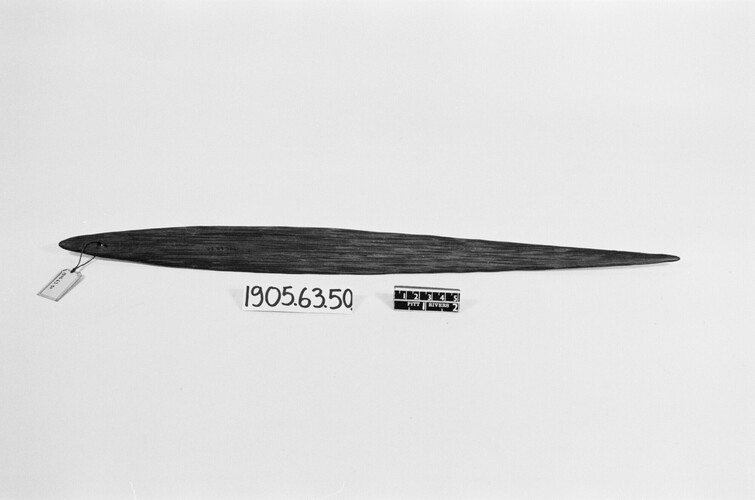
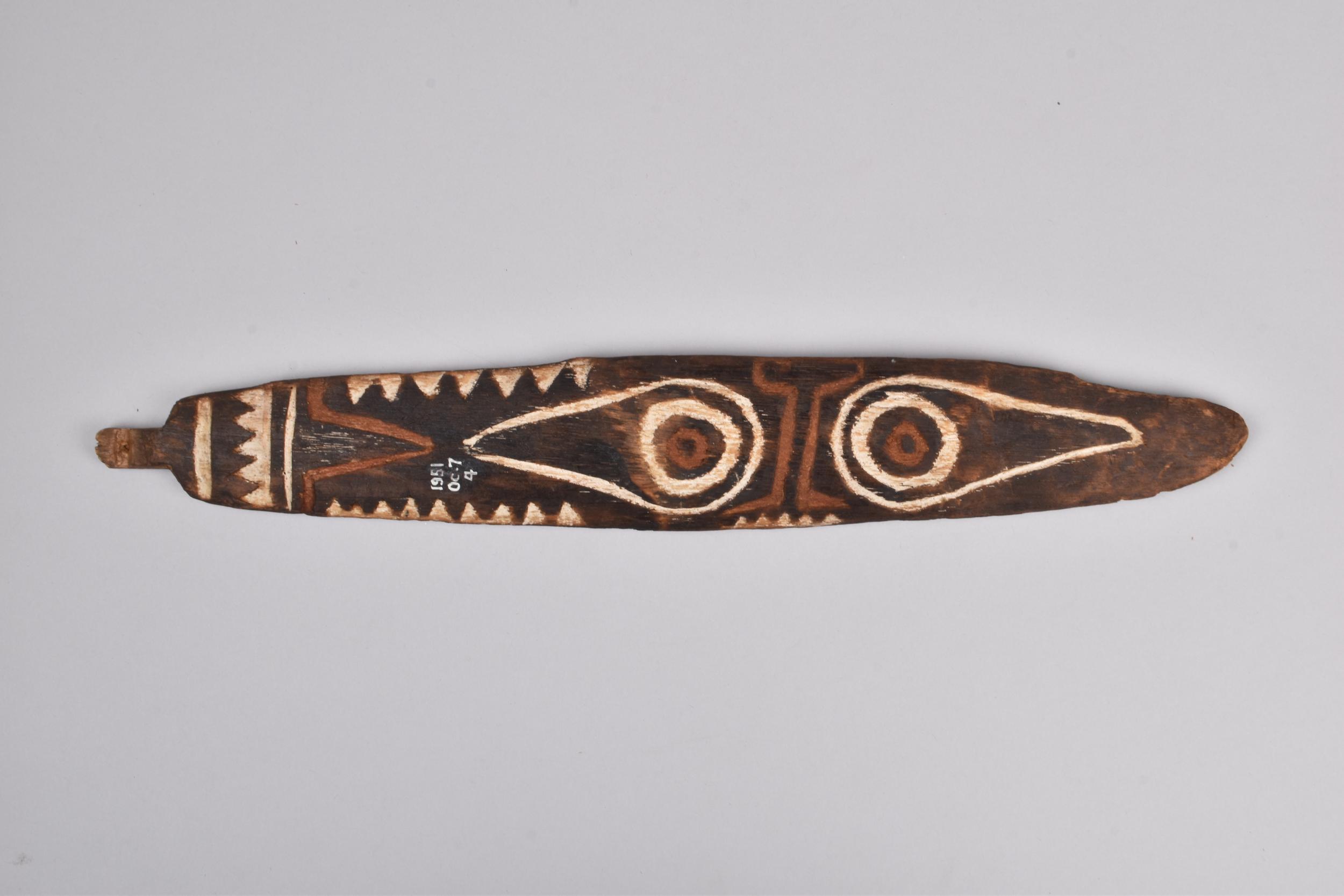
- Bull-roarer of the Maipua, Pitt Rivers Museum, Oxford (acc. 1905.63.50). A second Maipua blade, British Museum Oc1951,07.4, collected by the missionary J. H. Holmes between 1893 and 1900, is soft wood carved on both faces and painted black, red and white, 45.5 cm long, with two great ringed eyes between saw-tooth borders.
Sources
- Pitt Rivers Museum, Oxford, acc. 1905.63.50 View · archived
- British Museum Oc1951,07.4 (Maipua, Namau; collected by J. H. Holmes, 1893-1900) View
- J. H. Holmes, In Primitive New Guinea (1924), pp. 188-189 View
- A. C. Haddon, 'The Kopiravi Cult of the Namau, Papua', Man 19 (1919), no. 91, pp. 177-179 View · archived