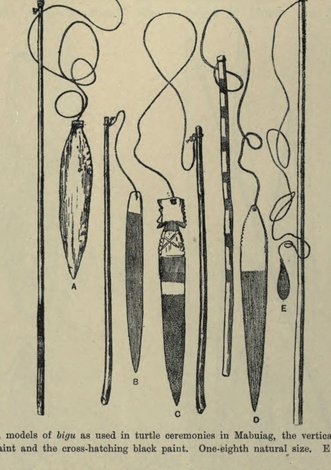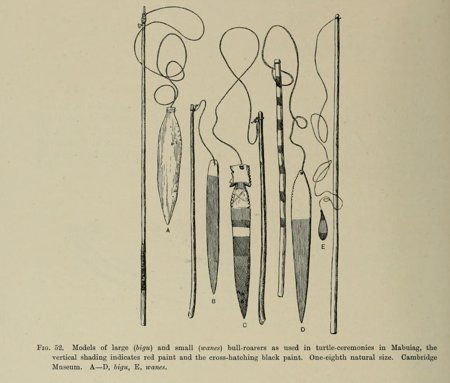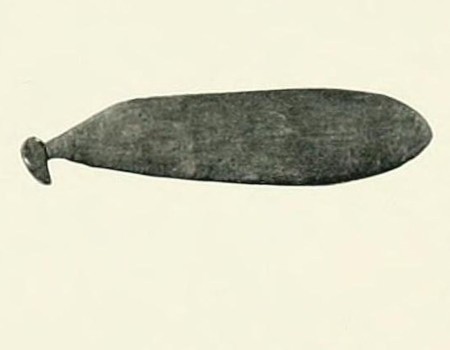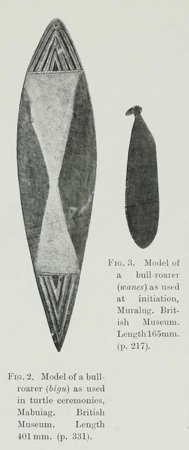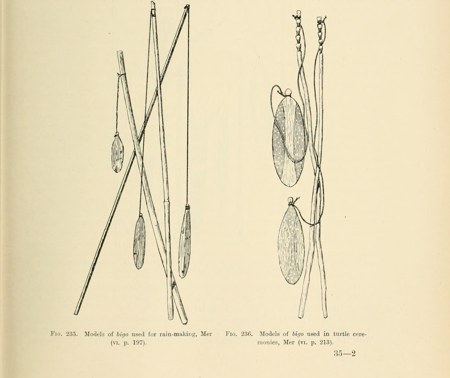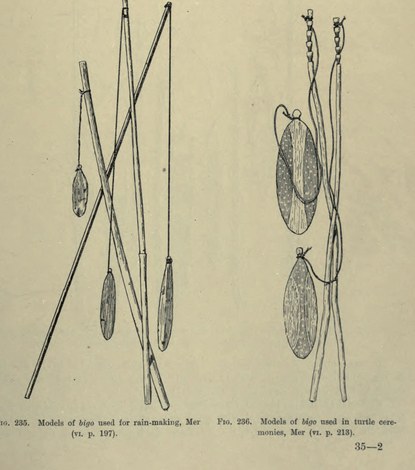
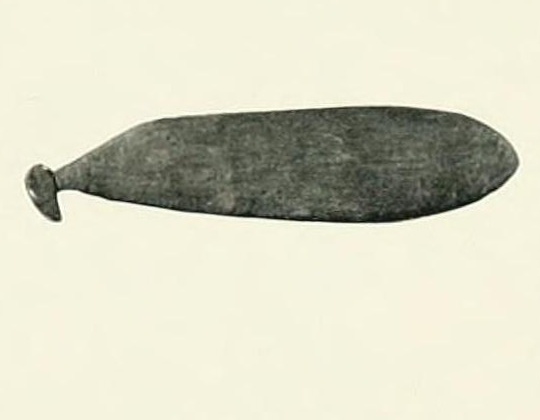
A man on a Mabuiag hill watched for the pale undersides of captured turtles gleaming in the returning canoes. When he saw them he swung a small bullroarer, and the women ashore knew the hunt had succeeded. On Muralug, Waitu and his son Zagra would speak of the wanes only after drawing Alfred Haddon aside, and Waitu made him a model on the promise that no woman would ever see it. Across the islands between Cape York and New Guinea, a blade could bring news of food, help win the season’s turtle, enter a boy’s instruction, guard a garden or dress a rain-making stone. 1, 5
Mabuiag, Torres Strait · Muralug / Prince of Wales Island, Torres Strait
Mabuiag: the canoe has more than a crew
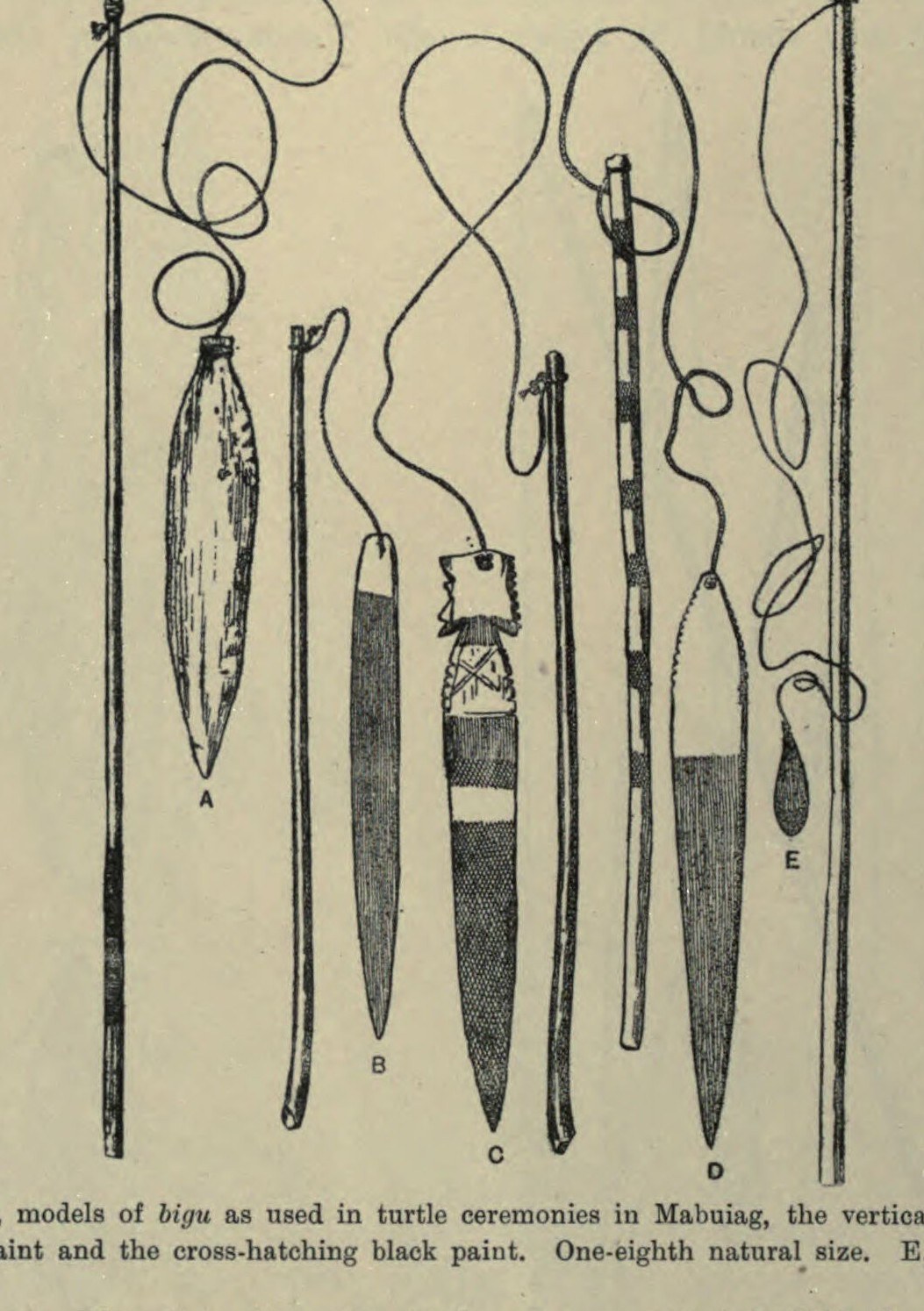
The turtle-breeding season joined preparation, reputation and ritual. Each canoe had its own agu, a platform displaying turtle heads and shells, and the crew with the largest array at the season’s end won the greatest glory. Waria drew the staging with carapaces laid in two long rows and large bigu hanging from it, moving in the wind. Before departure men swung a blade over the canoe, then whirled large bigu and smaller wanes around the platform. After a few turns the small instrument could be lashed backwards and forwards to change its noise. Sunday’s drawing places the performers inside a canoe at Gumu, their raised arms carrying the action above the hull. 1
Small wooden human figures, wauri, also stood on the agu. The crew invited their spirits to join the voyage and carried some figures and bigu aboard. After the catch, men circled the platform clockwise with bullroarers and rattles; going the other way would let the turtles swim off. Women could see the small wanes used in fishing, a use islanders called “half-play.” The lookout’s signal carried the men’s success at sea straight into the women’s day ashore. 1, 9
The first turtle of the breeding season called for a different gathering. It went to the Surlal clan’s ceremonial ground and was reddened with ochre. The men painted lines across chest and belly matching the turtle’s undershell, put on cassowary-feather head-dresses and danced round it with bigu and nut-shell rattles. A creeper pushed into the turtle’s cloaca enacted the abundance hoped for in the breeding season. Afterwards the turtle was handed to the Dangal men to eat. All this happened in daylight, yet women, children and other clans kept away: the women who watched the fishing blades were not admitted here. 2
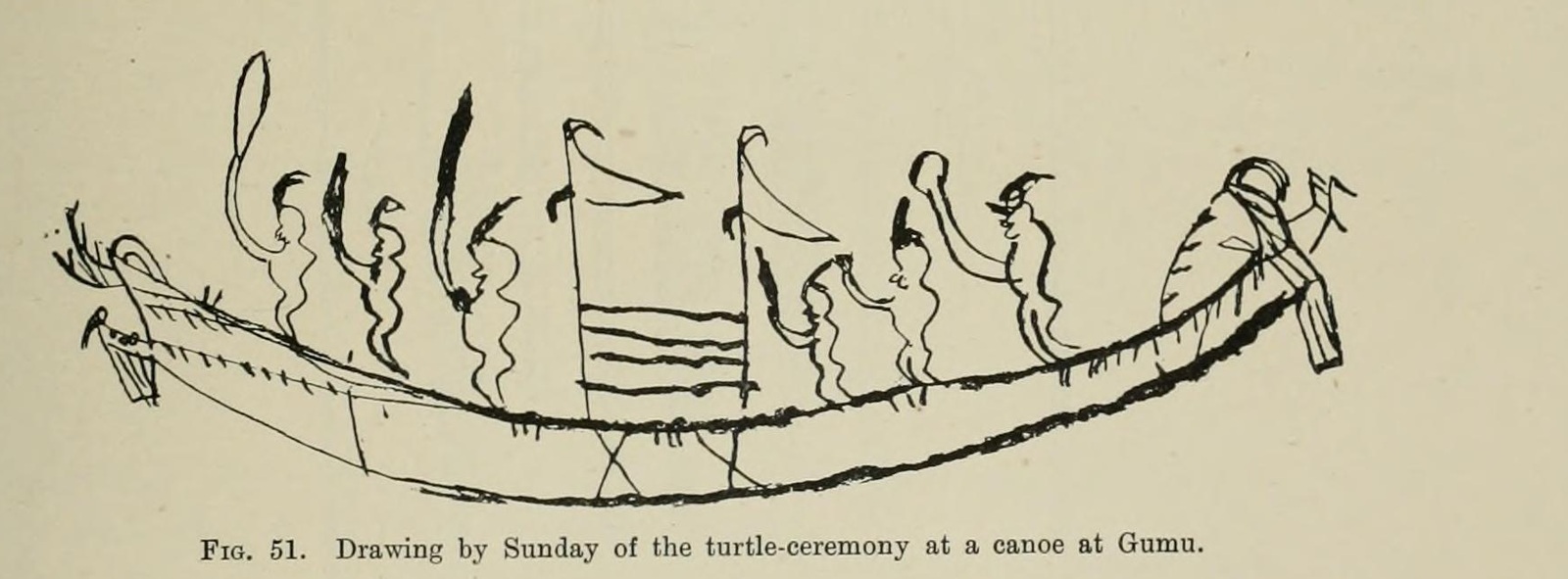
Sunday’s drawing of the turtle ceremony at a canoe at Gumu, Mabuiag. Men swung a bullroarer over the canoe before departure. 11
A rainbow house for the garden’s night workers
Mabuiag’s gardens had guardians with bodies. A madub was a wooden human image, sometimes female, set beside a garden to care for yams, sweet-potatoes, bananas and sugar-cane; a special form watched the tobacco. Gizu drew a bamboo arch sheltering three figures, its curve representing the rainbow. Fringed wands rose from the top, each hung with a bigu, and more blades dangled across the little house. 3
At night, people said, the madub came alive. They went around the garden swinging bullroarers, dancing and singing of rain beside the bananas; by daylight they were wood again. Men danced and sang around the gardens too, scraping each foot across the soil and pulling their hands out to either side, and the spirits of the figures followed their movements. These garden images were kept apart from augud, the beings and objects of the clan cults. 3
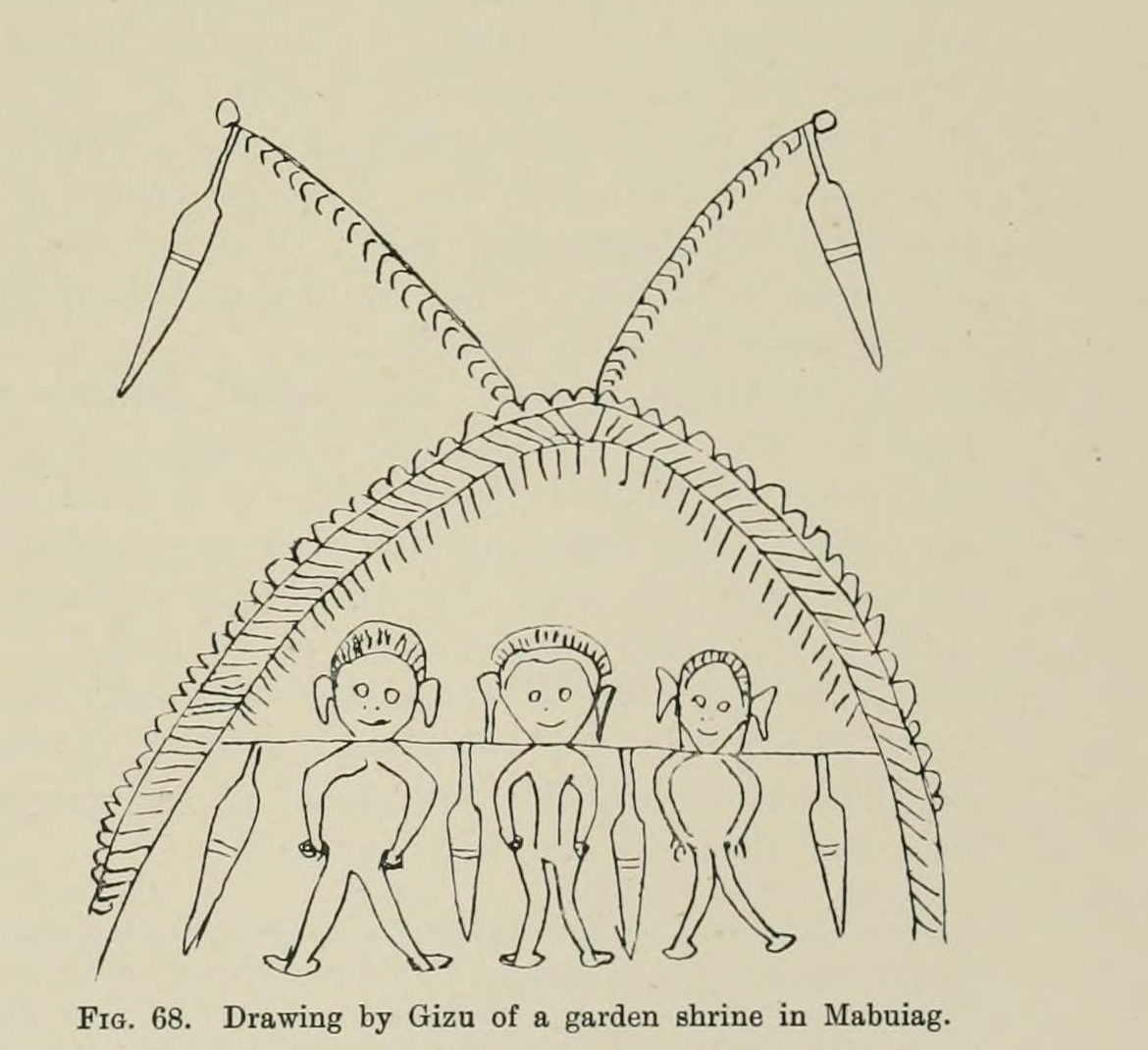
Gizu’s Mabuiag garden shrine: madub beneath a bamboo rainbow, with bigu hanging inside and from its upper wands. 10
Yam: Maino’s human-shaped slab
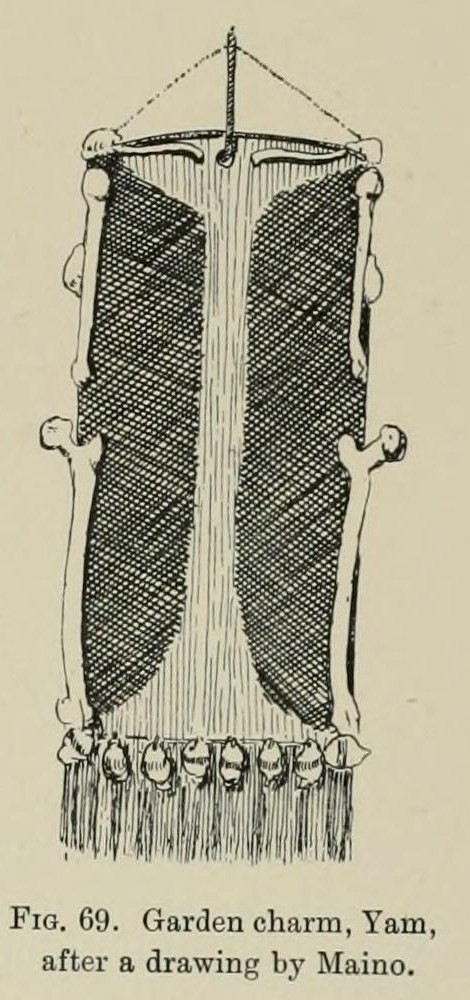
On Yam, or Iama, the bigu had charge of sweet-potatoes and yams as well as turtle. Maino, chief of Tutu and Yam, described another object called either madub or bigu: a large oblong slab hung from a shady tree in a hidden place in the bush. It was black with a red central band. Human collarbones lay along its upper edge; arm and thigh bones flanked its sides. White cowries marked its edges, and a fringe finished its lower margin. Maino’s drawing shows a human form, hung up to work for the garden. 4
Yam’s crops also had a keeper in Modokorosa, a mythical woman once married to Sida, whose work was to make coconuts, bananas and yams fruitful. When fruit and root crops ripened, masked men danced through the night in the garig kap, resting briefly when tired and then going back to the dance. 4
Muralug and Keriri: learning to take one’s place
On Muralug, boys spent five weeks in the bush with an older man. They ate vegetable food and could neither see women nor be seen by them. Showing them the wanes and teaching its use was the heart of their initiation. Waitu and Zagra’s whispered conversation with Haddon came out of that guarded knowledge: the men who controlled the revelation to boys also decided whether a stranger might hold a model. 5
On Keriri, or Hammond Island, a local man told C. G. Seligmann how boys were made. Maternal uncles took a charcoal-blackened novice into the bush for about two months. His friends could visit, but he answered them only through his uncles. He learned the digging stick, canoe handling and fishing lore; he was shown a bullroarer and told to run errands for older men, feed them and never steal. At sundown his uncle brought him back, freshly decorated, to sit on a mat for a dance. 5
Moa and Muralug: asking the wind to work
The wanes also served people who needed wind. On Moa, or Mua, a “big man” blackened his body and whirled a small leaf-shaped blade to raise it, and he could quiet it again. On Muralug a knowledgeable man spun a very thin wanes rapidly on a long line. If that failed to bring enough wind, he climbed a tree and swung it from the top. 6
Moa (Mua) Islanders, western Torres Strait (Kauralaig group) · Muralug / Prince of Wales Island, Torres Strait
Mer: rain has owners, names and competing customers
On Mer, each rain-maker was expected to own a doiom, a stone carved as a man. Young men learned to dress it with a small bigo and nut-shell rattles tied at the neck, then with two petticoats. At the seasonal irmer gali the images hung in a great circle while their keepers danced inside it, holding pale-green coconut branches with small nuts still attached. The songs asked rain to restore a drought-weakened person and to enter the parched trees. 7
The stones had reputations of their own. Gasu’s Dugena brought especially heavy rain with a little thunder; Enoka’s Serpaker excelled at thunder and lightning. Once, when Dugena failed him, Gasu threw it down and broke off its head, then regretted it and wired it back together. After showing Haddon the ceremony he sold Dugena, tried to undo the bargain the next day, and went on missing it. Later Gasu and Enoka joined forces over the next year’s crops, still short of the old stones they had given up. 7, 8
Rain could also set neighbours against each other. During a dry spell in the rainy season of 1889, Sagori and Gi wanted water for their gardens and began to make rain. The Dauereb people wanted fine weather for fishing. Gasu and Pugari, both church deacons, stopped the rain by taking out the doiom. Meanwhile, in the open, small boys from Saibai, pupils at the Mer mission school, played with bullroarers like the one Waitu had handed over in secret on Muralug. 8, 9
Meriam (Mer / Murray Island), Eastern Torres Strait · Mer / Murray Island, Torres Strait · Muralug / Prince of Wales Island, Torres Strait