No. MUS2026-190
Hexagon-lattice blade, a Kalgoorlie miner's gift
Western Australia goldfields (acquisition locality)
Function not recorded
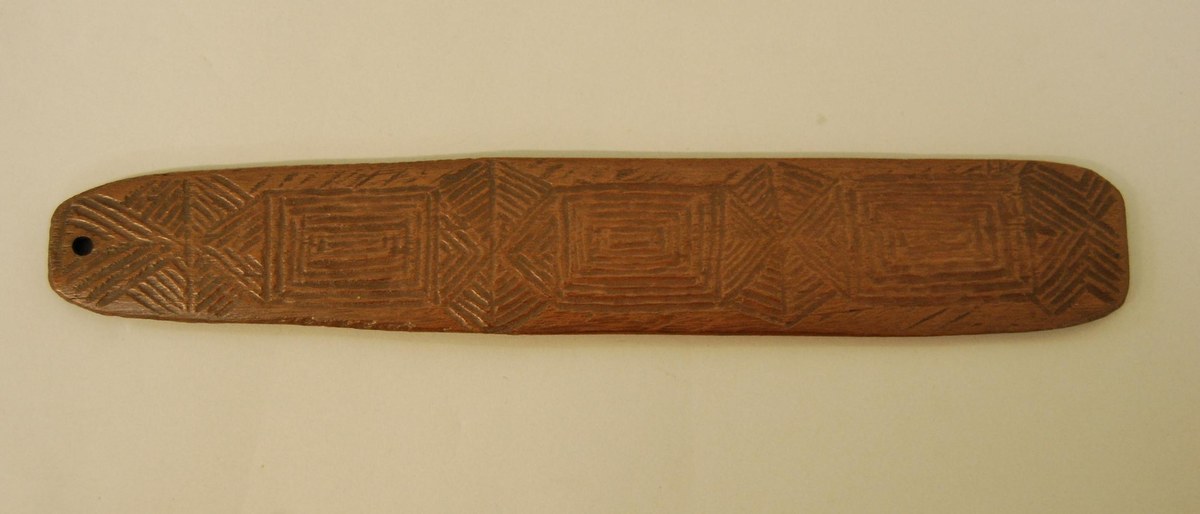
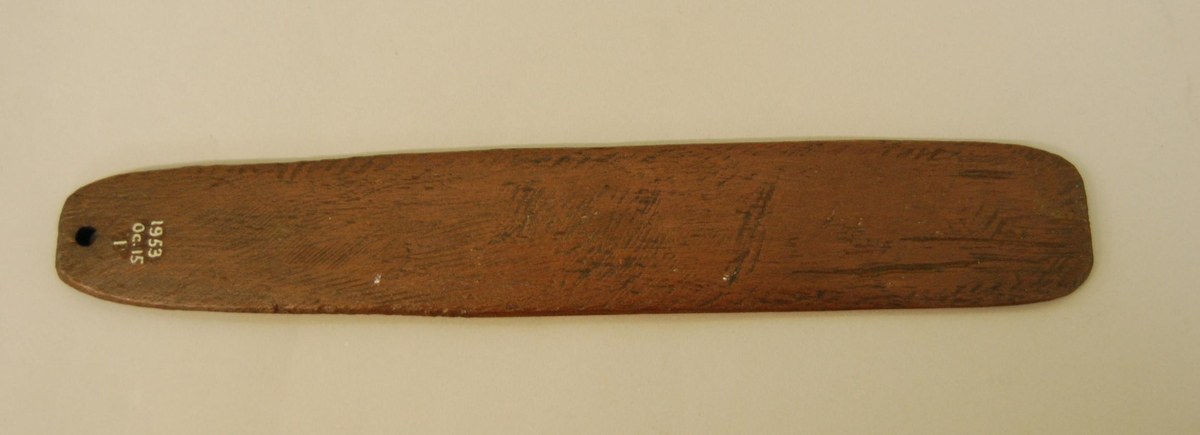
A white miner handed this blade to a visiting Englishwoman at Kalgoorlie in 1924, and that handshake is everything its paper trail records of its origins. Somewhere in Western Australia an unrecorded carver had incised one face with a running lattice of rectangles and hexagons and drilled the hole for the cord; the goldfields boomtown, which pulled people and their possessions in from across the state's deserts, was only where it changed hands. Miss E. Jones carried it home to England and, thirty years later, gave it to the British Museum.
Particulars
- Object
- Wooden bullroarer, 32.6 x 5.7 cm, terminal hole at one end; one face incised with a repeating pattern of concentric rectangles and hexagons, the other plain and tool-marked. Made 19th to early 20th century (before 1924).
- Function
- Not recorded for this specimen.
Source
British Museum Oc1953,15.1; register (Oc1953,15 series): 'Given to donor in 1924 at Kalgoolie [sic] by a white miner.' Donated by Miss E. Jones, 1953; curatorial comment (N. Froggatt 2018) links the donor to the party of Mary Montgomerie Bennett's circle reported in the Sunday Times (Perth), 2 March 1924