No. MUS2026-206
Nyamal cora eaten by white ants
Pilbara · Western Australia
Sacred / spirit
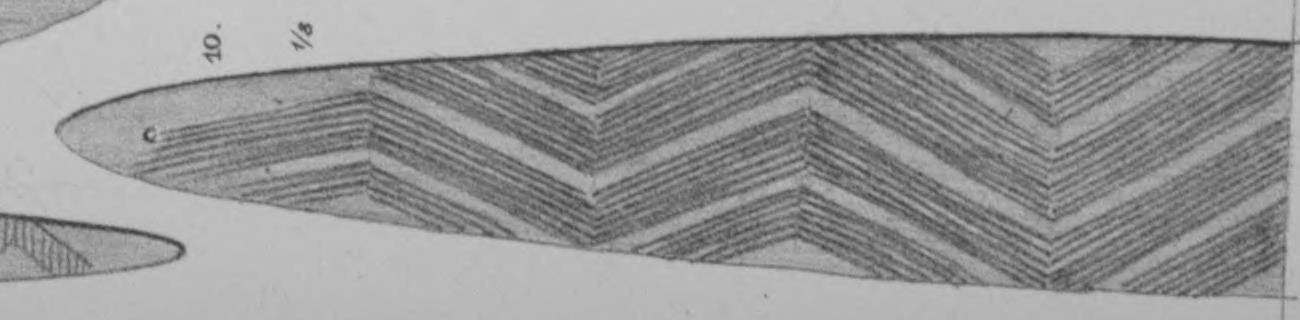
cora / bonangharry
Source term: devil scarer or bullroarer
cora / bonangharry (Clement's own spelling boonangharry; banangari in Radcliffe-Brown 1913): the Pilbara bullroarer, glossed 'devil-scarer' because it is swung to drive off the djuno, the evil spirit blamed for every illness and every death. A shared Ngayarta term; cora is recorded only in the Leiden catalogue headings and is never glossed.
Sixty-three centimetres of red-stained wood, lanceolate, convex on both faces, one of them ruled with close zigzag grooves from end to end, and eaten in places by white ants: a bullroarer from the Nullagine district, between the Oakover and the Turner, which Emile Clement gives as the country of the Gnamo — the Nyamal. On the plate printed with Clement's notes it is figure 10, and figure 10 is on the short list he names when he describes what these things were for. When someone fell ill, the boonangharries were set in motion, and the taketa came painted in white and red stripes and walked round the sick person in huge circles that got smaller and smaller until he pounced. Illness had one cause and death had the same one, an evil spirit called djuno, and the blades were swung to drive it off. Clement's word for them was devil-scarers.
he suddenly pounces upon him, rubbing vigorously the affected part with his hands, or a cowry-shell [...]. Then putting his mouth on the seat of pain, he pretends to pull out with his teeth the cause of the illness, generally one or two semitransparent pebbles [...] which he carefully carries from the camp and buries in the sand.
Emile Clement, "Ethnographical Notes on the Western-Australian Aborigines," Internationales Archiv fuer Ethnographie 16 (1904), p. 8
Particulars
- Object
- Item 150 (inv. 1207/19), 63 x 6 cm, the second-largest of the eleven. Lanceolate, both sides convex, one of them covered with numerous zigzag grooves lying close together; stained red, pierced at one end, partly damaged by white ants. Plate IV fig. 10 - one of the eight figures Clement names as set in motion over a sick person.
- Function
- Named by Clement among the boonangharries set in motion over the sick while the taketa circled the patient; swung at a death to drive off the djuno, held to be the cause of every death; and swung violently in the camp through the buckli circumcision gathering.
Source
J. D. E. Schmeltz, Ethnographica II: Sammlung Clement aus Nordwest-Australien, Internationales Archiv fuer Ethnographie 16 (1904), Group XI, item 150; Wereldmuseum (Rijksmuseum voor Volkenkunde) Leiden, inv. 1207/19. Function and the Gnamo territory from Emile Clement, Ethnographical Notes on the Western-Australian Aborigines, same volume, pp. 8-13