No. NGUINEA-010
Namau "Imunu Viki" bullroarer, Baroi River
Papua New Guinea · Gulf Province · Purari Delta · Naman District · Baroi River · Ukiaravi · Oceania · Sahul
Restricted
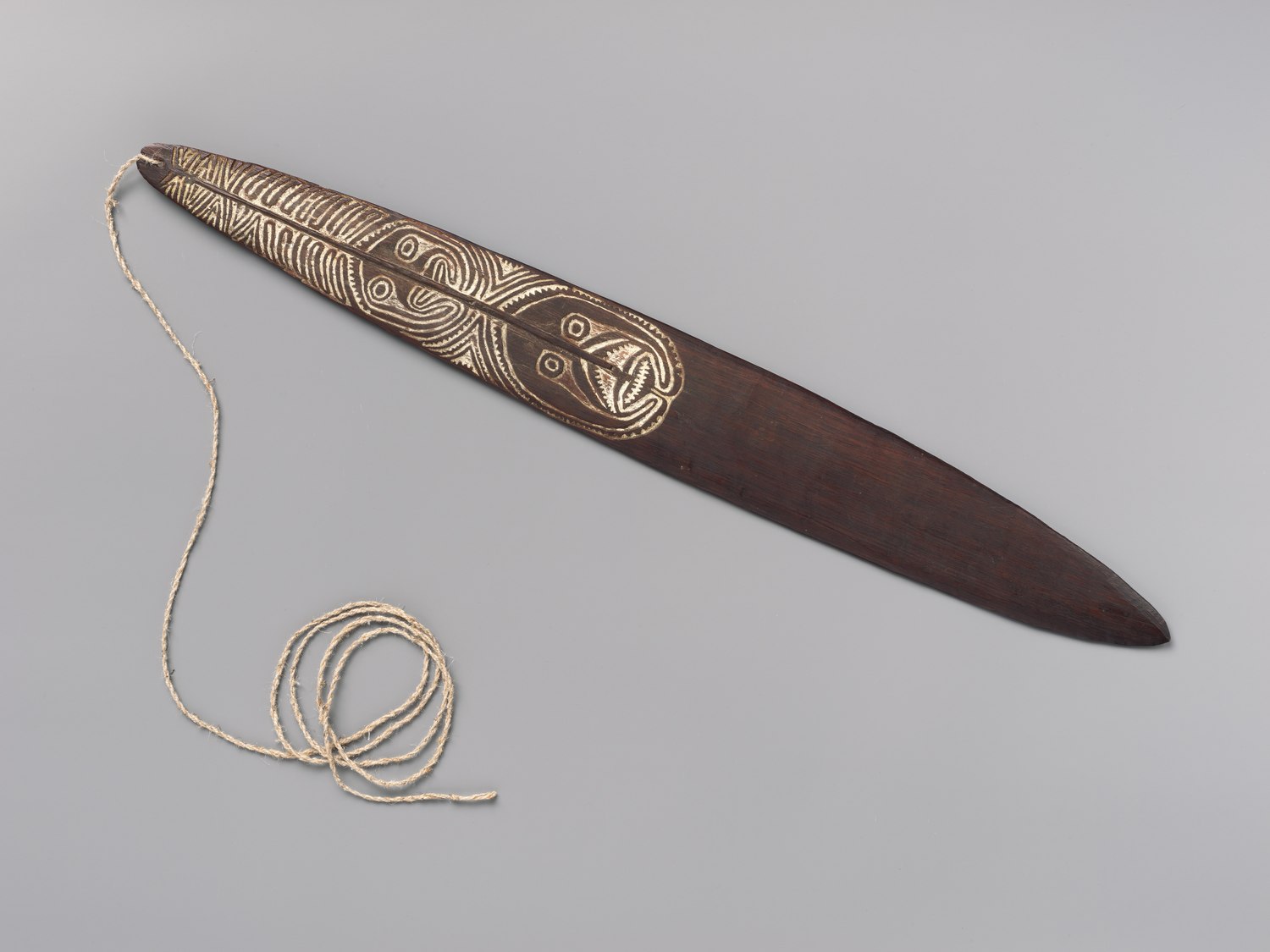
Imunu Viki
Source term: Bullroarer
"Crying imunu" — the cry of the imunu, the spirit.
Etymology. Imunu viki means 'crying imunu' — the crying spirit: imunu is the Purari Delta word for the pervasive spirit-beings of the delta, and the bullroarer's whir was heard as an imunu crying, at the funerals of prominent men and in the men's-house rites where it gave voice to the kaiaimunu effigies. The instrument's name thus contains the spirit category itself.
Among the Namau of the Purari Delta, this bullroarer was the voice of a spirit. Its Namau name, recorded at Cambridge as Imunu Viki, "crying imunu," names the cry of the imunu itself — sounded at the funerals of prominent men, where the whir stood for a spirit lamenting the dead, and at the initiation of boys, where it was the voice of the kaiaimunu, the great wickerwork monster kept in the men's house. It was known only to initiated men. Alfred Cort Haddon collected it on the Baroi River at Ukiaravi, at a ravi (a men's ceremonial house) named for a man called Omai, and it entered the Museum of Archaeology and Anthropology at Cambridge in 1916.
Particulars
- Object
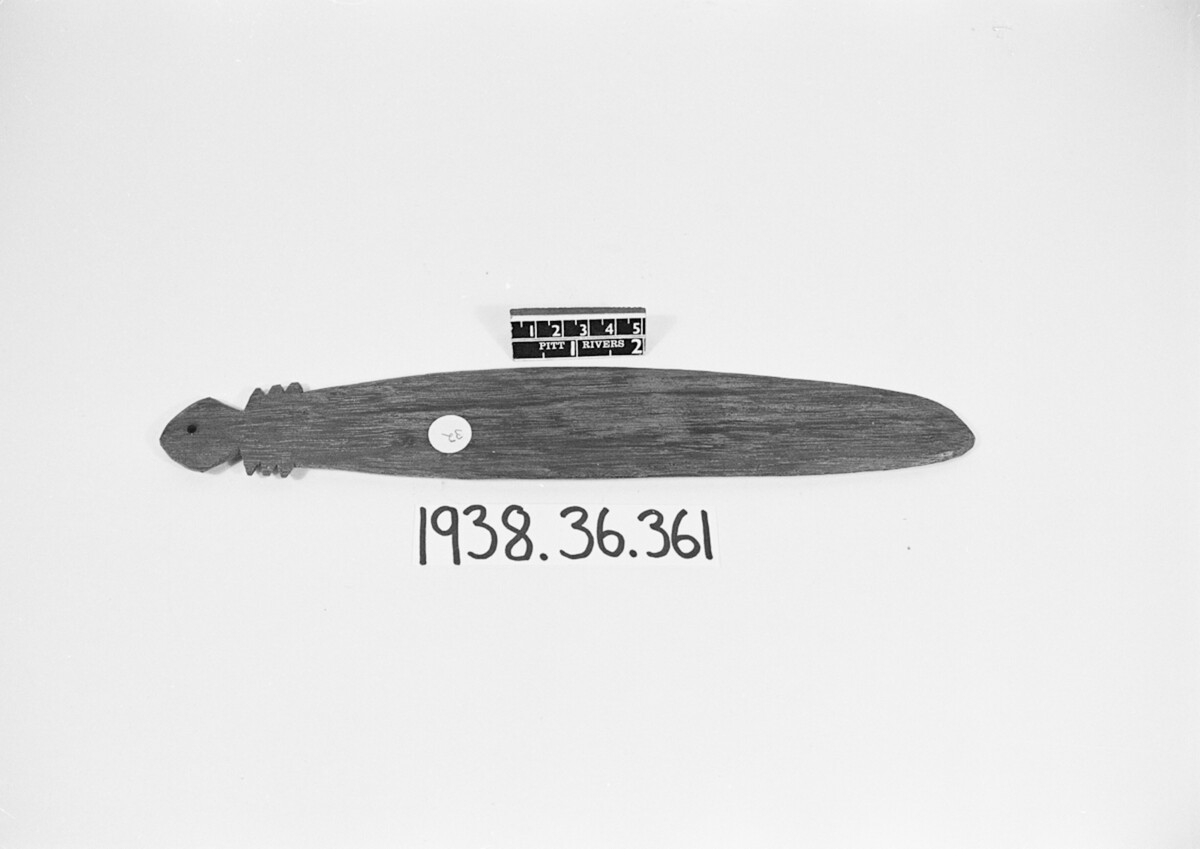
- One of five bullroarers from two Ukiaravi men's houses — this one from Omai's ravi, four from Kara-arabi's. Four more Namau blades, called upura imunu, are at Oxford: one 305 by 47 mm, with a face cut beside the cord hole and three jagged notches biting shoulders into one edge, and three plain blades stepping down from 377 to 260 mm.
Source
Museum of Archaeology and Anthropology, Cambridge, E 1916.143.179 (Omai's ravi) and E 1916.143.186–189 (Kara-arabi's ravi), Ukiaravi, Baroi River, Gulf Province, collected by A. C. Haddon; Pitt Rivers Museum, Oxford, 1938.36.360–363