No. MUS2026-042
Emouno, voice of the kaiaimunu
Papua New Guinea · Papuan Gulf area · Oceania · Sahul
Restricted
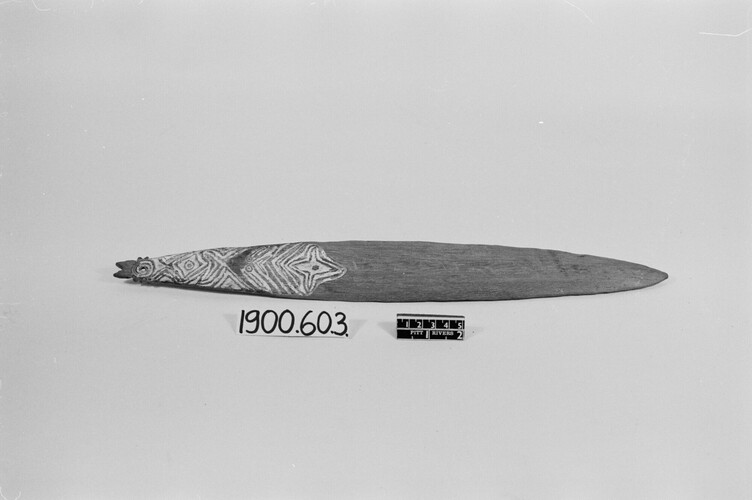
emouno
Source term: bull-roarer
emouno: the Jare name for the bull-roarer.
Across the Purari Delta the whir of a bull-roarer was the voice of a monster. The sound was understood as the speech of the kaiaimunu: great four-legged wickerwork effigies with gaping mouths, woven from cane and kept in the closed-off rear of the men's house. The instrument was sacred and secret, known only to initiated men; women and children heard the roar but were not to see its source. Elsewhere in the delta the slat was called imunu viki, "weeping spirit," and the same sound was raised at the funerals of prominent men, where it carried the cries of a spirit lamenting the dead. F.E. Williams, who spent an eight-month season in the delta in 1922 and published The Natives of the Purari Delta in 1924, set down much of what is known of these rites. This example, a bull-roarer of the Jare, entered the Pitt Rivers Museum in Oxford in 1900.
their eerie sound was said to be the voices of the kaiaimunu, powerful spirits embodied in large wickerwork effigies depicting monstrous animals kept in the men's ceremonial house
The Metropolitan Museum of Art, New York, catalogue entry for a Namau bullroarer, Purari Delta (1979.206.1545)
Particulars
- Object
- Bull-roarer of the Jare, Pitt Rivers Museum, Oxford (acc. 1900.60.3).
- Function
- In the Purari Delta the bull-roarer (imunu viki) is a sacred object known only to initiated men, sounded in male initiation as the voice of the kaiaimunu spirits (F. E. Williams, The Natives of the Purari Delta).
Source
Pitt Rivers Museum, Oxford, acc. 1900.60.3; Metropolitan Museum of Art, New York, 1979.206.1545; F. E. Williams, The Natives of the Purari Delta, Territory of Papua Anthropology Report 5 (Port Moresby, 1924), pp. 131, 165–167