No. PNG106
Kiwai madubu, mother of the yams
Papua New Guinea · Western · Oceania · Sahul
Restricted
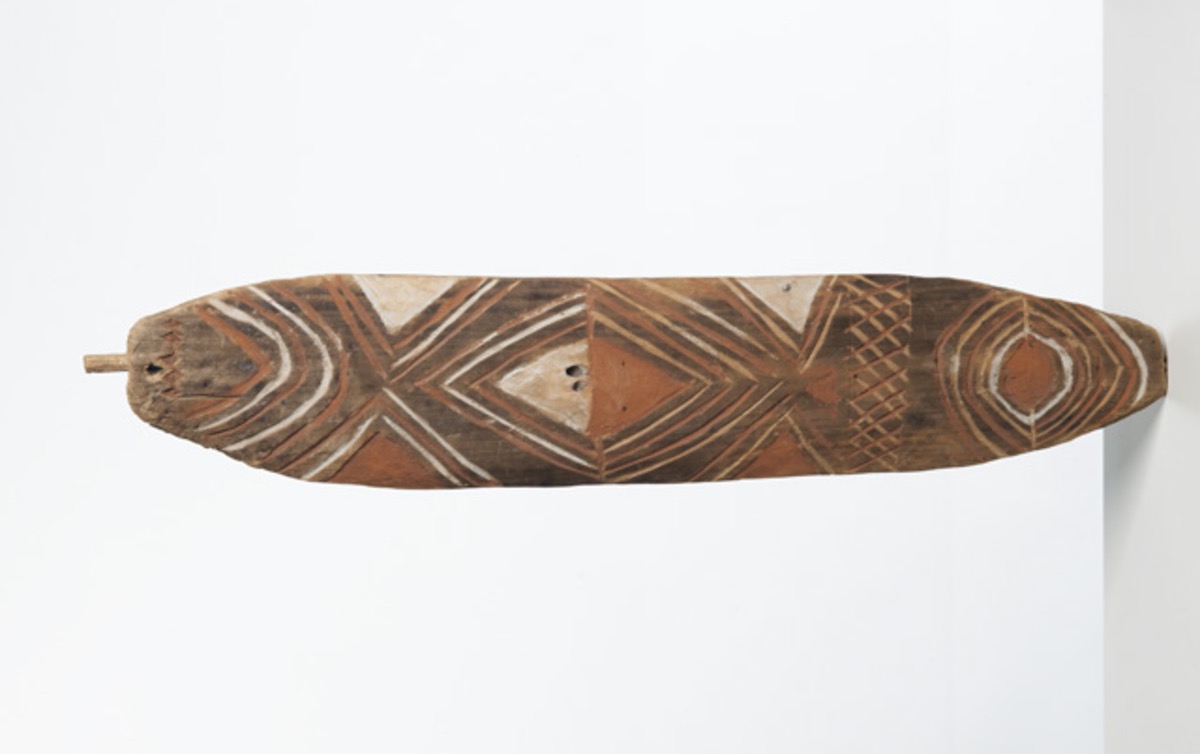
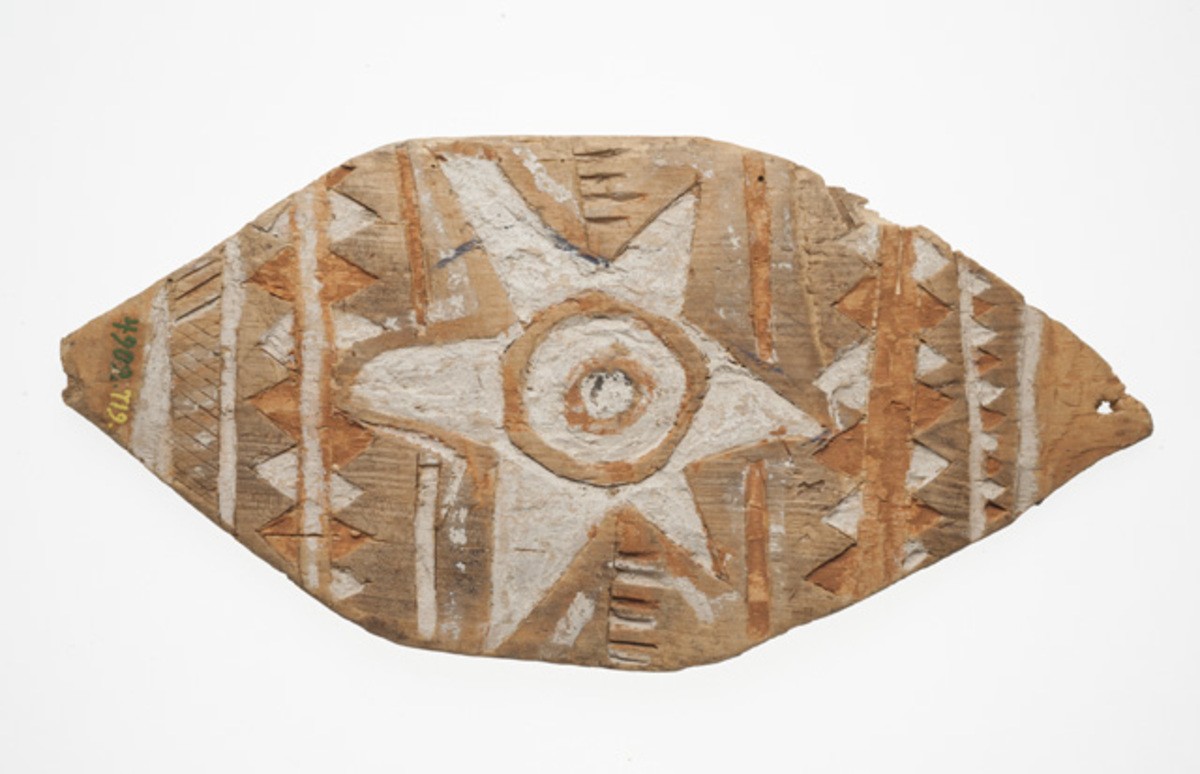
madubu
madubu — the bullroarer's true (secret) name at Iasa, per Haddon; in the coastal Kiwai origin tale the instrument also bears the onomatopoeic name bigu/boigu, 'for it called out its own name when whirling round' — the same sound-word the Mabuiag islanders across the strait use for their deep-noted bigu (Landtman, Folk-Tales, no. 261). Chalmers' Fly-mouth specimen bore the name Buruma-maramu, 'the mother of the yams' (buruma, a yam variety + maramu, 'mother') — the same buruma-maramu recorded in Landtman's museum name-bundle.
In the western Fly River and Kiwai Island country, bullroarers hung in the men's long houses, off-limits to women and the uninitiated — and their whirling belonged to gardens, new canoes and turtle ceremonies. At Iasa the madubu's whirling was expected to fill the plots with yams, sweet potatoes and bananas; a novice first met it behind a tabooed fence in the bush, where he learned to make the crop-bringing voice, and in the garden rite Landtman recorded, a husband and wife's mingled fluids were smeared on the blade so that its swinging scattered the 'medicine' across the field. One roarer the missionary Chalmers sent to England from the Fly mouth was labelled Buruma-maramu — 'the mother of the yams.' Men swung their roarers to wake a new canoe, opened the horiomu ceremony with it when the spirits first appeared, and used it to start the dances of the nigori turtle rites. The darimo, the men's house, held the Kiwai's two great secret rites: the moguru, most secret and most important, with its sexual instruction of pubescent boys and girls, and the mimia fire ordeal. The coastal Kiwai of Mawata kept the instrument's origin story — the first bullroarer flew whizzing into the air crying 'bigu-bigu-bigu,' announcing its own name. The Fly River Kiwai tell that an old woman found the first bullroarer while chopping firewood, and that it came to her afterwards in a dream to tell her its own name and to teach her the rite for the yams. She told her husband, and the secret became the men's.
At Iasa, in Kiwai, I was informed there were two initiation ceremonies. At the first a madubu, or bull-roarer, is shown to each koiameri (the kernge of the Western islands) in a tabooed and fenced-in portion of the bush, and he is taught how to use it ... the whirling of the madubu insures a good crop of yams, sweet potatoes and bananas.
A. C. Haddon (ed.), Reports of the Cambridge Anthropological Expedition to Torres Straits, Vol. V (1904), "Notes on the Initiation Ceremonies in Kiwai," p. 218.
Particulars
- Object
- An Iasa madubu that Haddon collected in 1898, now in Cambridge, is an oval wood blade carved with different incised designs on each face (zigzags, toothed triangles, cross-hatching and groups of triangles on one face, diamonds on the other), finished in red ochre and white lime, with its plaited plant-fibre suspension loop still attached. A Landtman-collection blade from the Fly, painted with a white star and a ringed central eye, is in the Finnish Heritage Agency.
- Function
- Revealed at initiation and whirled for crops; also used to wake new canoes, at horiomu ceremonies, and at nigori turtle rites.
Source
A. C. Haddon, Reports of the Cambridge Anthropological Expedition to Torres Straits, vol. V (1904), pp. 218–219, fig. 30; A. C. Haddon, Head-hunters (1901), pp. 104–106; G. Landtman, Folk-Tales of the Kiwai Papuans (1917), no. 261; J. van Baal, BKI 119 (1963), p. 204; K. A. Gourlay, Sound-Producing Instruments (1975), pp. 44, 54; Cambridge MAA Z 8273