No. MONTAGUE1921-002
Kookynie district initiation bullroarer
Kookynie district · Goldfields-Esperance, Western Australia
Sacred / spirit
Source term: bull-roarer
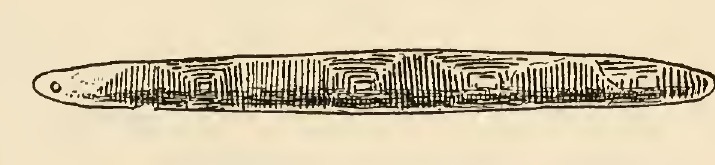
The second blade on Montague's 1921 plate came from the Kookynie district, in the goldfields country of Western Australia. At 22 inches it ran an inch longer than its Wiluna companion — a dark-brown blade that might at first sight be taken for a small shield — but narrower, its pale wood cut with a longitudinally concave face and roughly grooved into diminishing squares divided by transverse cuts. Montague paired the two as bullroarers used in initiation ceremonies.
No. 2 from the Kookynie district, Western Australia.
Montague 1921:36
Particulars
- Object
- Light-colored wooden blade, 22 inches long, with a longitudinally concave face and rough grooved diminishing-square decoration divided by transverse grooves; one terminal perforation is visible in Montague's Figure 19 drawing.
- Function
- Used in initiation ceremonies.
Source
Leopold A. D. Montague, Weapons and Implements of Savage Races (London, 1921), pp. 36-37, fig. 19 no. 2