No. MAT1898-004Australia
Oscar Ranges Kimberley bullroarer
Australia · Oscar Ranges, Kimberley, Western Australia
Restricted
- Initiation rite
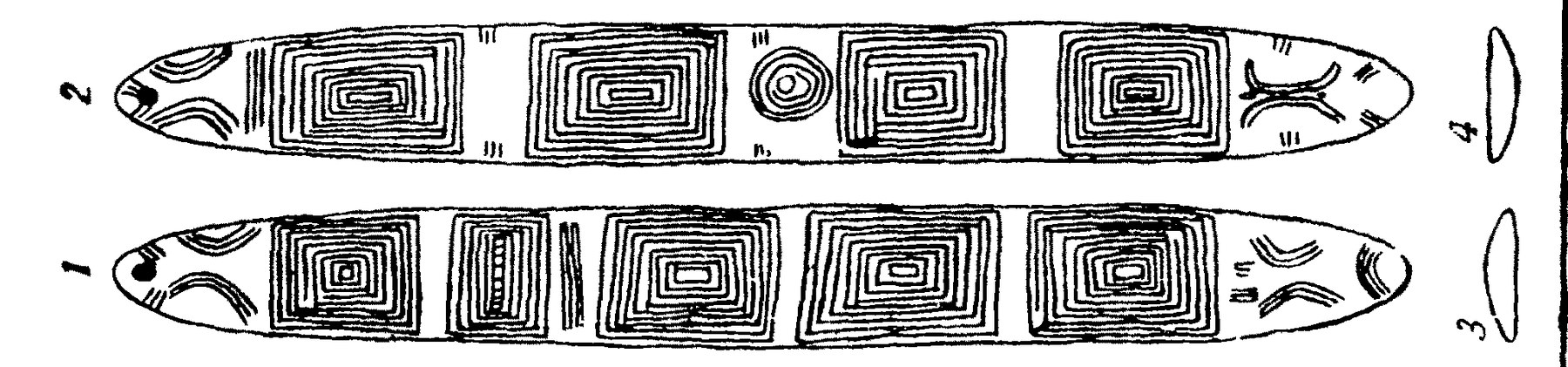
Source term: bull-roarer
In the Kimberley the bull-roarer was an instrument of men's initiation, sounded at the ceremony of circumcision that carried boys into manhood. This one — nearly two feet of carved hardwood from the Oscar Ranges — Froggatt passed to R. H. Mathews, who turned it over and found something peculiar. One face swelled convex while the other lay flat, a quirk he had met before only in bull-roarers from the west. Each face carried its own incised drawings; the timber itself he could not name.
One side is convex, and the other flat, a peculiarity I have before observed in bull-roarers from West Australia.
R. H. Mathews, plate description of the Oscar Ranges (Kimberley) specimen lent by W. W. Froggatt, "Bullroarers used by the Australian Aborigines" (Journal of the Anthropological Institute 27, 1898); text as reprinted in "Notes on the Aborigines of New South Wales"
One more plate

Particulars
- Function
- Kimberley bullroarers are reported by Froggatt as used at the ceremony of circumcision; Plate figs. 1-4 show the Oscar Ranges specimen, with carved convex and flat faces.
Discussed in 2 essays
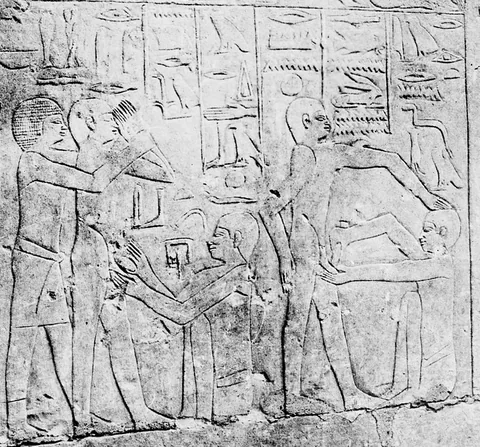 The Bridegroom of Blood
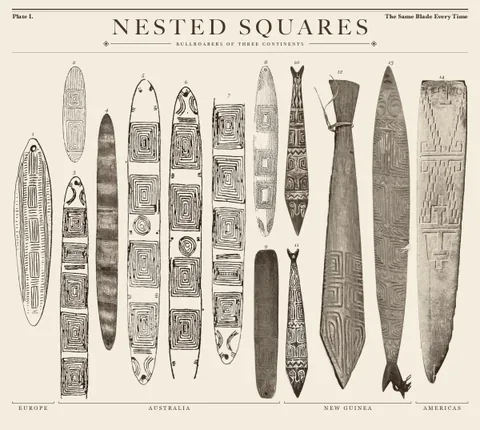 The Same Blade Every Time
Source
R. H. Mathews, 'Bullroarers used by the Australian Aborigines,' Journal of the Anthropological Institute 27 (1898): 52-60, plate figs. 1-4
Nearby in the atlas
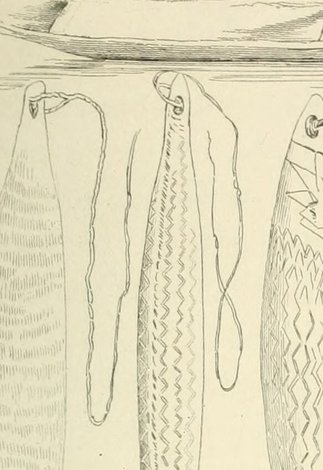 Adelaide kadnomarngutta and wimmarriAustralia · Adelaide region · Restricted
 Clarence Richmond dhooanbooka yoolundry dhalguñgunAustralia · Clarence and Richmond Rivers · Restricted
 Culgoa wuddoolnurran and ghidjoolkumbalAustralia · Culgoa River · Restricted
 Kamilaroi Weir River murrawan and mooniburrigeanAustralia · Weir River / Tallwood, Queensland · Restricted
 Gheewarra, the Murrawin summonsAustralia · Macleay and Bellinger Rivers · Restricted
- Port Lincoln witarna and pullakalliAustralia · Port Lincoln · Restricted