No. PNG52
Finschhafen
Papua New Guinea · Morobe · Oceania · Sahul
Restricted
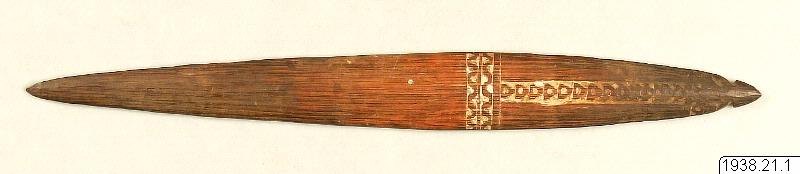
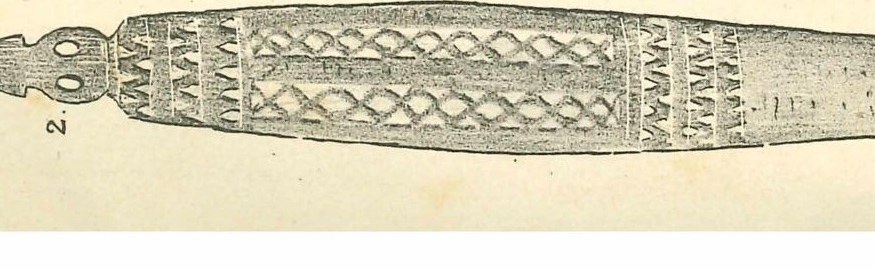
balum
ghost, spirit of a dead person
Etymology. Among the Yabim and Bukaua, balum means "a ghost or spirit of a dead person," and the same word names the swallowing initiation-monster and the bull-roarer taken to be its voice; each Bukaua bull-roarer also bears the name of a particular dead man.
Among the Yabim, Bukaua, Kai, and Tami peoples about Finschhafen, on the south-eastern tip of the Huon Peninsula, the whirring of the bull-roarer was the voice of a monster called balum, and no boy ranked as a grown man until he had been circumcised by it. The rite was staged as a swallowing. A long hut, about a hundred feet in length, was built to represent the monster's belly, high at the head end and tapering toward the rear, with a pair of great eyes painted over the entrance and the projecting roots of a betel-palm standing for its hair. The novices were led inside to be devoured and, after their wounds healed, disgorged. The women and the uninitiated were told that the beast had swallowed their sons and brothers and would release them only for roast pigs, and the mothers fattened young pigs to redeem each boy from its belly. The instrument and the monster both bore the name balum, and the lodge where the novices were kept was the monster's house, balumslum. The Neuendettelsau Lutheran mission, founded at Finschhafen in 1886, supplied much of the early record of the cult. The balum spirit was said often to take the form of a sea-snake, and the Bukaua kept small, high-voiced roarers for the ruling ancestors’ wives, distinct from the serving instruments. The surrounding peoples told of a woman finding the first instrument: in the Kai and Bukaua accounts a chip flies up whirring as she chops wood; in Bamler’s Tami account she finds a ready-corded blade washed ashore. Men acquire the instrument, and the woman’s death seals its secret.
When a lad bleeds to death from the effect of the operation, he is secretly buried, and his sorrowful mother is told that the monster swallowed him and refused to bring him up again.
Frazer, The Belief in Immortality and the Worship of the Dead, Vol. I (1913), Lecture XII (the Bukaua of German New Guinea)
Particulars
- Object
- Bullroarer, sacred flute and slit-gong are all in use here.
- Function
- Voice of the monster balum in the Huon Gulf male-initiation/swallowing rite; women and the uninitiated kept from it.
Sources
- K. A. Gourlay, Sound-Producing Instruments in Traditional Society: A Study of Esoteric Instruments and Their Role in Male-Female Relations, New Guinea Research Bulletin 60 (1975), Table 1, entry 52 View
- S. Lehner, “Bukaua,” in R. Neuhauss (ed.), Deutsch Neu-Guinea, vol. III (Berlin: Reimer, 1911), pp. 411-412, 414
- Ch. Keysser, in R. Neuhauss (ed.), Deutsch Neu-Guinea, vol. III (1911), p. 34
- G. Bamler, in R. Neuhauss (ed.), Deutsch Neu-Guinea, vol. III (1911), p. 495
- James George Frazer, The Belief in Immortality and the Worship of the Dead, vol. I (1913), Lecture XII