No. MUS2026-303
Victorian bullroarer on its human-hair cord
Australia · Victoria
Restricted
Peer Boor E Gah
Source term: Bullroarer
Peer Boor E Gah: the local name recorded with this Victorian bullroarer; it is not translated in the record.
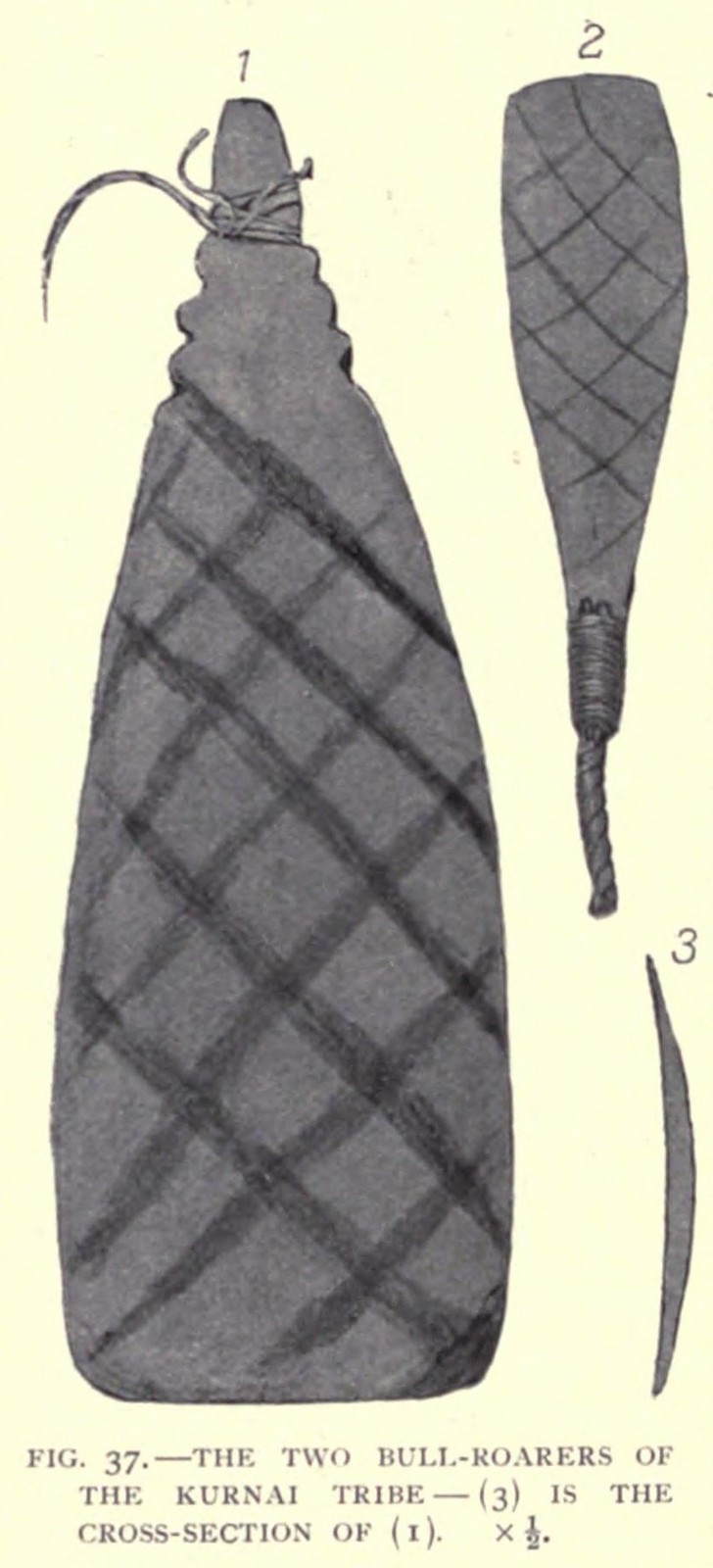
A blade of fourteen centimetres, a stick of forty-eight, and between them a cord spun from human hair: the whole apparatus survives, which is rare. In the Victorian ceremonies A. W. Howitt recorded, a bullroarer of this kind travelled as a credential. When a Wurundjeri headman on the Yarra wanted to make boys into men, his messenger carried one, along with a man's kilt, as the summons to the Talangun — and it was kept hidden from women and children the whole way.
Particulars
- Object
- Bullroarer, 140 x 35 mm, joined by a cord of human-hair string to a 477 mm stick. A second complete Victorian rig in the same museum pairs a 424-millimetre blade with its stick on an assembly reaching 622 millimetres.
- Function
- Secret-sacred men's ceremonial object, restricted to initiated men.
Source
Pitt Rivers Museum, Oxford, object 1900.55.277.1 / irn 39675