No. PNG18
Iatmul — Mindimbit
Papua New Guinea · East Sepik · Oceania · Sahul
Restricted
Source term: Schwirrholz; bullroarer / sacred flute / slit-gong
Schwirrholz: Reche’s German term for bullroarer. wagan: Iatmul avenging clan-spirits whose voices are the secret slit-gongs.
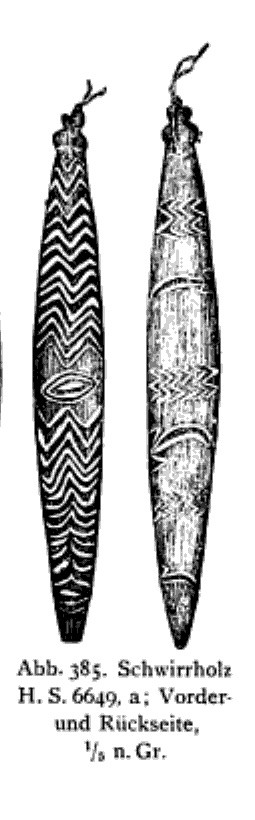
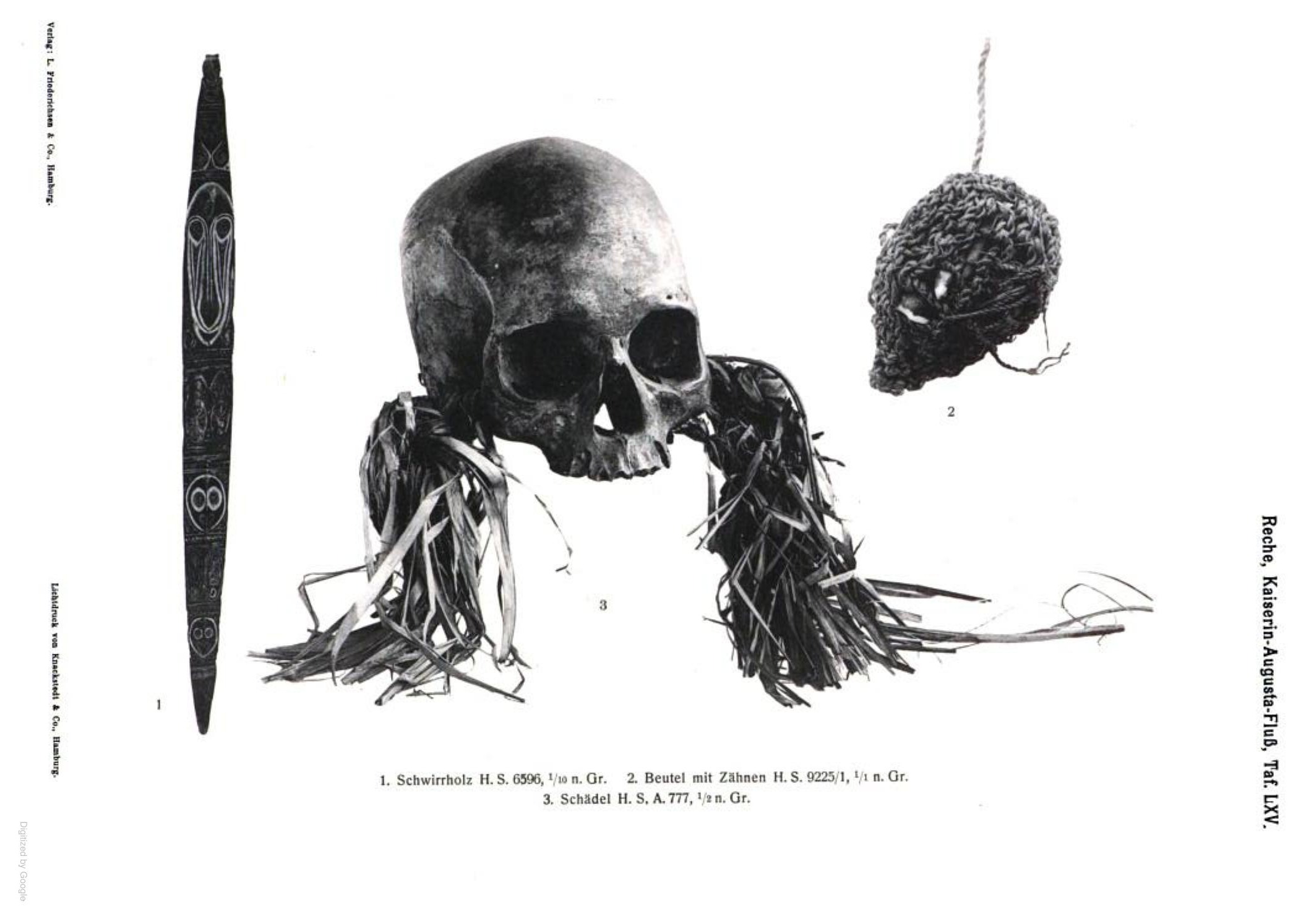
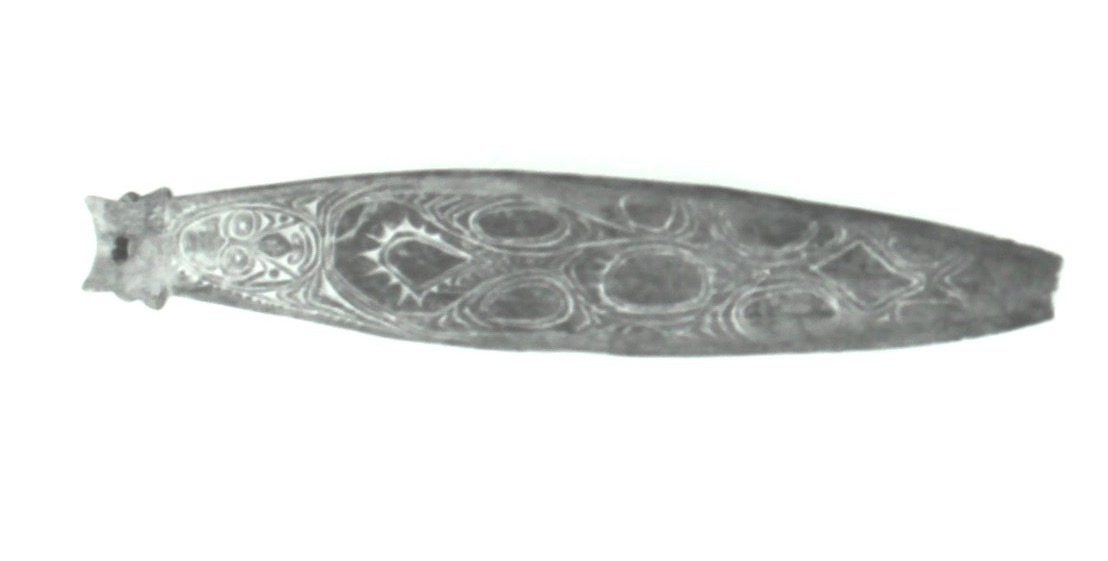
At Mindimbit on the Middle Sepik, Otto Reche documented H.S. 6649a, a 37.5-centimetre carved blade with a twisted-bast cord and a short wooden handle. Its forked cord mount kept the line aligned as the blade rotated. The expedition found it stored inside the belly of a large woven crocodile. Reche’s paired engraving shows the patterned front and back. A second plate depicts the monumental 140-centimetre H.S. 6596 from Mụåńgêm, which Reche judged very probably also a bullroarer and interpreted as a formal embodiment of the initiation spirit. In the later Iatmul rites Bateson described, novices learned to play flutes and swing bullroarers; women saw parts of the ceremony and heard the hidden instruments sounding from the house. The wagan slit-gongs belonged to the more serious secrets.
Beim Schwingen gibt es einen sehr tiefen, brummenden Ton.
When swung, it produces a very deep, humming tone.
Reche, Der Kaiserin-Augusta-Fluss (1913), p. 350, fig. 385
Particulars
- Object
- H.S. 6649a from Mindimbit (the “293-km village”): carved wooden bullroarer, 37.5 × 4.7 cm, with a 46 cm twisted-bast cord and 9.5 cm handle; front and back figured by Reche, who reports a very deep humming tone when it was swung. It had been stored inside the belly of the large woven crocodile H.S. 6649b.
- Function
- In wider Iatmul initiation rites, novices learned to swing bullroarers; women heard the hidden instruments from the ceremonial house while seeing parts of the ceremony.
Sources
- Otto Reche, Der Kaiserin-Augusta-Fluss (Hamburg, 1913), p. 350, fig. 385, Taf. LXV View · archived
- MARKK, Hamburg, expedition inventory H.S. 6649a
- MARKK, Hamburg, expedition inventory H.S. 6649b
- Gregory Bateson, Naven (1936; 2nd ed., 1958), p. 137
- K. A. Gourlay, Sound-Producing Instruments in Traditional Society: A Study of Esoteric Instruments and Their Role in Male-Female Relations, New Guinea Research Bulletin 60 (1975), p. 51
- Gregory Bateson (1935), p. 168; Naven (1958), pp. 128, 130, 134, via Gourlay 1975, p. 51