No. AUSMAIN-030
Ngatatara (Ngadadjara) — namatuna
Western Desert, centred on the Warburton Ranges (eastern WA, extending into SW Northern Territory and NW South Australia); the namatuna myth was recorded by Roheim from the Ngatatara man Kulaia (with the Aranda man Thomas) at Hermannsburg Mission, Aranda country (NT)
Restricted
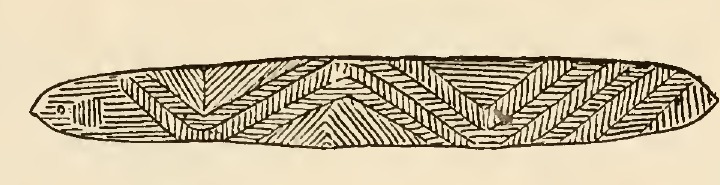
namatuna
namatuna: the Aranda name (Luritja mandagi) for the small pierced slat whirled as a bull-roarer, distinguished from the larger unpierced tjurunga.
Etymology. namatuna, the Aranda term for the small pierced bull-roarer tjurunga (Luritja mandagi), is the word in the initiation myth Roheim's Ngatatara informant Kulaia related, in which the old men chase the novices out with it; no literal meaning is recorded. In the love-magic songs of the same area the instrument is sung as quatja para, 'penis of the water,' that is, lightning.
Among the Ngatatara — the Western Desert people Roheim also called the Ngadadjara — the small whirled slat was the namatuna. Roheim, working from Aboriginal informants in 1929, set it apart from the large unpierced tjurunga: a little sacred board, one of the small ones with holes in them to be used as bull-roarers and whirled. In the initiation he recorded, the old men chased the novices out with the namatuna, then whirled it through the night to frighten the women and children, who did not dare leave their camp until dawn. The same slat had a second life as love magic, sung with a man's ornaments to draw women toward him. The myth in which the old men drive the boys out with the namatuna Roheim credited, in his own footnote, to Kulaia, a Ngatatara man, told at Hermannsburg Mission.
The old men chased them out with the namatuna (bull-roarer).
Geza Roheim, The Eternal Ones of the Dream (1945), p. 26; the myth is credited in Roheim's footnote to 'Thomas (Aranda) and Kulaia (Ngatatara) at the Mission, Hermannsburg.'
Particulars
- Object
- A flat wooden slat — one of the small pierced tjurunga "with holes in them to be used as bull-roarers and to be whirled," as opposed to the large unpierced tjurunga — swung on a cord to roar.
- Function
- Whirled in male initiation to chase and frighten the novices and to keep women and children away; the same slat is "sung" in love magic to draw women.
Source
Geza Roheim, The Eternal Ones of the Dream: A Psychoanalytic Interpretation of Australian Myth and Ritual (New York: International Universities Press, 1945), pp. 26 (namatuna initiation myth + footnote crediting Kulaia, Ngatatara), 43 (Ngadadjara = 'my Ngatatara'), 54 (central group: Jumu, Pindupi, Ngatatara, Pitjentara), 82 (namatuna = small pierced bull-roarer, whirled; distinct from large unpierced tjurunga), 109 (whirled all night in initiation to frighten the women and children)