No. WILD1977-001Australia
Two Sisters bullroarers of the katjiri
Australia · Hooker Creek (now Lajamanu), northern Tanami, Northern Territory
Restricted
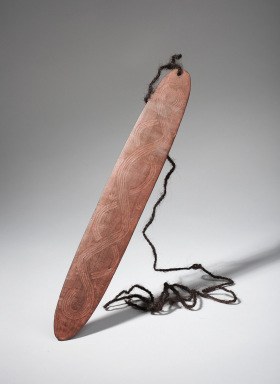
Source term: bullroarers (small and large); kumaku, a "huge bullroarer" pole
katjiri: the Two Sisters ritual of Hooker Creek, from a northern word meaning "woman"; ngatilkatjara: its local name, "two women" of the ngati (mother's sister) category; nangkuru: the pit that is the Sisters' womb; kumaku: the decorated pole, "a huge bullroarer".
At Hooker Creek the Warlpiri said the bullroarers were women. The katjiri, the ritual that bound together all men's ceremonial life there, belonged to two sisters, and its two blades were the sisters themselves: the small one, with its high, piercing whistle, was the elder, and so "more dangerous" and "more important" than the big one with its low rumble. Each novice, eyes covered, dipped a finger into a little hole of arm blood and tasted it; it was the urine of the Two Sisters, he was told, who must have passed by. An elder circled the boys striking the ground with the point of the large bullroarer: the Sisters walking close by on their digging sticks. Then the blade was swung, and at last the boys could watch it turn. To seal their silence each touched his tongue to a spear-tip that stood for the clitoris. The rite ended in birth. From a pit dug as the Sisters' womb, the novices crawled out along a twelve-foot flattened pole, "a huge bullroarer" dusted with red and white fluff, scraping their chests and stomachs as they went.
Finally, the junior novices are permitted to watch the bullroarer being swung. They are told that it is the Two Sisters themselves.
Stephen A. Wild, "Men as Women," JASHM 4(3) (1987), p. 169
Particulars
- Object
- A pair of bullroarers of different sizes: a small one with a high-pitched, piercing whistle and a large one, sharp-pointed, with a low rumble. At the climax a twelve-foot flattened pole, the kumaku, decorated with red and white fluff, is displayed as a huge bullroarer.
- Function
- The central symbols of the katjiri, the Two Sisters ritual at Hooker Creek: novices are told the blades are the Two Sisters themselves, the small one the elder and more dangerous. Used in all men's secret and semi-secret rituals and never swung in the presence of women and children.
Source
Stephen A. Wild, "Men as Women: Female Dance Symbolism in Walbiri Men's Rituals," Dance Research Journal 10(1) (1977–78); reprinted in Journal for the Anthropological Study of Human Movement 4(3) (1987): 166–183, at pp. 169–170