No. MAT1898-006
Wiradthuri Macquarie-Bogan mudthega and moonibear
Australia · Macquarie and Bogan Rivers · Southeast
Restricted
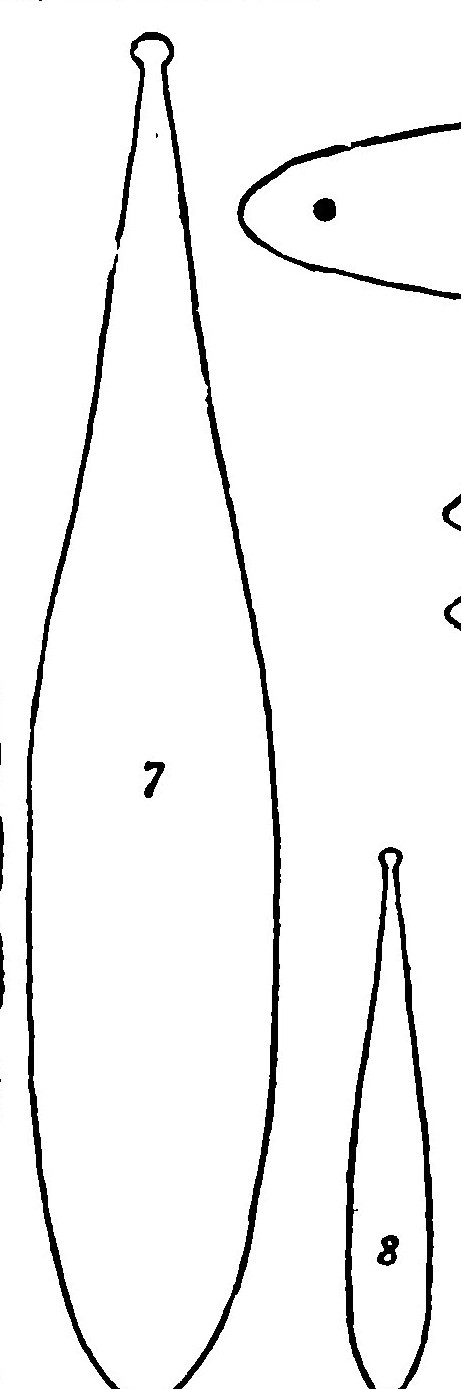
mudthega / moonibear
Source term: bull-roarer
Wiradthuri (Wiradjuri) names for the two bull-roarers of the Burbung initiation: mudthega the large instrument, moonibear the small.
Etymology. In the Wiradthuri Burbung myth the All-Father Baiamai, after destroying the boy-devouring being Dhuramoolan, put his voice into all the trees of the forest and split one to make the first mudthega, so that every bull-roarer speaks with Dhuramoolan's voice; Mathews adds that the large instrument is also known outright as booboo and dhuramoolan.
The large bull-roarer here, the mudthega, was a slab of brigalow wood nearly fourteen inches long, handed to the surveyor R. H. Mathews by the headman of a Wiradthuri tribe on the Macquarie River, who had used it in the Burbung ceremonies of his people. Its smaller companion, the moonibear, was cut from sandal-wood and swung on a mungal-wood handle some two and a half feet long; Mathews records that it was "sounded at the Burbung ground during the continuance of the ceremonies of initiation." The same pair, under other names, ran from the Macquarie to the Culgoa Rivers. A. C. Haddon, drawing on Mathews's account of the Burbung, noted what became of the mudthega and moonibear once the rite was over: after they were shown and explained to the novices, they were split into pieces and driven into the ground out of sight, or burnt.
Dhurramoolan is a dreaded evil being who is supposed to attend at the initiation ceremonies, and the sound of the bullroarer represents his voice, which is said to have resembled the rumbling of distant thunder, or the weird roar of the wind during a storm. … The noise made by the moonibear is said to represent the voice of Dhurramoolan's wife.
Mathews 1898, "Bullroarers used by the Australian Aborigines," Journal of the Anthropological Institute 27:56
Particulars
- Function
- Large mudthega and small moonibear bullroarers used in Burbung ceremonies of Wiradthuri tribes on the Macquarie, Bogan, and other rivers.