No. MUS2026-222Australia
Charlotte Waters emu churinga
Australia · Charlotte Waters and Hermannsburg, Northern Territory (both places named in the museum's locality string)
Restricted
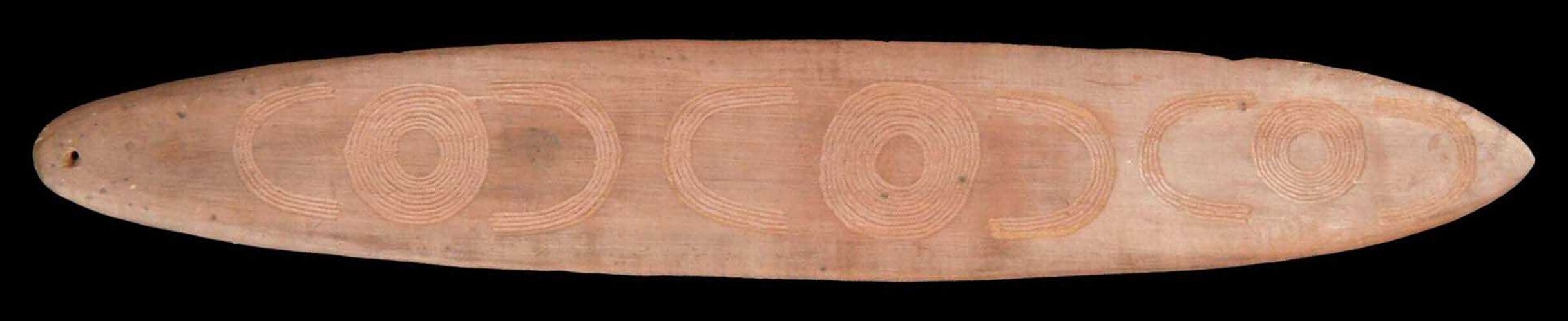
Ilia; Namatuma
Source term: Emu churinga or bullroarer
Ilia and Namatuma: two local names recorded together for this one blade.
A wooden blade cut over with the design of a totemic ancestor, an emu, and pierced at one end so a cord could be knotted through it. It came from somewhere between Charlotte Waters and Hermannsburg in the southern Northern Territory in 1908, and reached Cambridge the following year. What came with it is rarer than the blade itself: the object's own names, Ilia, and Namatuma. Two words for one blade, set down without translation.
Emu churinga or bullroarer, inscribed with designs representing a totemic ancestor. Hole in end.
Museum of Archaeology and Anthropology, University of Cambridge, catalogue description for accession E 1909.933
Particulars
- Object
- A wooden blade inscribed with designs representing a totemic ancestor, with a hole in one end for the attachment of a cord.
- Function
- A churinga inscribed with sacred designs, not to be seen by uninitiated people; wooden examples pierced at one end for a cord make their characteristic sound when whirled.
Source
Museum of Archaeology and Anthropology, University of Cambridge, E 1909.933 (Charlotte Waters / Hermannsburg, Northern Territory; collected by H. J. Hillier)