No. PNG7
Boiken
Papua New Guinea · East Sepik · Oceania · Sahul
Restricted
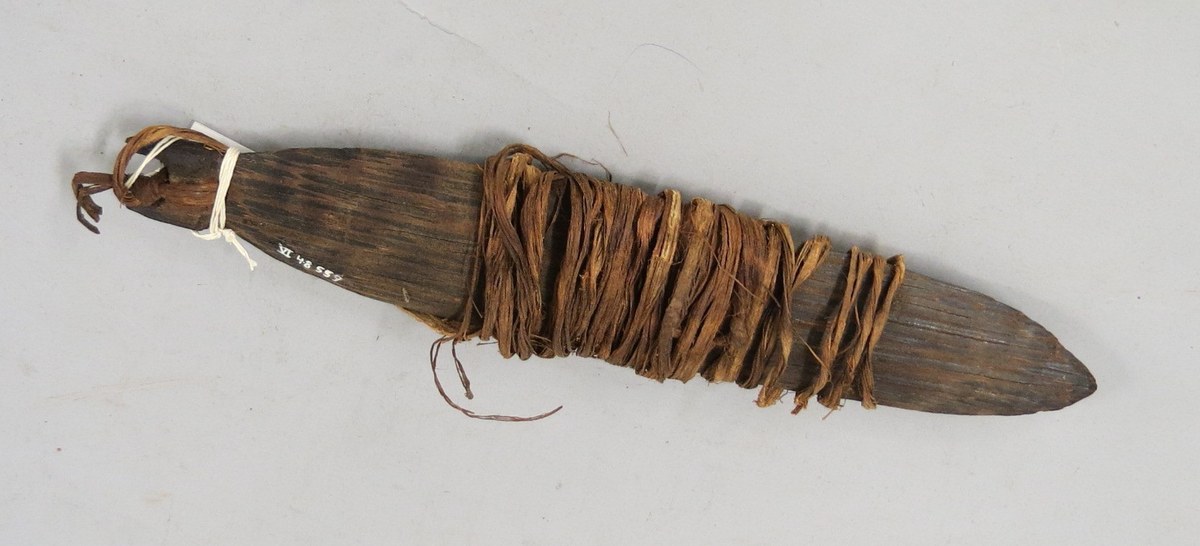
Among the Yangoru Boiken of the East Sepik, the bullroarer belonged to the wala, the stream-spirits believed to form from the mystical union of dead male ancestors whose shades congregate in the water. In former times, if the wife of an important man insulted his sexuality, she was disciplined by "the wala": a band of men who swung a bullroarer and destroyed the couple's belongings. Bullroarers, weapons, and cooking and dining utensils were sometimes incised with abstract designs said to be the "face of the wala." Paul Roscoe, who recorded these practices, names hand drums and monotone flutes as the people's main instruments, with the slit-gong sounded to summon relatives at a death.
The principal supernaturals are human fiends that stalk lone villagers at certain seasons, the spirits of the ancestors, and the wala spirits.
Roscoe, "Yangoru Boiken: Religion and Expressive Culture," Encyclopedia of World Cultures (Oceania)
Particulars
- Function
- Among the Yangoru Boiken the bullroarer is the instrument of the wala, stream-spirits formed from the mystical union of dead male ancestors, swung by a band of men who act as the wala to discipline and enforce social sanction.
Sources
- K. A. Gourlay, Sound-Producing Instruments in Traditional Society: A Study of Esoteric Instruments and Their Role in Male-Female Relations, New Guinea Research Bulletin 60 (1975), Table 1, entry 7 View
- Paul B. Roscoe, “Yangoru Boiken,” in Terence E. Hays (ed.), Encyclopedia of World Cultures, vol. 2: Oceania (Boston: G. K. Hall, 1991), pp. 388-391, “Religion and Expressive Culture”