No. AUSMAIN-001
Wiknatara (Wik-Iiyanh)
Australia · Western Cape York, Aurukun region · Cape York Peninsula
Restricted
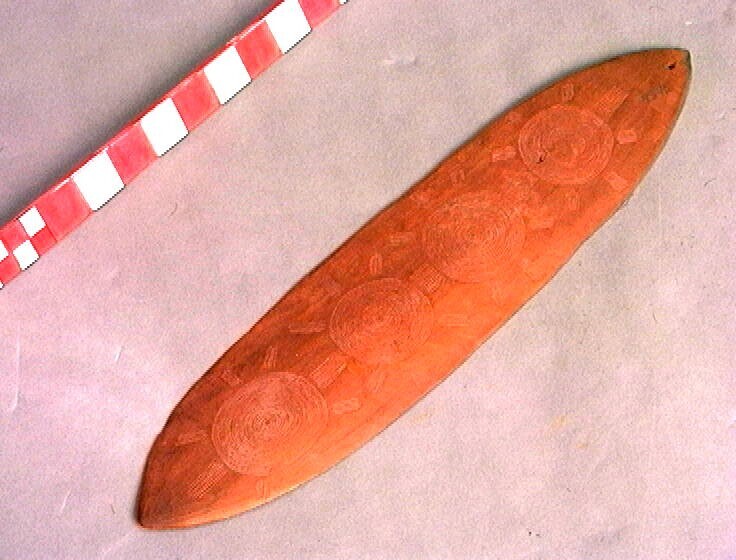
moiya / pakapaka / moipaka
moiya and pakapaka: Wik-Mungkan bullroarers; moipaka: Wiknatara bullroarers, male and female, described as husband and wife.
Etymology. The moipaka of the Wiknatara are a male and female pair of bullroarers explicitly said to be husband and wife — the male phallus-shaped, the female described as a wantyu pian or 'grown-up woman' — swung by married men as a charm to draw a married woman's attention. The account is Ursula McConnel's, as summarized and quoted by Geza Roheim.
"It belongs to us women, we found it" — so the girls sing in the Wik-Mungkan and Wiknatara myth, whirling the bullroarers they discovered before ceding them: "But no matter! We leave it for the men! It is they who will always use it." Then they hid the roarer in the crack of a bloodwood tree and went down under the water, and that place became the auwa, the totem centre of the bullroarer. Four voices sound in the story: the Wik-Mungkan moiya and pakapaka, and the Wiknatara moipaka, a husband-and-wife pair, one bullroarer male and one female, married to each other. Among these Cape York peoples the roarer also closes a boy's initiation and turns in a married man's love-magic.
The moipaka is swung to attract the attention of a married woman. If it is swung outside the camp she will come out of curiosity to see what it is. The swinger then quickly hides it, for should a woman see it she would cease to be curious and hence the charm would not work.
Roheim, The Eternal Ones of the Dream (1945), p. 79, after McConnel, 'Myths of the Wikmunkan and Wiknatara Tribes' (1935)
Particulars
- Object
- Wik-Mungkan and Wiknatara bullroarer totem complex: moiya, pakapaka, and male/female moipaka bullroarers.
- Function
- Women-first and gendered bullroarer myth: girls first sing and whirl the bullroarers, then leave them to men; Wiknatara moipaka are male/female husband-and-wife bullroarers.
Source
Ursula McConnel, 'Myths of the Wikmunkan and Wiknatara Tribes,' Oceania 6(1) (1935), pp. 66-93; Géza Róheim, The Eternal Ones of the Dream (New York: International Universities Press, 1945), pp. 79-82; Billy Mammus (Bambeigan), men's bullroarer narratives and songs recorded by Ursula McConnel, Watson River, 1934, 00:11:35–00:29:48 (AIATSIS)