No. AUSMAIN-018
Ngarinyin (Ungarinyin)
Australia · Northern Kimberley, WA, wandjina country
Restricted
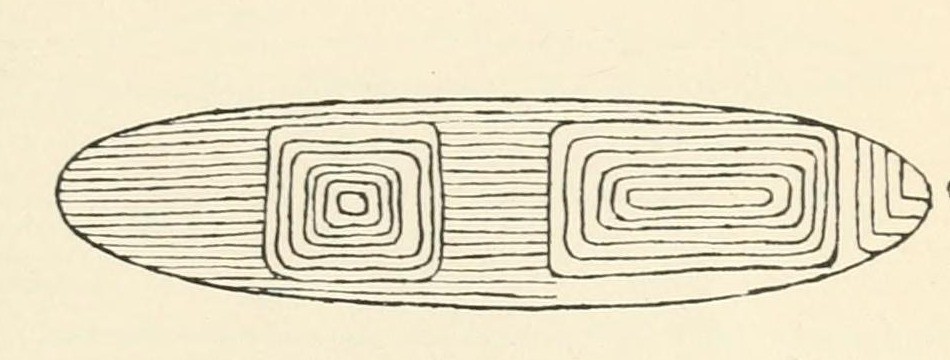
Among the Ngarinyin of the northern Kimberley, in wandjina country, the bull-roarer comes in two sexes: men distinguish a "male" from a "female" bull-roarer, an exception to the usual Australian pattern in which the whirled slat is sounded in secret-sacred increase ceremonies to separate the men's domain from the women's. Beyond that bare fact, recorded in passing by the comparative literature, little of the Ngarinyin usage has reached open sources. Helmut Petri, who chose the Ngarinyin as his subject on the 1938 Frobenius expedition to the Kimberley, did not publish his ethnography until the 1950s, and the objects the expedition collected, along with Petri's notes on the mythology, were lost in the bombing of Frankfurt in 1944. What is clear is the cult context: Ngarinyin increase ceremony belongs to the Wandjina, and the life-force the Wandjina dispense is Wunggurr — Ungud, the Rock Python, the Kimberley Rainbow Serpent whose encircling body is painted as the band around the Wandjina's head.
the Ungarinyin know of "female" bull-roarers
Koepping, "Bull-Roarers," Encyclopedia of Religion (1987), via Encyclopedia.com
Particulars
- Object
- Whirled wooden slat-on-cord; Ngarinyin specifically distinguish 'male' and 'female' bull-roarers.
- Function
- Used in fertility / increase ceremonies with secret-sacred character; the male/female distinction separates men's from women's domains.
Source
Klaus-Peter Koepping, 'Bull-Roarers,' Encyclopedia of Religion (1987)