No. NGUINEA-004
Kambrambo
Papua New Guinea · Lower Sepik, East Sepik Province · Oceania · Melanesia
Restricted
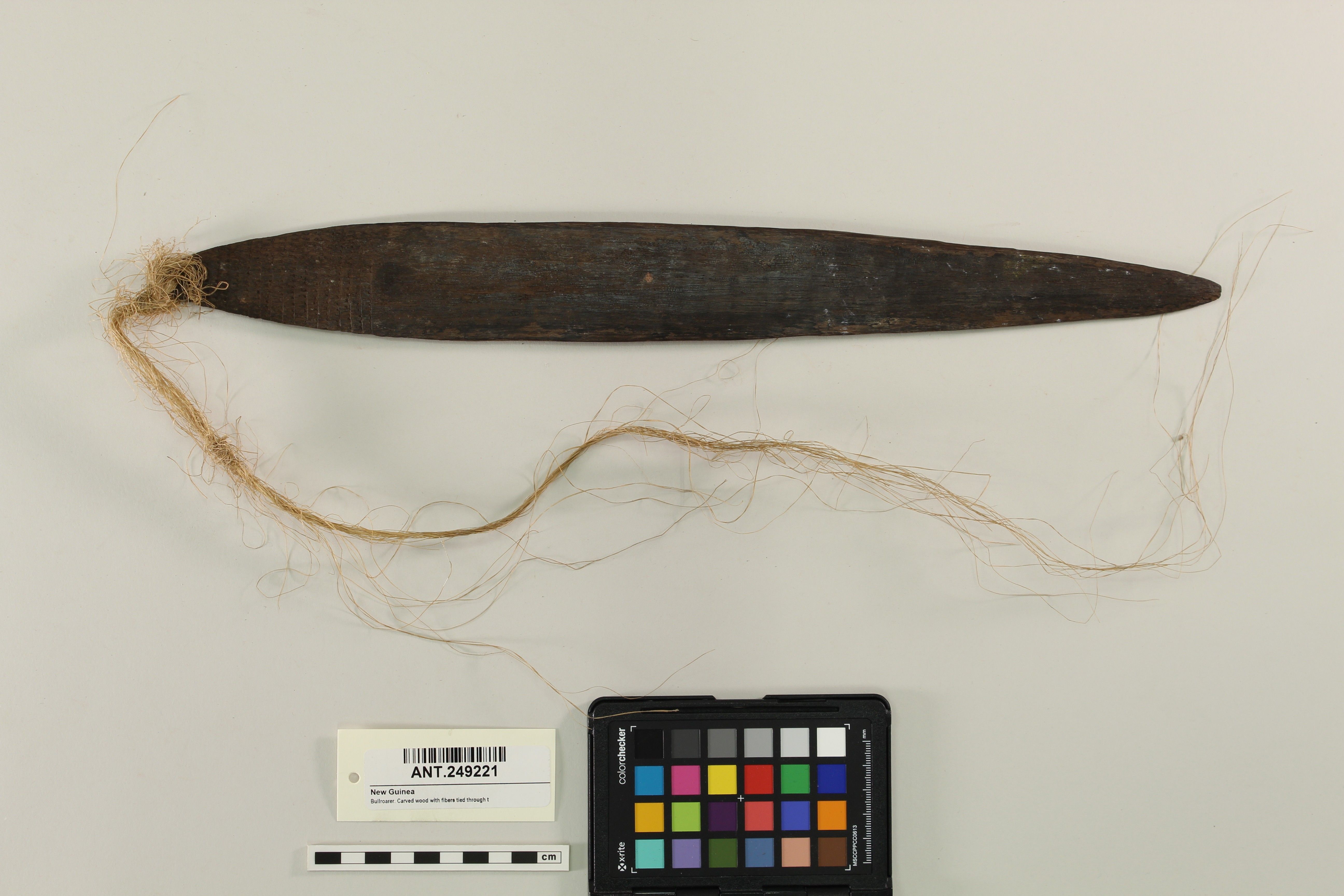
Felix Speiser reached the large stilt-village of Kambrambo, on a Sepik lagoon, on 13 November 1930 and was rowed into the ceremonial house to watch the closing phase of a boys' initiation that had already run for six months; he filmed it (released only in 1963 as Encyclopaedia Cinematographica E 502) and described it in print in 1937. In the fenced yard where the secluded novices were kept, the bull-roarer was whirled for about half an hour alongside the paired sacred flutes; on the morning of the great rite all the women but a few very old ones were driven from the village, the drums sounded, and "now and then the bull-roarer could be heard." Three ten-metre crocodile effigies of bark-painted cane then swallowed the boys one by one through their working jaws; the novices, "counted as dead," were bled by rubbing with crocodile-jaw teeth and thorny lianas, the effigies were burned, and at the end the bull-roarers were swung and the flutes blown again before the crowd dispersed. The whole performance was glossed for the women as the boys being eaten by the crocodile, which would surrender them only in exchange for pork.
Man sagte mir dazu: ‚Nun sei der Knabe ein Verwandter des Krokodils geworden und das Krokodil werde ihm nun nichts mehr anhaben.‘
They told me: 'Now the boy has become a kinsman of the crocodile, and the crocodile can do him no more harm.'
Felix Speiser, "Eine Initiationszeremonie in Kambrambo am Sepik, Neuguinea," Ethnologischer Anzeiger IV/4 (1937), as reprinted in C. A. Schmitz, Film E 502 companion text (IWF, Goettingen, 1964), p. 7
Particulars
- Object
- Bull-roarer used in boys' initiation rites at Kambrambo village, lower Sepik; filmed ca. 1930 by Basel ethnographer Felix Speiser (1880-1949), published 1963 as Encyclopaedia Cinematographica E 502. A bullroarer from the surrounding Grass Country, the grassland plain between the Sepik and the Keram, is in the Yale Peabody Museum (YPM ANT 249221): a long dark slat with a band of toothed carving near its head, traces of black paint, and its fibre cord still tied through the hole.
- Function
- Whirled during initiation alongside sacred bamboo flutes, crocodile-effigy 'swallowing' of novices, and ritual bloodletting.
Source
Speiser, Felix, "Eine Initiationszeremonie in Kambrambo am Sepik, Neuguinea," Ethnologischer Anzeiger IV/4 (1937), pp. 153-157 — Speiser's eyewitness field account of the November-1930 rite; reprinted (with minor omissions) in the companion publication to his film, C. A. Schmitz, "Kambrambo - Neuguinea (Unterer Sepik): Riten bei der Knabeninitiation," Film E 502, Encyclopaedia Cinematographica (Goettingen: Institut fuer den Wissenschaftlichen Film, 1964), 8 pp; Yale Peabody Museum, YPM ANT 249221 (Grass Country, between Sepik and Keram rivers; purchased 1980)