No. LOEB1929-008
Kaya-Kaya Tugeri Sosom bullroarer
Indonesia · Papua New Guinea borderlands · Dutch New Guinea near British territory · Oceania
Restricted
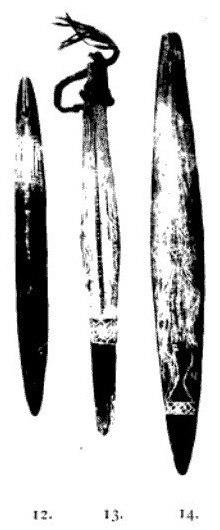

Sosom
Source term: bullroarer
Sosom (also sasam) = both the whirled bullroarer and the mythical giant/dema it personifies among the Marind-anim/Tugeri; dema = a Marind-anim mythical creator-being.
Etymology. The bullroarer's name is an eponym: the instrument bears the name of, and is taken to be the voice of, the dema (mythical giant) Sosom.
Among the Tugeri, or Kaya-Kaya, on the south coast of what was then Dutch New Guinea, the bullroarer and a mythical giant share one name: Sosom. The giant arrives each year with the south-east monsoon — a being of stone, so vast that he stands with one foot on either bank of the Merauke River — and when he comes a festival is held in his honour and the bullroarers are swung; women may not look at him, on pain of death; at the initiation of boys the instrument is Sosom himself, who kills the novices and brings them back to life — in van Baal's fuller account a swallowing, Sosom devouring all the neophytes, "each time he swallows one, disgorging another through his posterior parts." The myth also tells where the instrument came from. Sosom was a brute of a giant who, caught fast in copulation with a girl, could not free himself; the girl's mother cut off his penis with a strip of sago-leaf sheath, and a stork at last drew it out with its beak — and that severed member, van Baal concluded from the traditions, is the first bullroarer. In a coastal telling the organ fell into the river and became a watersnake; in another tradition the men invented Sosom outright, to frighten the women.
Die Kaja-Kaja kennen das Schwirrholz, sosóm. Sosóm heißt auch ein Riese, der der Sage nach jedes Jahr mit dem Südost erscheint. Er ist von Stein und so groß, daß er mit einem Fuß auf dem einen, mit dem zweiten auf dem anderen Ufer des Merauke-Flusses steht. Wenn er kommt, wird ein Fest gehalten, bei dem das Schwirrholz ertönt. Die Frauen dürfen ihn nicht sehen, sonst müssen sie sterben. Ihm werden Knaben, patúr, gebracht, die er tötet, aber wieder zum Leben erweckt.
The Kaja-Kaja know the bullroarer, sosóm. Sosóm is also the name of a giant who, the legend says, appears every year with the southeast wind. He is of stone and so huge that he stands with one foot on one bank of the Merauke River and with the other on the opposite bank. When he comes, a festival is held at which the bullroarer sounds. The women may not see him, or they must die. Boys, patúr, are brought to him; he kills them, but wakes them to life again.
Rudolf Pöch, Vierter Bericht über meine Reise nach Neuguinea, Sitzungsberichte 115 (1906), p. 901.
Sources
- Rudolf Pöch, 'Vierter Bericht über meine Reise nach Neuguinea,' Sitzungsberichte der Akademie der Wissenschaften in Wien 115 (1906): 895-903, p. 901
- Edwin M. Loeb, 'Tribal Initiations and Secret Societies,' University of California Publications in American Archaeology and Ethnology 25(3) (1929), p. 253; note 18, p. 254, via Webster (1911), p. 495 View · archived
- Webster, Journal of the Royal Anthropological Institute 41 (1911), p. 495, cited in Loeb (1929)
- J. van Baal, Dema (1966), pp. 267-273, 480, 485ff., 534
- J. van Baal, Jan Verschueren's Description of Yéi-nan Culture (1982), sections 3341-3342