Voices, revelations and the people entrusted with them
Across Australia, the whirled board repeatedly joins an ancestral being to a living ceremony: it summons people, announces a presence and passes into a novice’s hands. From Cape York’s snake-name to Gippsland’s grandfather, these traditions make sound a form of inherited authority, with distinctive local stories and rules.
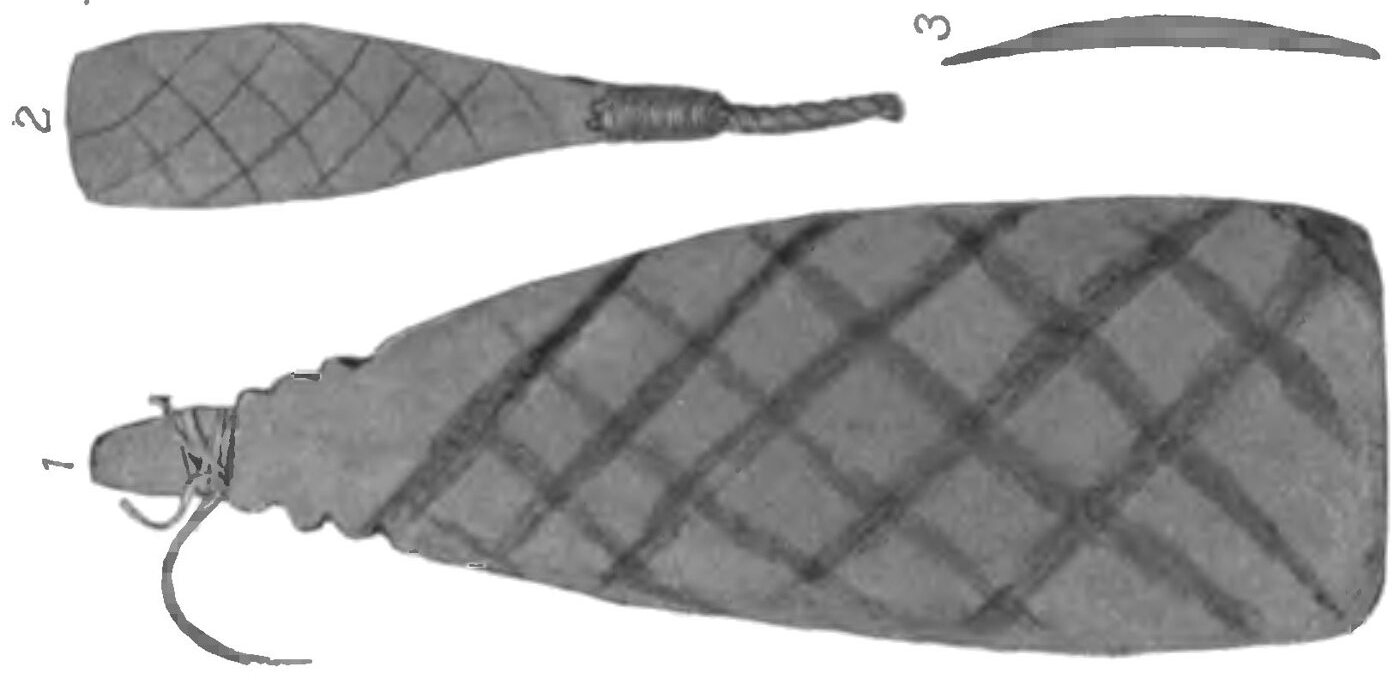
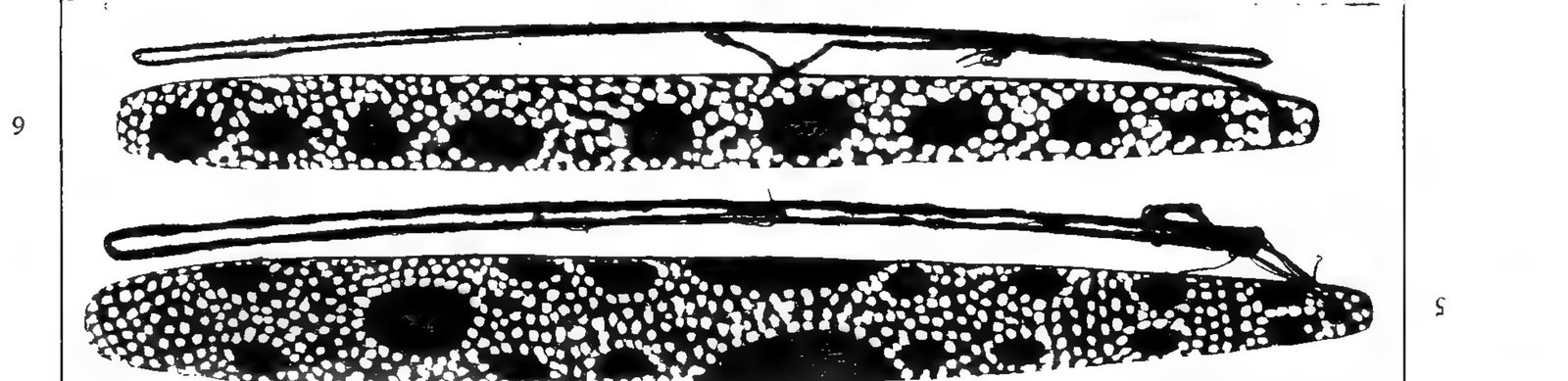
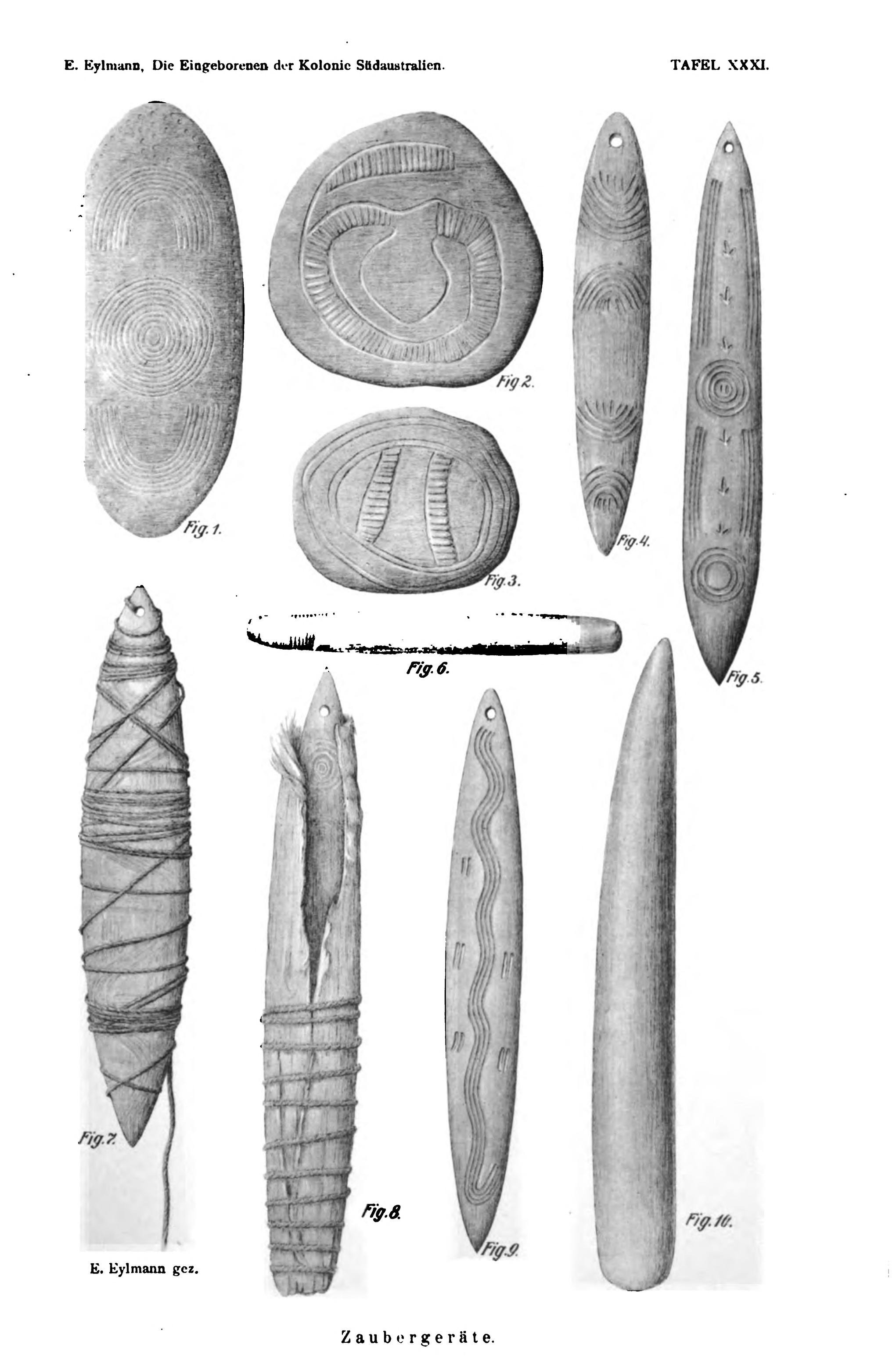
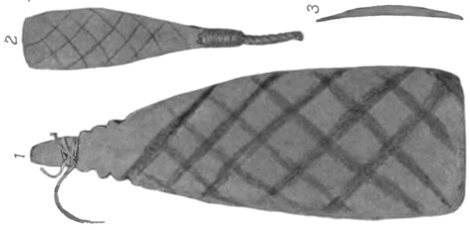
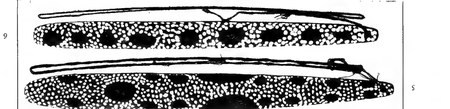
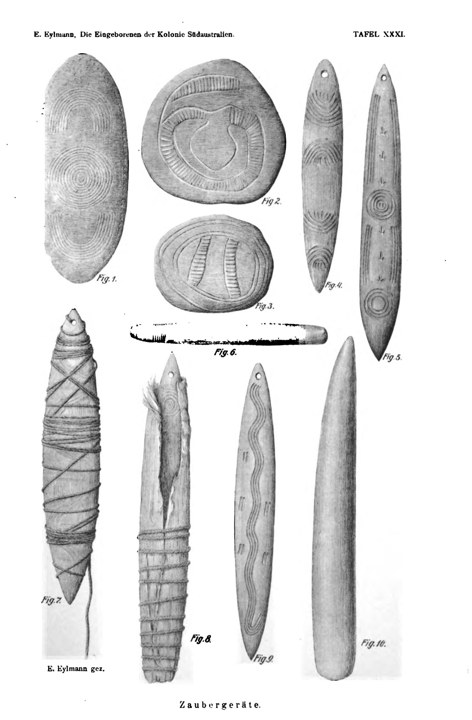
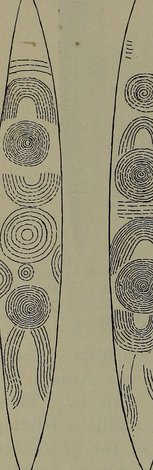
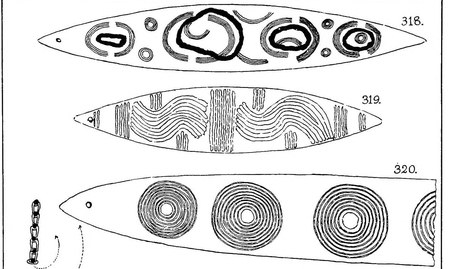
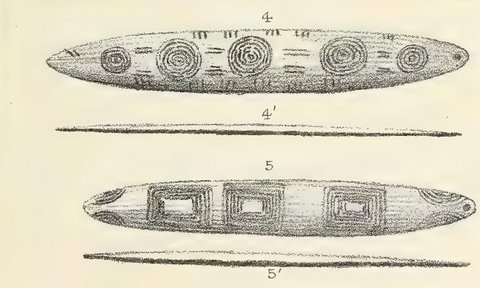
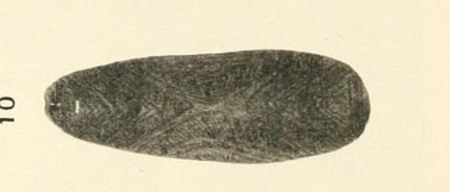
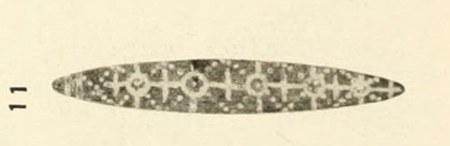
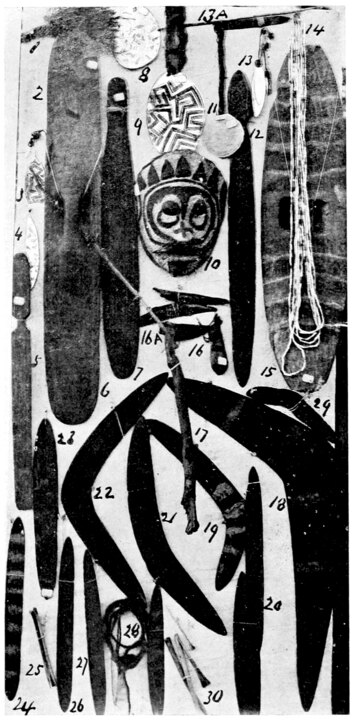
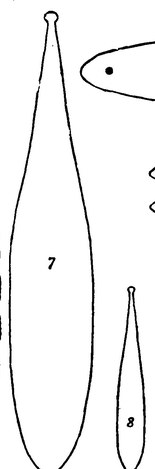
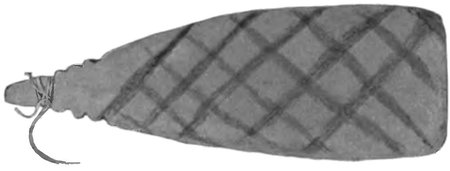
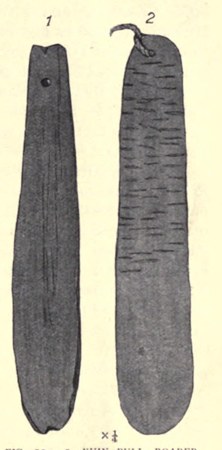
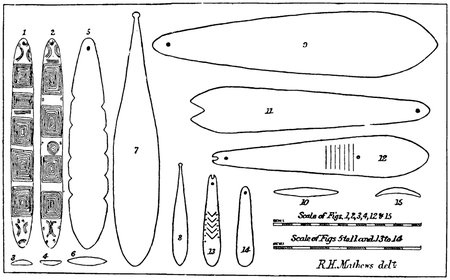
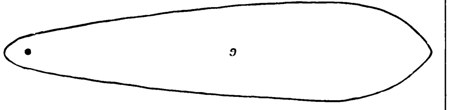
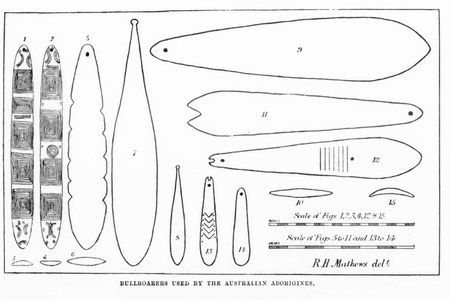
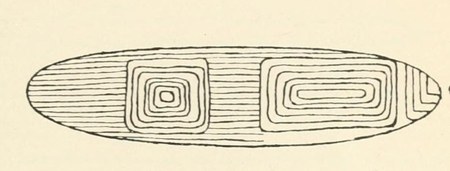
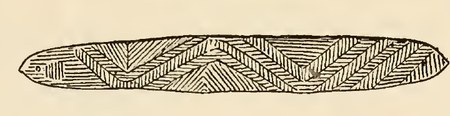
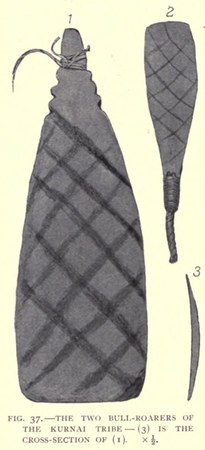
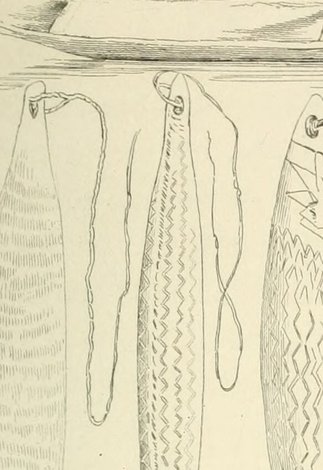
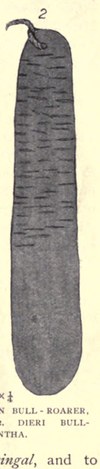
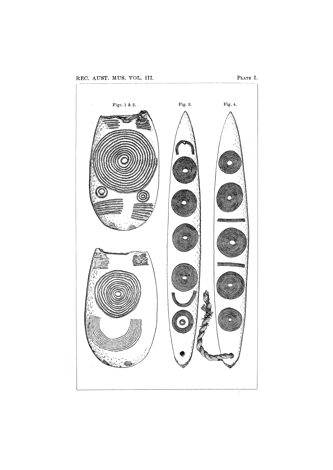
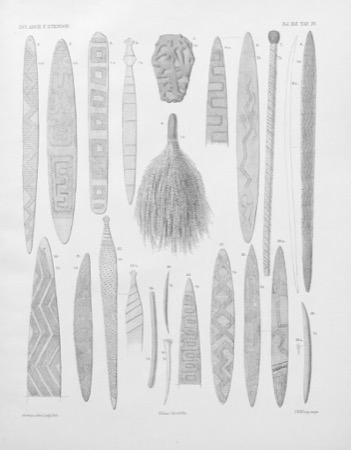
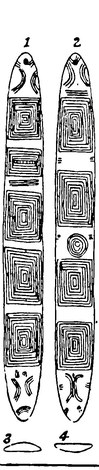
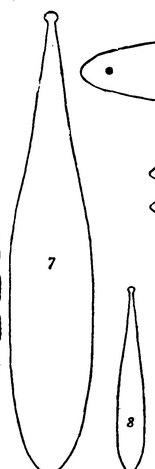
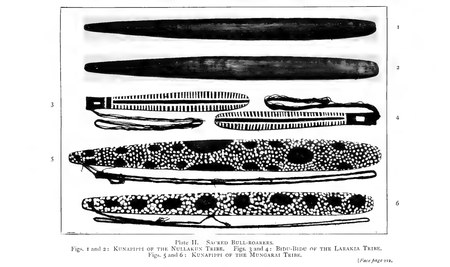
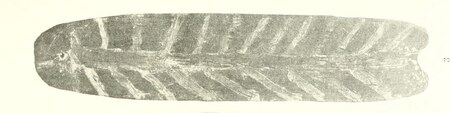
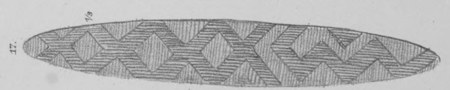
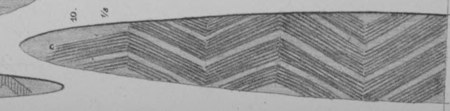
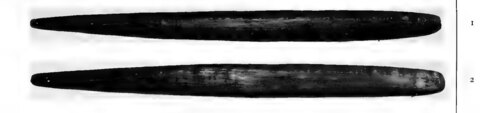
Kurnai / GunaiTwo bull-roarers of the Kurnai (Gunai), figured by Howitt (1904, Fig. 37).A. W. Howitt, The Native Tribes of South-East Australia (1904), Fig. 37 · Public domainMungaraiSpencer's plate of the Mungarai kunapippi.Spencer, Native Tribes of the Northern Territory (Macmillan, 1914), Plate II · Public domainArunta / ArrernteEylmann’s Plate XXXI (1908). Figures 4, 5, and 9 are West Arunta bullroarers.Erhard Eylmann, Die Eingeborenen der Kolonie Südaustralien (1908), Plate XXXI · Public domain
Sixteen men emerge from the scrub in Gippsland, their paired boards roaring and screeching around boys whose heads are covered with blankets. Around Port Keats an approaching roar announces the Mother of All. On Cape York a mentor swings a blade called Snake over a boy who has just been told he is snake-bitten. Across these distant ceremonies, the instrument does the same momentous work: it makes a powerful presence audible, then brings a new person into the company entitled to handle it. 1, 7, 5
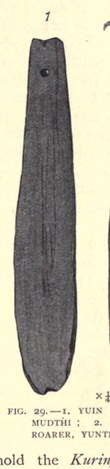
The Australian roarer is often more than a sacred object with a sound attached. Its name, marking or voice places it inside a story of who made the world and who may carry that work forward. The Yuin hear Daramulun’s thunder in the mudthi; the Kurnai call their larger blade Tundun, the ancestral grandfather. Among the Mungarai, Kunapippi names both the sacred sticks and their first owner. These are local identities, but their shared arrangement is striking: a shaped piece of wood carries the authority of a being older than its present custodians. 1, 2
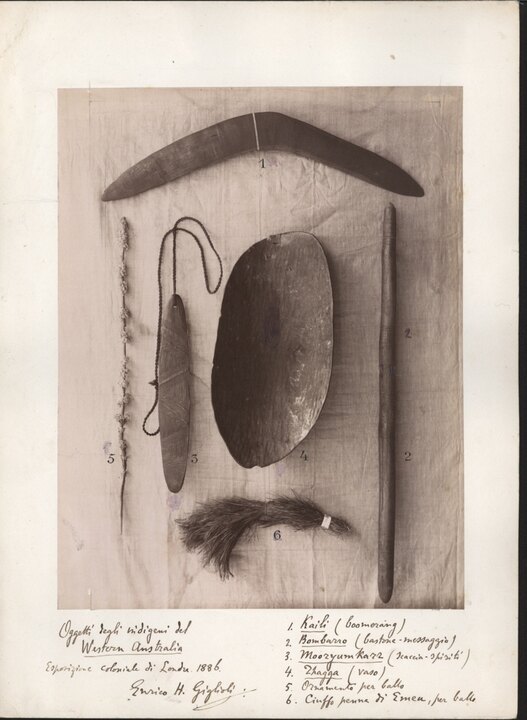
In Yolngu ceremony the serpent can be present in the whole instrument. The published Wawaluk account explains the blade as the snake’s body, its human-hair cord as the fangs and its roar as the voice. In Wambaya country, a carved purtuli belongs to Katakitji, the snake ancestor of Beetaloo Waterhole. Spencer and Gillen say the sacred value of the Wambaya object comes from this ancestral association, without a spirit living inside it. Ancestral presence can be embodied, voiced or maintained through a particular inherited bond. 8, 3
Before the roarer confronts a novice, it can gather the people who will make him a man. A Ngarigo messenger carries the mudji with a spear, boomerang and shield. A Wurundjeri messenger carries the instrument and a man’s kilt when he calls the Talangun. In the Roper River country, Mungarai messengers take kunapippi to distant groups. The object is a credential: its presence tells recipients what kind of gathering is proposed and under whose authority the speaker has come. 1, 2
Those calls draw networks together. Howitt’s Yuin Kuringal brought people from the coast, Monaro and inland country whose languages could be mutually unintelligible. The ceremonial summons crossed that distance through recognized messengers and the things they bore. Spencer records a similar conjunction in the north: men carrying kunapippi were safe on their mission. The powerful sound-making object could therefore work silently, wrapped and carried, before anyone swung it. 1, 2
Revelation changes the novice’s relation to the sound. At the Kurnai Jeraeil, the headman directs the boys’ eyes first to the sky and then down to the men holding the boards. He teaches them Mungan-ngaua’s history and the law of the rite; they take the instruments in hand with apprehension. That evening the same boys circle the women’s camp, now making the frightening voices themselves. Learning how the sound is made also means accepting responsibility for when and to whom it may be heard. 1
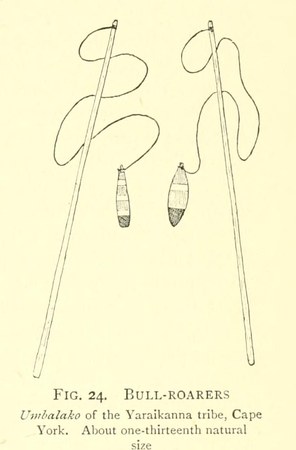
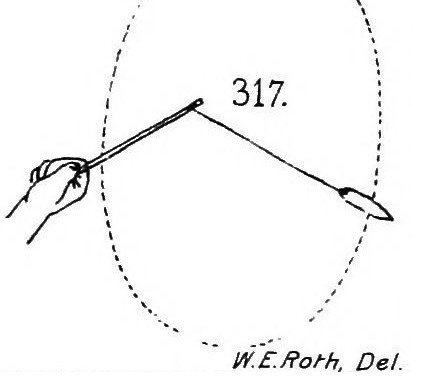
On the McIvor River, Roth watched a boy pinched awake and told that a snake had bitten him. His mentor swung the dunggul to kill the imagined snake, then handed it over: the novice now possessed its dangerous agency. At Bloomfield the teaching came after animal dances, instruction by fathers or maternal uncles and nose-piercing. At Murinbata Punj, concealed swingers sprang into view and prospective brothers-in-law presented new boards. Across these scenes, instruction culminates in a tangible transfer, binding ritual experience to a person who can repeat it. 5, 7
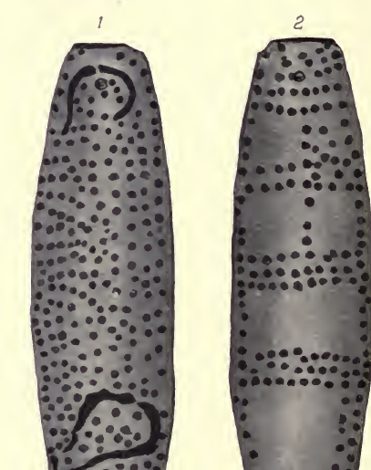
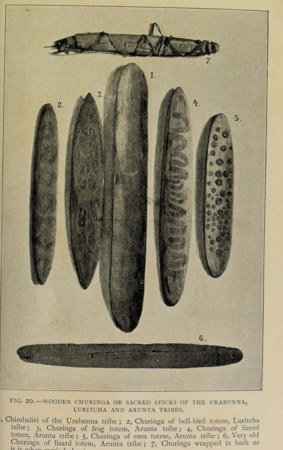
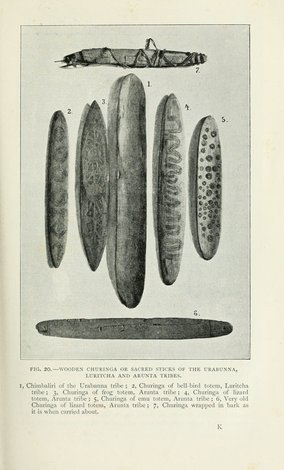
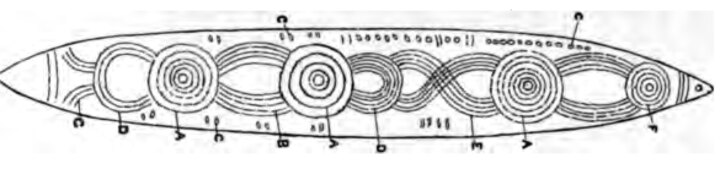
Central Australian sacred boards make inheritance visible in wood and country. Spencer and Gillen distinguish the small pierced wooden churinga that are swung from the wider class of wooden and stone sacred objects. Among the Arrernte, churinga are bound to ancestral identities and kept in secluded storehouses among the rocks. A bullroarer belongs to this world of treasured ancestral things; it is not exhausted by the moment when it is sounded. 4
The Kaytetye origin story even explains the right timber. Two Tumana hear Atnatu’s roar from the sky and try to copy it. Bark does not give the right voice; mulga wood does. Down flies from the sacred objects they whirl, and trees arise where it falls. After wild dogs kill the makers, men who had watched transmit the making and sounding to others. In the Warumungu story, dogs tear Murtu-Murtu apart and his scattered flesh becomes the trees from which roarers are cut. Different ancestors, related events: the material used by living makers grows from ancestral action. 3
On the Dampier Peninsula in the West Kimberley, Djamar travels with the galaguru and makes his approach audible through it. At Burumar its human-hair cord breaks as he swings it. The board flies into the celestial place Worms translates as “with the fleshless,” in the Coalsack region beside the Southern Cross; Djamar later enters that realm himself. A board sounded on earth occupies a place in ancestral geography far above its custodians. 12
Far to the south, at Eucla, Daisy Bates’s vocabulary places the yinma in the dark patch of the Milky Way as the sacred board’s shadow. Her Willilambi account links long yeenma boards and boorbing roarers to a particular ancestral victory: old men carve the eaglehawk’s heart, ribs and entrails into hardwood belonging to their own totem. Both northwestern and southern examples make the object part of a larger ancestral world, extending from the material in a maker’s hands to the sky. 13
The accounts explain possession as carefully as sound. Spencer heard two Mungarai traditions: one makes Kunapippi a great male founder with spirit-boys in his bags; another follows a woman carrying her wrapped boards, joining other women’s ceremonies and losing the instruments to Kumkum. On Cape York, Bambeigan’s Wik account gives the first voices to girls who find the instruments, sing of owning them and leave them to men. These are distinct narratives, but all make present custodianship the outcome of an ancestral event rather than an unexplained custom. 2, 6
The same concern with rightful custody appears in living Indigenous interpretation. During a 2012 Pitt Rivers Museum consultation, Yolngu elder Joe Neparrnga Gumbula and another Yolngu Elder classified the museum’s Australian bullroarers and churinga as secret/sacred men’s ceremonial objects, for initiated men of the appropriate country and clan. Their statement recognizes a class across great distances while keeping authority local: the right to an object belongs to particular people. 9
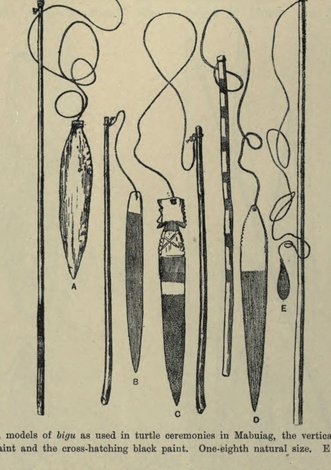
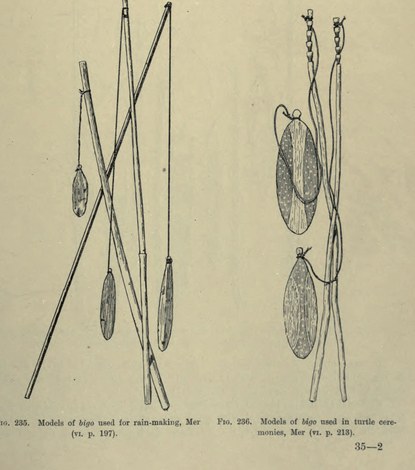
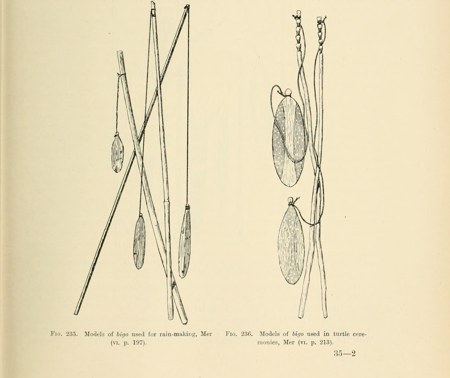
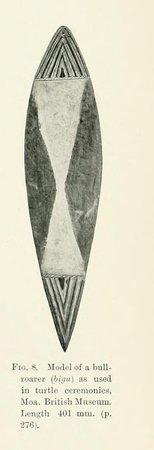
Australia also holds uses that illuminate the range of the instrument. Brown recorded Kariyarra initiates receiving two banangari, one at the belt and one behind the head, while women were permitted to see them. In Torres Strait, Mabuiag men sounded bigu and wanes over fishing canoes and around turtle remains; on Mer, a little bigo hung from a rain-maker’s stone figure. These practices share the capacity to make a carrying sound do ceremonial work, without imposing the same access rule on every place. 10, 11
The continental resemblance rests in a recurring relationship: ancestral stories give an object its identity, ceremonies make that identity audible, and people acquire obligations through holding and transmitting it. Its strongest examples run from the tropical northeast through Arnhem Land and the centre to the far southeast. Local words and rites give that relationship its substance. A serpent’s voice, a grandfather’s paddle and a founder’s sacred stick belong together in this comparison because each turns inherited authority into something that can be heard and handed on. 1, 7, 2, 3, 5
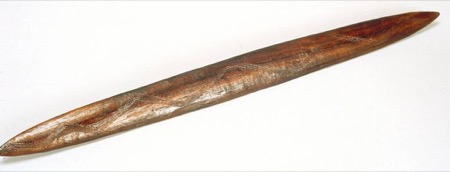
Among the Kurnai of Gippsland, the men in charge of the boys at the Jeraeil told them that in the afternoon they would be shown their grandfather. What they were shown was the Tundun, the larger of two bull-roarers, "the man"; the smaller blade was the Rukut-Tundun, "the woman," his wife. Both are…
In Walter Roth's account of the Koko-yimidir initiation he witnessed in June 1899 on the southern bank of the McIvor River, the painted novices are told to lie down and feign sleep, then each is suddenly "awakened" by a sharp pinch on the arm and told he has been snake-bitten. As the boy starts…
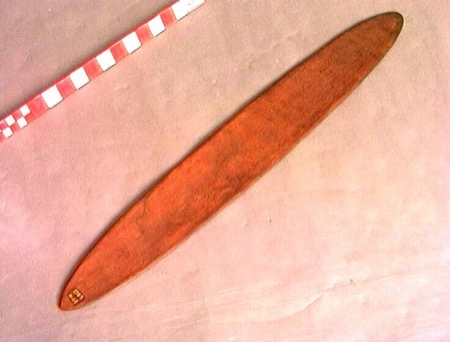
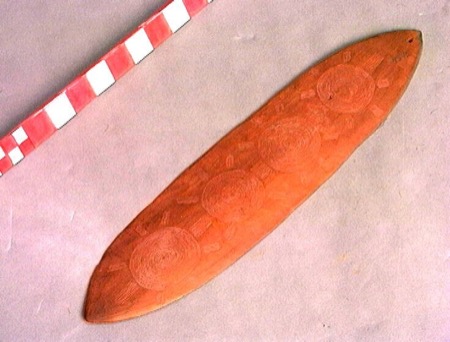
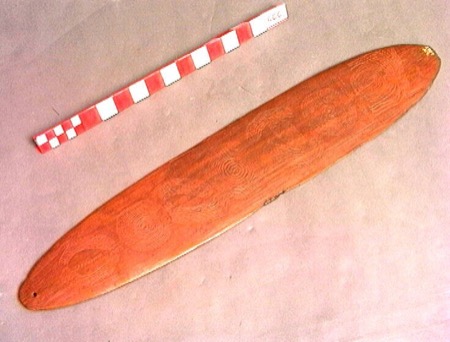
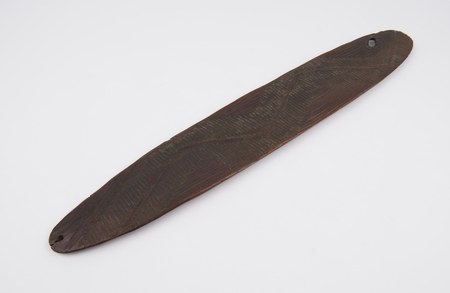
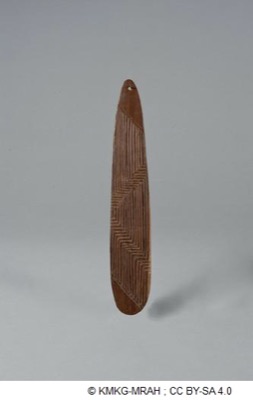
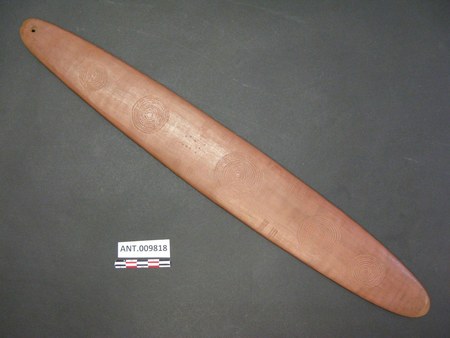
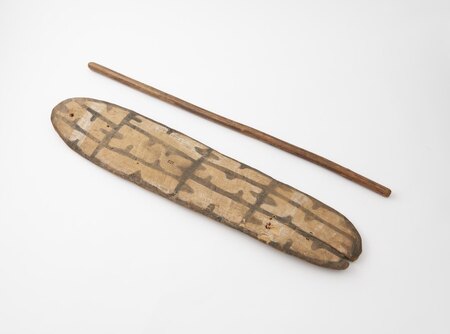
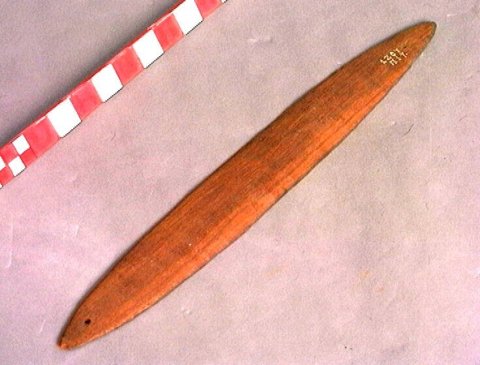
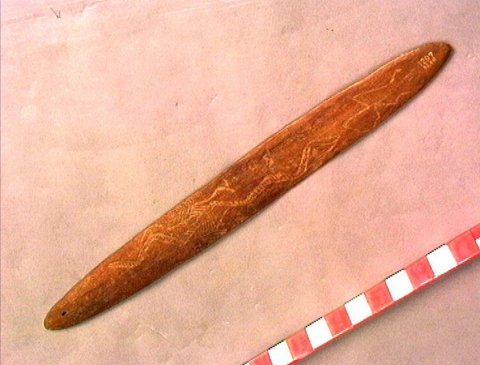
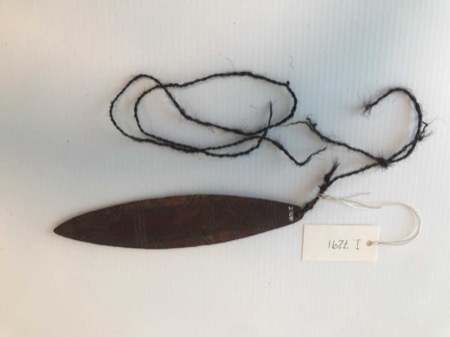
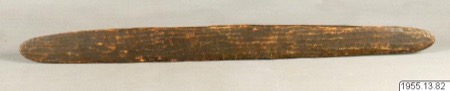
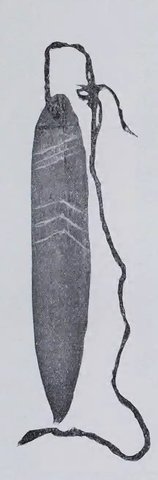
Representative — not this record’s object · An elongated wooden board incised with fine wavy parallel lines.
Spencer, Native Tribes of the Northern Territory (Macmillan, 1914), Plate II · Public domain
Among the Mungarai of the middle and upper Roper River, in the country east of Mataranka, the bull-roarers were called Kunapippi, after the ancestral being who first owned them. Baldwin Spencer, who recorded the tradition during his 1911-12 fieldwork, found them considerably larger than those of…
Among the Murinbata of the Port Keats region, the bullroarer (ngawuru) is the emblem of Karwadi, the secret name of a spirit also called The Mother of All or The Old Woman, and the roaring sound it makes when swung is held to be the sign of her real presence. The anthropologist W. E. H. Stanner,…
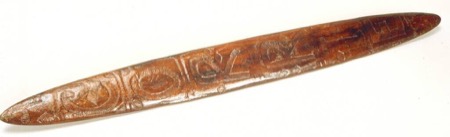
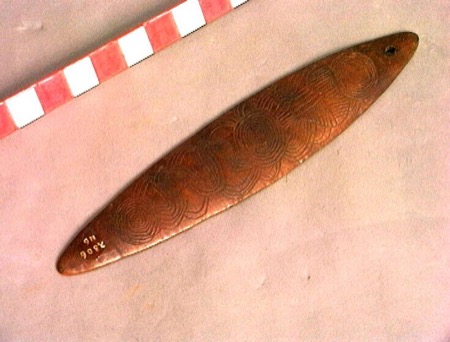
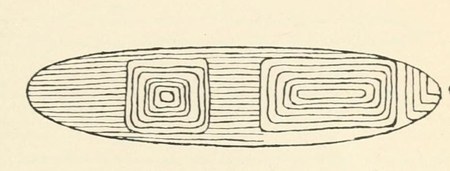
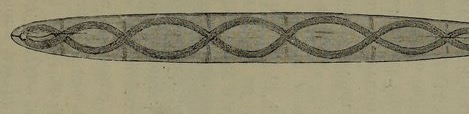
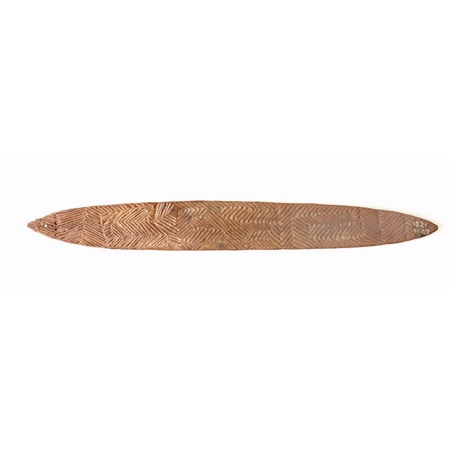
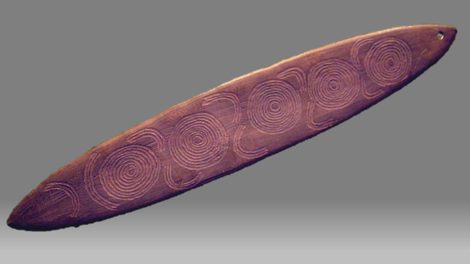
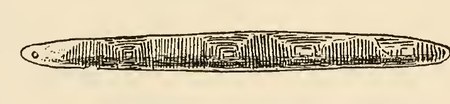
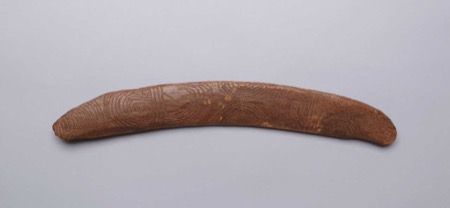
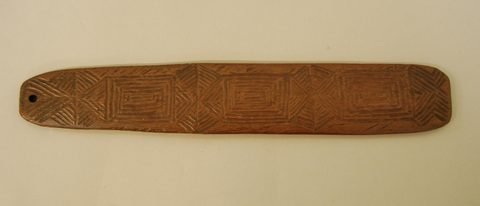
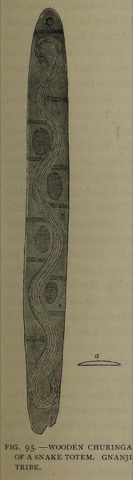
Representative — not this record’s object · A wooden board carved end to end with concentric scrolls and key-pattern.
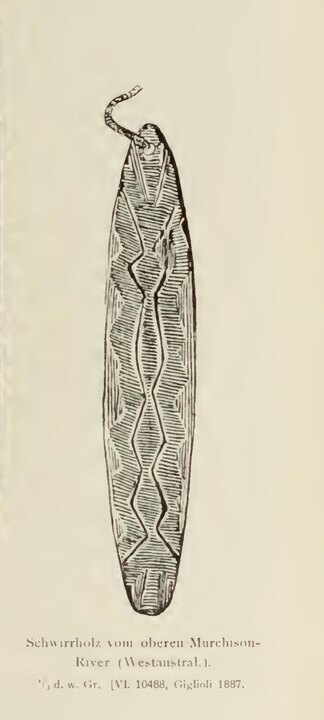
Erhard Eylmann, Die Eingeborenen der Kolonie Südaustralien (1908), Plate XXXI · Public domain
Among the Arunta of the MacDonnell Ranges, the sacred objects called churinga could be seen by women or uninitiated men only on penalty of death, or of being blinded with a fire-stick. Spencer and Gillen, working in the Alice Springs district in the 1890s, described two kinds: flattened stones and…
Spencer & Gillen, The Northern Tribes of Central Australia (1904), Fig. 91 · Public domain
The Kaitish tell how the churinga was invented. In the Alcheringa two men named Tumana, themselves sprung from churinga, heard far off the roaring that the sky-dweller Atnatu made twirling his own churinga, and set about imitating the sound: slats of bark failed, but a churinga cut from mulga wood…
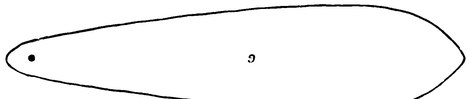
Haddon (ed.), Reports of the Cambridge Anthropological Expedition to Torres Straits, vol. IV, 1912, Plate XII fig. 7; figure rotated for display · Public domain
J. D. E. Schmeltz, catalogue of the Clement collection, Internationales Archiv für Ethnographie 16 (1904), Plate IV; drawn and lithographed by R. Raar from the Leiden ethnographic museum; Internet Archive scan by Robarts Library, University of Toronto · Public domain
J. D. E. Schmeltz, catalogue of the Clement collection, Internationales Archiv für Ethnographie 16 (1904), Plate IV; drawn and lithographed by R. Raar from the Leiden ethnographic museum; Internet Archive scan by Robarts Library, University of Toronto · Public domain
Haddon (ed.), Reports of the Cambridge Anthropological Expedition to Torres Straits, vol. IV, 1912, Plate XII fig. 7; figure rotated for display · Public domain
Keriri / Hammond Island (Kaurareg), western Torres Strait
Candidate only
Representative — not this record’s object · Kalkadoon wilmurra from Queensland’s Selwyn District, Q.E. 13/237
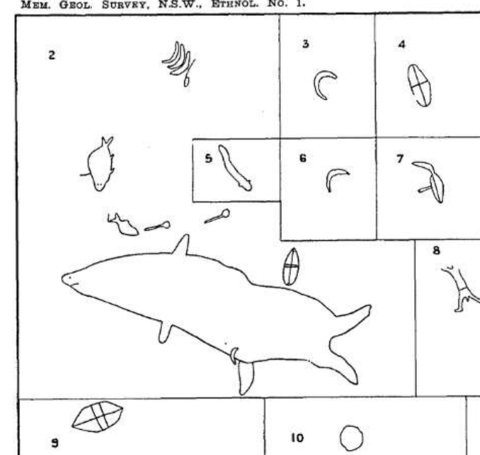
W. D. Campbell, Aboriginal Carvings of Port Jackson and Broken Bay (Geological Survey of New South Wales, 1899), Broken Bay Plate 12, fig. 2 · Public domain
Ellis Trig North, Cottage Point, Ku-ring-gai Chase National Park; site ID 45-6-0278; Campbell BROKEN BAY Plate 12 fig. 2, McCarthy BROKEN BAY Group 122
Candidate only
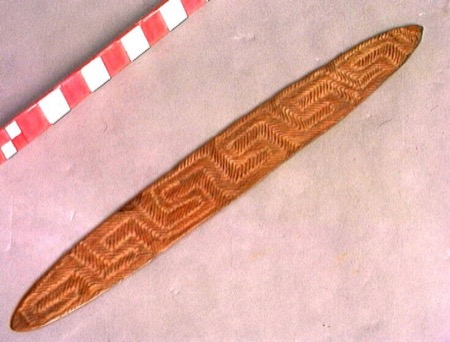
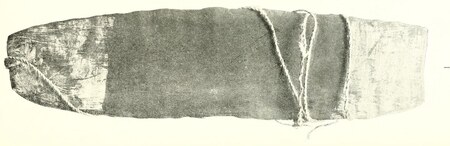
Representative — not this record’s object · Red-edged companion blade E.13713, with white-painted ends
Haddon, Reports of the Cambridge Anthropological Expedition to Torres Straits, vol. VI (1908), Pl. VIII fig. 1 — Wellcome Collection M0005261 · CC BY 4.0
Kulgera district, southern Northern Territory (people not named on the record)
Chapters VII, IX and XI; pp. 494–496, 538, 565, 583–586, 628–632, 687, 700–701. Howitt witnessed Yuin and Kurnai ceremonies; other passages identify named correspondents. Haddon and Loeb restate these accounts and are not extra witnesses.
pp. 222–224, 275–277, 351–353, 366–373, 420–421, 434–435, 498–503. Anula kunapipi is an early local ceremony-name, not proof of every feature of later Mother cults.
pp. 175–176: eyewitness Koko-yimidir snake-bite episode and separate Bloomfield initiation. The adjacent communities do not inherit one another’s instrument-names.
Oceania 6(1), pp. 80–83, The Bullroarers (Moiya and Moipaka), bilingual text and free translation told by Bambeigan; distinguishes Wik-Mungkan and Wiknatara terms. Róheim’s later retelling is the same source chain.
Art Bulletin of Victoria 29; NGV republication 18 June 2014. Published account of Wawaluk ceremony, serpent blade/body/string/voice and Mathaman Marika’s 1963 Arafura Lagoon. No particular painted mark is identified as a bullroarer.
Research and responses: July 2012 consultation with Dr Joe Neparrnga Gumbula and a Yolngu Elder from Arnhem Land; their classification concerns the museum’s Australian bullroarers and churinga. It does not document each Pilbara object’s local rite.
Journal of the Royal Anthropological Institute 43, pp. 168, 174: Kariyarra and Ngarluma initiation objects; Kariyarra women permitted to see the bullroarer.
V pp. 217–220, 330–333, 347, 352: western-island initiation, turtle fishing, garden charms and wind. VI pp. 194–198: Mer rain-making. Distinct island functions are not combined.
Anthropos 45:641–658, especially pp. 647–650; Bād/Bardi galaguru journey and broken-cord flight to baug-ara-njara. Retained primary source packet coalsack-bullroarer-western-australia-2026-09-03.md; no fresh restricted-source access.