No. HAYS1986-014
Kuman toy, the koa kept secret
Papua New Guinea · Chimbu (Simbu) · Oceania · Sahul
Play / practical
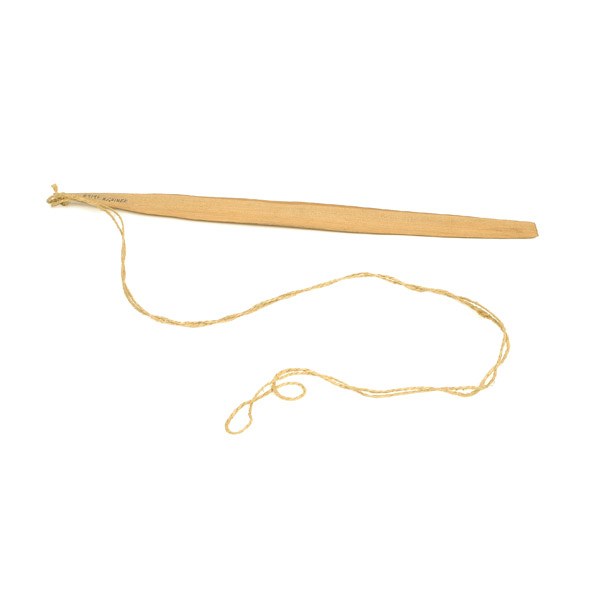
Source term: bullroarer
In the Chimbu valleys the sacred sound belonged to the flutes. The Kuman called them koa — a word that also meant menstrual blood and vagina — and told of a huge cassowary-like bird that lived in the woods and hatched its eggs under a big stone; a woman or child who saw the flutes risked deformity, and pigs that would go blind and waste away. The only Kuman women allowed near them were old women whose children were grown and who no longer looked after pigs or planted much sweet potato. The bullroarer had no such standing here: among the Kuman, as among the Gende to the north, it was a children's toy — the two exceptions Hays found, at the western edge of the instrument's Highlands range.
In the Highlands, only in Gende (Aufenanger 1979: 83) and Kuman Chimbu (Bergmann 1971/2: 194) did bullroarers have a non-sacred status, viz., that of children's toy.
Hays 1986:439 (Anthropos 81), citing Bergmann 1971/2:194
Particulars
- Object
- A bullroarer used as a children's plaything among the Kuman of the Chimbu region.
- Function
- A children's toy, with no sacred status — unlike the strictly guarded Kuman koa flutes.