MARIKA1963-001 - artwork depiction
Mathaman Marika's Wawaluk lagoon painting
Australia - North-east Arnhem Land - Yirrkala
Restricted Candidate only
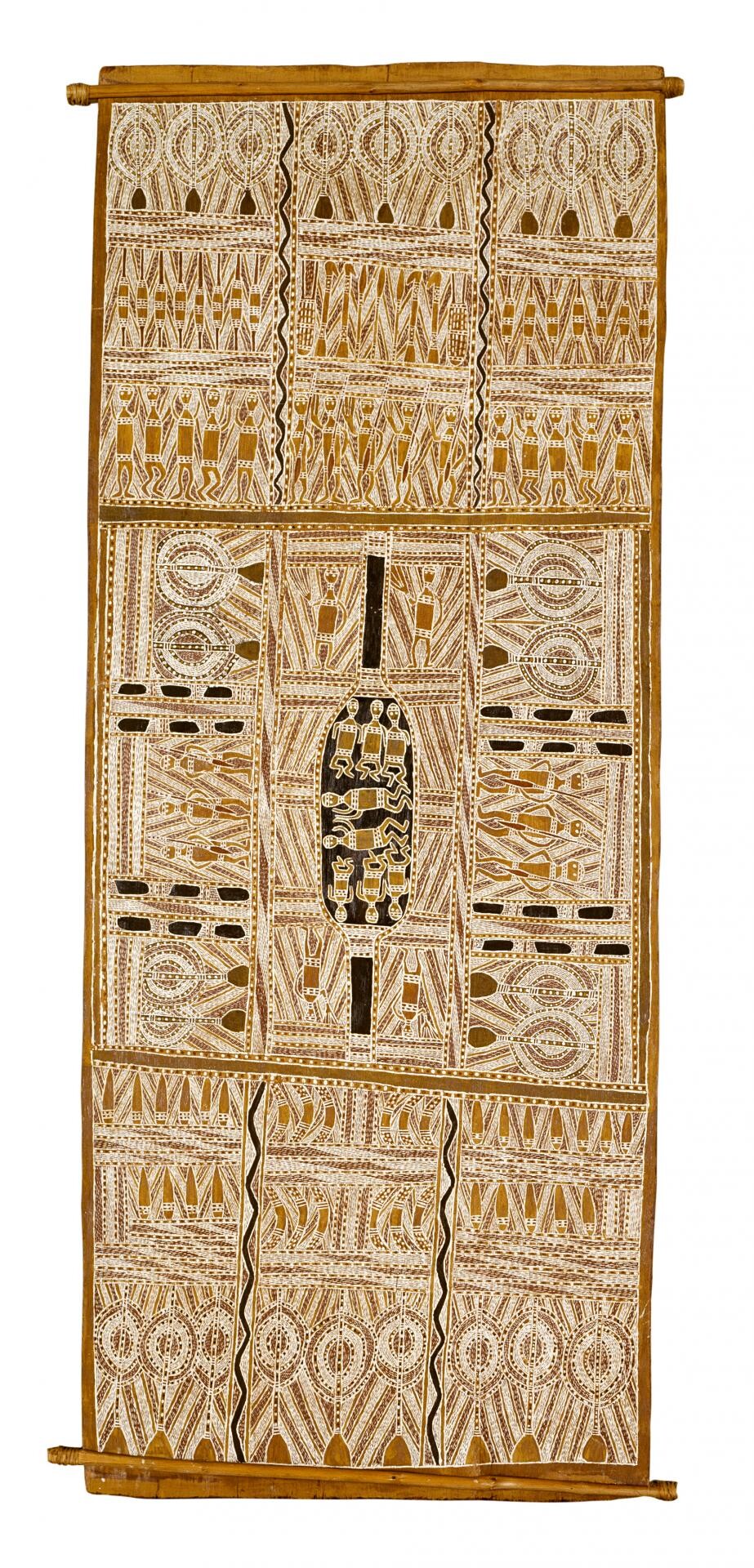
Source term: bullroarer (Davidson's English; no Yolngu object-name is published in the essay)
Wawaluk (also Wawilak, Wagilag): the ancestral sisters whose journey and swallowing by the great snake underlies the ceremonial complex depicted here. Kunapipi: the associated ceremony, rowed elsewhere in this atlas as AUSIN-014, AUSIN-015 and SPENCER1914-001. Mirramina: the sacred lagoon toward which the sisters' footprints run in this painting.
In 1963, at Yirrkala on the north-east coast of Arnhem Land, Mathaman Marika painted a lagoon in earth pigments on a sheet of bark. It is a map and a list at once: the water of Arafura Lagoon laid out flat, the black footprints of the Wawaluk sisters walking toward the sacred lagoon Mirramina, and around them the gear of the ceremony that follows their story. Among that gear, in the ceremony if not identifiably in the painting, is the bullroarer — which James Davidson describes as a blade a metre long, tied to a stick with string spun from human hair, the blade being the snake's body, the string its fangs, the sound its voice. Which mark on the bark is that instrument, nobody has said in print. The painting is here because it inventories the ceremony, not because anyone has yet pointed to the roarer in it.
These bullroarers are about a metre long and are fastened to a stick with string made of human hair.
James A. Davidson, "Mathaman: warrior, artist, songman", Art Bulletin of Victoria 29, NGV web republication
- Object
- A bark painting, not an instrument. Mathaman Marika, Arafura Lagoon, 1963, earth pigments on bark, 152.4 x 69.0 cm, National Gallery of Victoria accession 1512-D5. James A. Davidson's NGV essay reads the work as a stylised map of Arafura Lagoon and as "an inventory of artefacts used in the Wawaluk ceremony", with black footprints marking the Wawaluk sisters' route toward the sacred lagoon Mirramina. Davidson describes the Wawaluk/Kunapipi bullroarer itself as a metre-long snake-bodied blade fastened to a stick with human-hair string, the blade being the snake's body, the hair string its fangs and the sound its voice. He does NOT key any individual painted motif in this work as the bullroarer, and none is identified here. A closely related second version was painted in 1965 (152.0 x 61.5 cm, formerly recorded as the James A. Davidson collection); it is supporting evidence, not this row's object.
- Function
- Depicted ceremonial complex. Function is Davidson's account of the Wawaluk/Kunapipi bullroarer as a ceremonial instrument of that cult, not a datum recorded against any painted motif in this work.
- Source
- James A. Davidson, "Mathaman: warrior, artist, songman", Art Bulletin of Victoria 29, NGV web republication
- Source location
Page references
Davidson, Art Bulletin of Victoria 29, NGV web republication 18 June 2014, unpaginated; NGV accession 1512-D5
- Source confidence
- medium Yirrkala township anchor, the place where the painting was made in 1963. The depicted geography — Arafura Lagoon and the sacred lagoon Mirramina, some 200 km to the west in the Arafura Swamp — is deliberately NOT used as the anchor: the atlas anchors painted-depiction rows on portable objects at the object's own place of making or finding (BRODY1983-001 anchors the Mimbres bowl at the Mattocks site, not at the scene it paints), and no instrument is attested at Arafura Lagoon by this source. The row is candidate_only and carries no dot in any case.
Discussed in: From Ooldea to Ilahita · In the Beginning Was the Word · Myths That Remember Sahul · Nggwal: The Cult That Crossed Sahul · The Ritual That Made a Mind · The Seven Sisters and the Voice in the Dark
- Snake-linked