No. MUS2026-220Australia
Katherine River bullroarer with a human-hair loop
Australia · Katherine River district, Northern Territory
Restricted
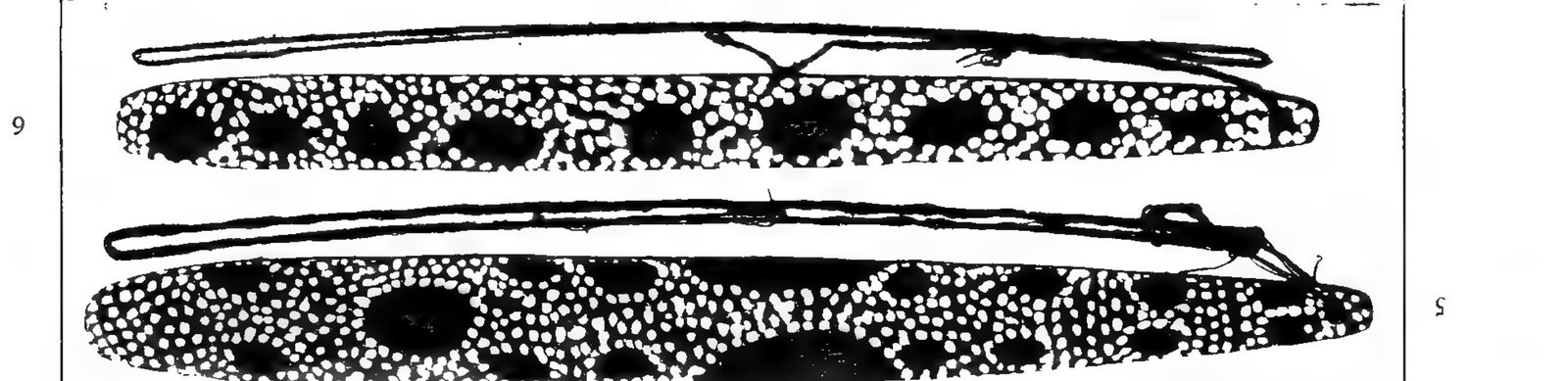
Source term: Bull roarer
Five hundred and eighteen millimetres of soft wood, sixty-six across, strung with a loop of human hair and painted with a pattern in blue. It came out of the Katherine River district sometime between 1871 and 1925, passed through Henry Wellcome's vast collection, and reached the Science Museum by transfer, slightly worn and insect-eaten by the time it was catalogued. Blue is an unusual pigment choice for the Top End, more often worked in ochre red, black and white. What a Katherine River bullroarer was for, Baldwin Spencer set down in 1914: after the operation the boy was shown the bullroarer, the Kunapippi, and told to say nothing to the women, who would be struck dead if they chanced to see it, and when the ceremony was over the old men carried it off to a secret place.
Bull roarer, made of wood with loop of human hair, decorated with painted blue pattern, slightly worn eaten, from Katherine River district, Australia, 1871-1925
Science Museum Group, catalogue description for object co104220 (accession A114984)
Particulars
- Object
- A blade of soft wood, 518 mm long and 66 mm at its greatest width, carrying a loop of human hair and decorated with a painted blue pattern. It is slightly worn and insect-eaten. A companion from the same district, Pitt Rivers 1900.55.276, is a smaller flat stick painted red, incised on both faces, with a long human-hair cord coiled into a ring.
- Function
- On the Katherine River the bullroarer was shown to the boy after circumcision and hidden from the women, who would be struck dead if they saw it; afterwards the old men put it away in a secret place.
Source
Science Museum Group, object co104220, accession A114984; Baldwin Spencer, The Native Tribes of Northern Australia (London: Macmillan, 1914), pp. 162-163