No. AUSMAIN-024
Mimikur bullroarer songs, Mount Gambier region
Southeast of South Australia (Mount Gambier, Lacepede Bay, lower Coorong); southern Ngarrindjeri-family country
Sacred / spirit
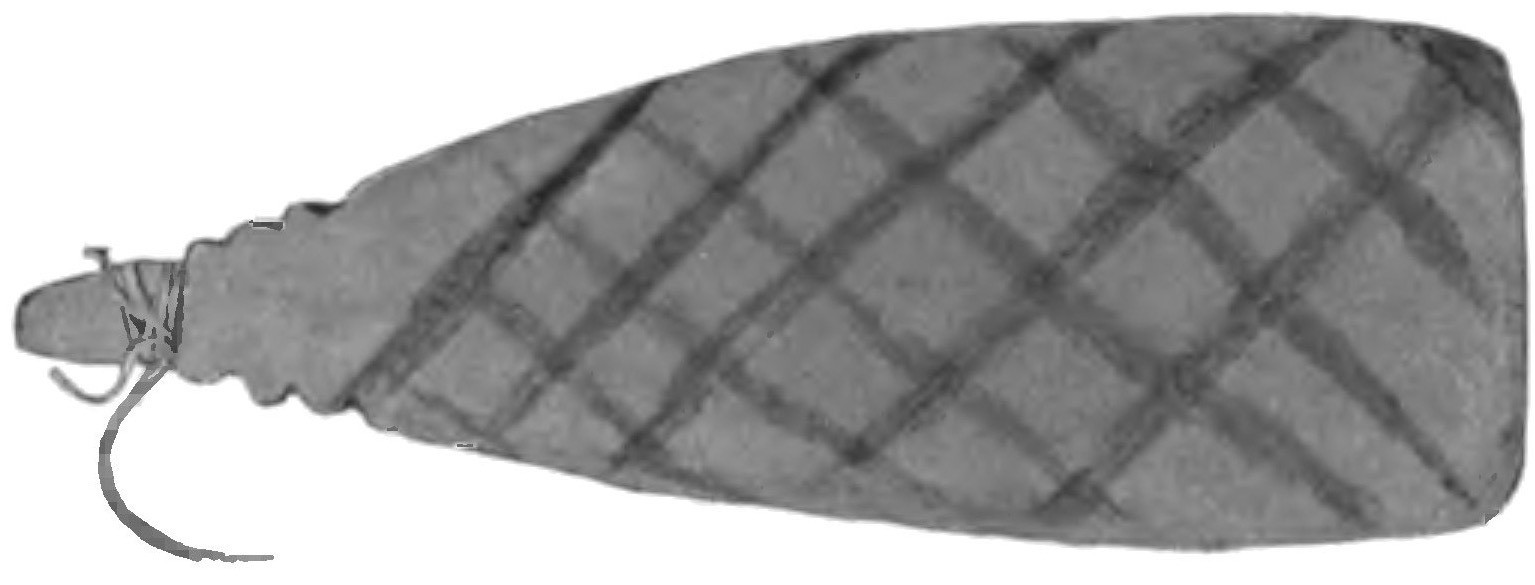
Mimikur
Source term: Mimikur (glossed "bullroarer" by Tindale); English "bullroarer"
Bunganditj / Ngarrindjeri-family term for the bullroarer, recorded by N. B. Tindale as the native name of the instrument whose song was sung.
In the far southeast corner of South Australia the bullroarer was the mimikur, and by the 1930s its songs were nearly all that remained of the local ceremony when Norman Tindale set up his recording gear. His informant, the Tanganekald man Clarence Long — Milerum — carried the song repertoires of several neighbouring peoples in his memory, and Tindale printed what he sang, words and all. The Meintangk mimikur song of 1932 runs 'Noala 'nala 'matu'weiangur 'kalaten / 'balinji:n 'jorankeinj 'noala 'nala / 'matu'weiangur 'manea 'ganda'lou / 'wolma'wia 'lawun 'geitjal 'konkinj / n'goreing n'gorein'gur — "that is her: Matu, a young woman, glancing, very free, standing about in sight of the young man." It is no love song: it is the first of a series sung in order to kill, its effect to bruise the victim and make him ill, and it came directly from the mythical being Gargum'bitj, also called Rupuli; the same song among the Buandik, or Bunganditj, of Mount Gambier was meant to kill outright. The Bunganditj song of 1937-38 tells of the ancestral woman Matujeire, who left her husband for another man — a bullroarer-magic-song sung whenever trouble between man and wife threatened boning and revenge killings, enacted as a dance and made topical with new names, and ended, as Milerum ended it, with the condemnation Ne'rokan! — "Die!" Tindale adds that the magician Dona'ganinj kept a mimikur hung in a katal, a "talking tree": spinning in the wind it frightened people away, and if he spoke a man's name to it, that man would sicken and might die.
'Matujeire 'wat paiju bayara ina: 'anjay 'koinja / 'mor 'wanunjup 'je:garam 'munungcin / 'weijan'gori dolamboinja anjenkoinja — Ne'rokan!
Matujeire [an ancestral woman's name] — came home at last — they have come together — the woman departs from the camp, seen by her husband — weijankar refuses — come back to her home — Die!
N. B. Tindale, "Native Songs of the South-East of South Australia" Part II, Transactions of the Royal Society of South Australia 65 (1941), pp. 236-237; sung by Milerum (Clarence Long), recorded 1937-38, SA Museum AA 338/11/12, Disc 4, Track 19.
Particulars
- Object
- No slat survives: the mimikur is known from its songs, which Milerum sang onto wax cylinder and acetate disc. The instrument named is the flat whirled-slat bullroarer of the southeast Australian type.
Source
N. B. Tindale, "Native Songs of the South-East of South Australia," Transactions of the Royal Society of South Australia 61 (1937), pp. 111-112, 119, and Part II, 65 (1941), pp. 236-237; South Australian Museum, Norman B. Tindale collection, recordings of Clarence Long (Milerum), AA 338/11/5 (1932) and AA 338/11/12 (1937-38)