No. NGUINEA-016
Banko lanqua, Banko the Old
Papua New Guinea · Morobe (former German New Guinea · Nordost-Neuguinea) · Oceania · Sahul
Restricted
banko lanqua
Source term: Schwirrholz
banko lanqua: individually named bullroarer bearing the attribute lanqua 'old' - among the neighbouring Tami this honorific is also a mark of esteem for eminent men, while the Bukawa apply it to bullroarers deserving special respect (Bukawa, Huon Gulf); Bamler 1911: 497 (Tami) and Lehner 1911: 410ff (Bukawa), via Gourlay 1975: 23. | balum li: the generic Bukaua word for the bullroarer, named for its blattaehnlich, leaf-like form (short form balum). | abumtau: a clan's ruling roarer, inherited and guarded by the balum muki. | ngasengomi: the 'serving' roarers, also named for the dead but of concern only to the actual descendant. | auwi lanqua: small high-voiced roarers speaking for the balumsfrauen, the wives of the ruling roarers - explicitly distinguished by Lehner from the ngasengomi. | saling: lanceolate wooden ornaments worn at the Balum feast, not sounded (Lehner 1911: 411-412).
Etymology. The second element is the attribute lanqua, 'old', an honorific which on this coast is applied both to eminent men and to bullroarers deserving special respect; Huon Gulf bullroarers also carry individual names, and the balum songs Neuhauss recorded among the Bukaua speak of individual bullroarer-spirits such as Tango yabo lanqua and Gumba lanqua. Banko is this instrument's own name, giving 'Banko the Old'.
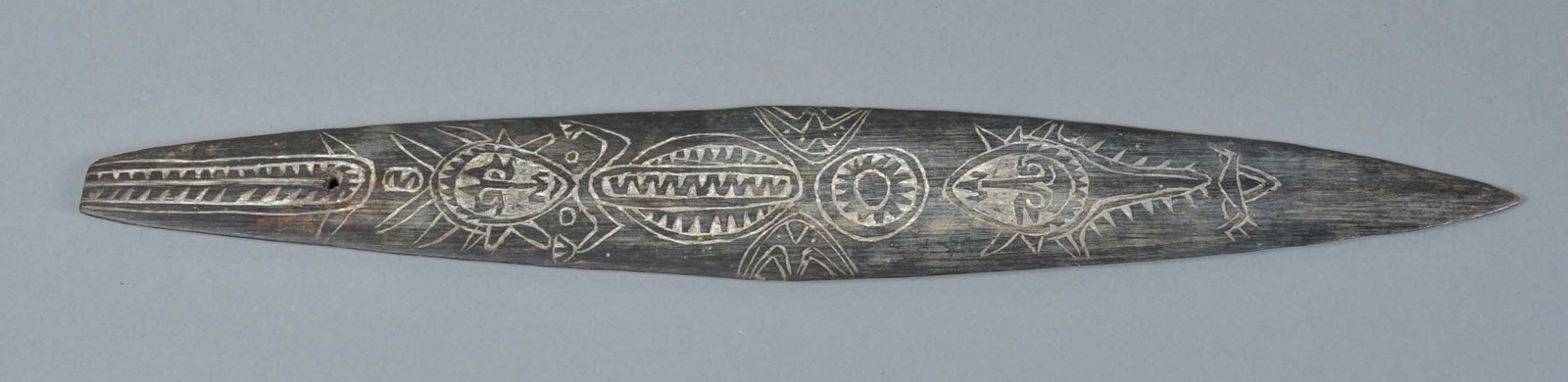
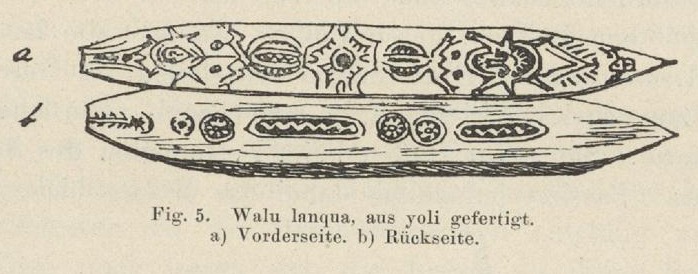
Banko lanqua - "Banko the Old." Among the Bukaua of the Huon Gulf each clan's ruling bull-roarer bore a dead man's name joined to lanqua, "the Old One," and the name doubled as the clan's war-cry, shouted in war, at pig-netting, at the pig market and at the girls' consecration; a man whose roarer was Tango yabo lanqua would never side with the party whose roarer was Nombu lanqua. The likeness to the dead man could be exact. Gumba the Old was carved with two humps for Gumba's protruding hip-bones, and at the village of Uwaung the roarer named for Wabo was hung deliberately askew on its cord so that it rasped instead of humming, because Wabo had a mutilated nose and spoke indistinctly. On the blades themselves Stefan Lehner got the old carvers to explain the ornament: a little sea-snake and a beetle grub warning that these delicacies must not be eaten, a butterfly for the message that travels landward and seaward alike, a scorpion that stings unseen, a spirit carrying fire to expose the man who tells, a spiny pandanus leaf nobody goes near - and, almost never absent, the eye of the abo fruit, which grows strong and seed-bearing only once it is broken from the stalk, as the boys are broken from the tree by circumcision. At circumcision hidden roarers gave voice to the monster balum, said to swallow the boys and hand them back as men. This 44-centimetre blade reached Berlin in 1910 from the physician-ethnographer Richard Neuhauss, its own old man's name still on the catalogue.
Schwirrholz, einheimische Bezeichnung "banko lanqua"
Bullroarer, indigenous designation "banko lanqua"
Ethnologisches Museum, Staatliche Museen zu Berlin, inv. VI 29955
Particulars
- Object
- A long, thin wooden blade, 44 cm long, 6.5 cm wide and 1.5 cm thick, classed by the Berlin museum as a Schwirrholz (bullroarer) and recorded under the indigenous name "banko lanqua". Collected in the Bukaua district on the Huon Gulf and acquired by purchase from the physician-ethnographer Richard Neuhauss in 1910. Bukaua roarers of this class were cut from yoli, abui, abong (Afzelia) or nip (coconut wood) and carved with a glossed motif programme - among them a little sea-snake, a beetle grub, a butterfly, a scorpion, a pandanus leaf and the eye of the abo fruit.
Source
Ethnologisches Museum, Staatliche Museen zu Berlin, VI 29955 (Bukaua, Huon Gulf; collected by Richard Neuhauss, acquired 1910); S. Lehner, 'Bukaua,' in R. Neuhauss, Deutsch Neu-Guinea, vol. 3 (1911), pp. 410-413 and figs. 5-16