No. SG1899-001
Arunta churinga bullroarer complex
MacDonnell Ranges · Alice Springs region · Central Australia
Restricted

Churinga / Churinga irula
Source term: Churinga or bull roarers
Churinga irula = "dressed wood" (Spencer & Gillen 1899:143), the small bored, hair-strung wooden churinga used as the bull-roarer proper. Namatwinna, a small love-charm churinga, from nama "grass" + twinjia "to strike," because it is first struck against the ground before being whirled (p. 541).
Etymology. Churinga implies something sacred or secret, naming both the object and the sacred quality it possesses.
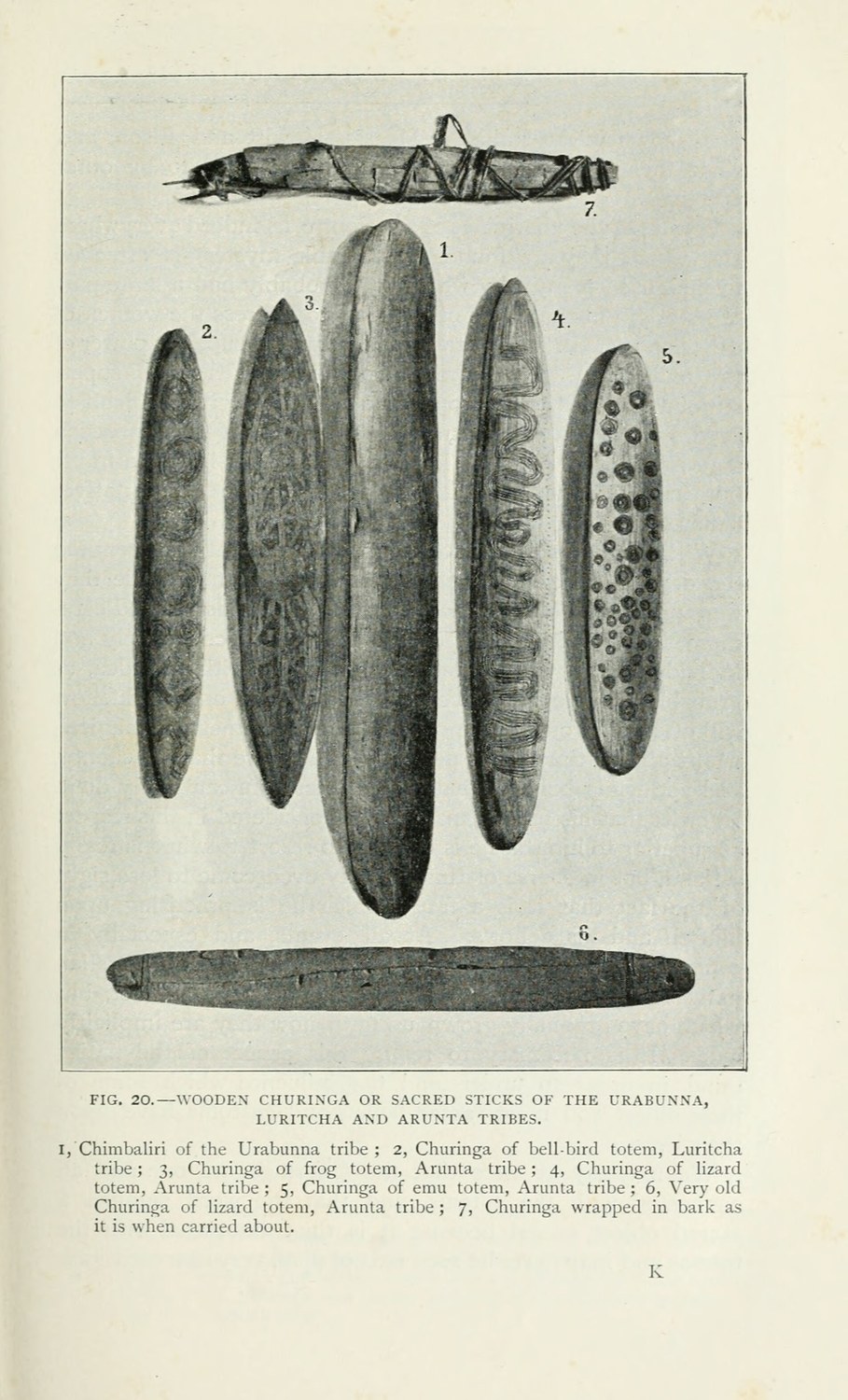
Among the Arunta of the MacDonnell Ranges, the sacred objects called churinga could be seen by women or uninitiated men only on penalty of death, or of being blinded with a fire-stick. Spencer and Gillen, working in the Alice Springs district in the 1890s, described two kinds: flattened stones and wooden slabs, often incised, kept hidden in storehouses among the rocks. Each churinga was held to contain the spirit part of an ancestor of the Alcheringa, the far-off creation time; the ancestor's body died and a rock or tree rose to mark the place, but his spirit remained in the stone. The smaller wooden ones, bored at one end and strung with human hair or opossum-fur string, were the bull-roarers proper, called churinga irula, "dressed wood." One small type, the namatwinna, took its name from nama, grass, and twinna, to hit, because when whirled it was first made to strike the ground. When the sound rose around the ceremonial ground during a boy's initiation, the women were told it was the voice of the great spirit Twanyirika, come to carry the boy away.
Those that are bored in this way and are only a few inches in length are used as bull-roarers during certain ceremonies, the sound being produced by whirling them rapidly round with the string kept taut between the hand and the bull-roarer ... During the whole time the bull-roarers were sounding all round so loudly that they could easily be heard by the women and children in their camp, and by them it is supposed that the roaring is the voice of the great spirit Twanyirika, who has come to take the boy away.
Spencer & Gillen 1899, The Native Tribes of Central Australia, pp. 143, 246
Particulars
- Object
- Sacred churinga include flattened stones and wooden slabs; smaller bored examples with hair or opossum string are used as bullroarers in ceremonies.
- Function
- Restricted sacred totemic objects; some are sound-making bullroarers used in ceremonies and tied to ancestor/spirit-person associations.
Source
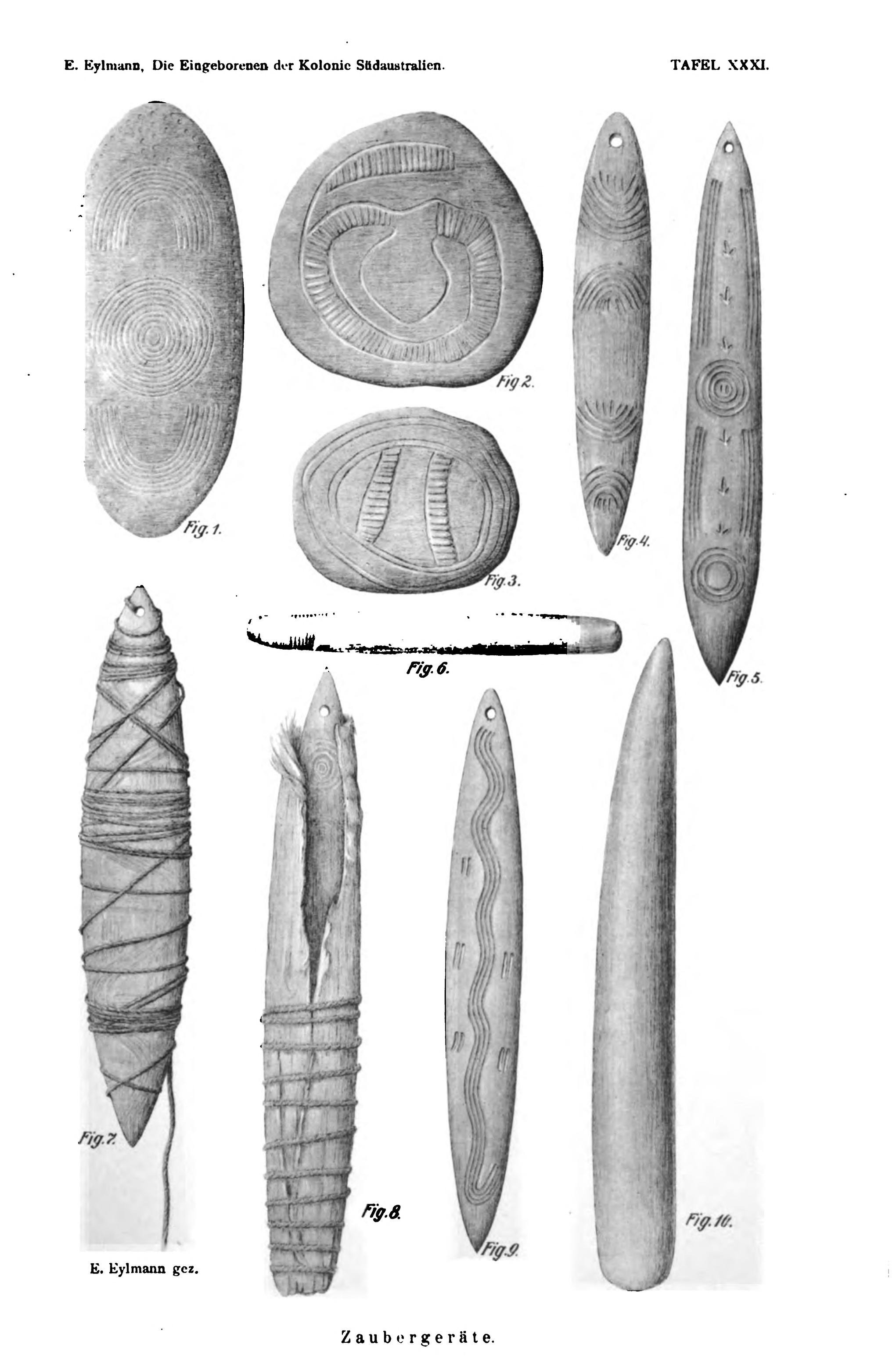
Baldwin Spencer and F. J. Gillen, The Native Tribes of Central Australia (London: Macmillan, 1899), ch. V, pp. 128-144, ch. VII and ch. XVI; E. Eylmann, Die Eingeborenen der Kolonie Südaustralien (1908), pl. XXXI figs. 4, 5 and 9