No. FRAZER1913-013
Anula Gnabaia bullroarer
Australia · Western Gulf of Carpentaria
Restricted
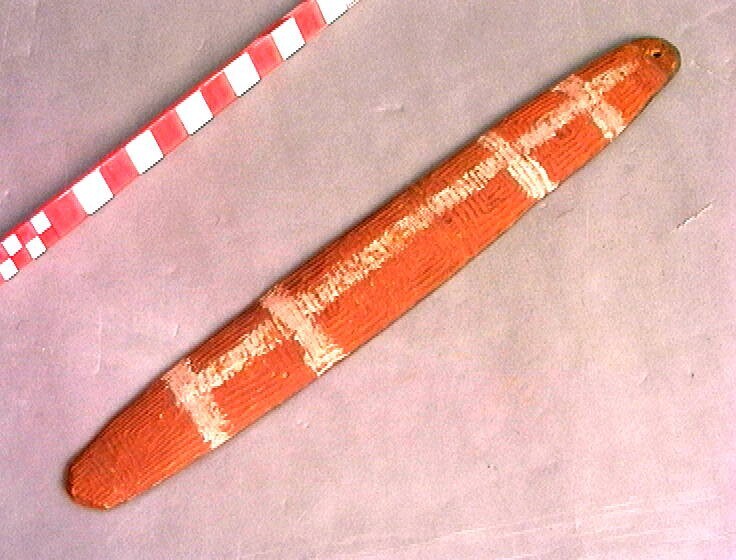
mura-mura; Wi-dirpi
Source term: sacred stick / bull-roarer
mura-mura and Wi-dirpi: the two Anula names for the bull-roarer; mura-mura is the sacred stick given to a newly subincised youth.
Etymology. Mura-mura is the Anula name for the sacred bullroarer presented to a newly subincised youth, described to him as kurta-kurta (tabooed) and, in Anula tradition, first made by the whirlwind; after the boy is struck on the back with it, the slat is buried in a hole representing a spot where the whirlwind totem emerged from the earth. Women and children were taught its roar was the voice of the great spirit Gnabaia, who swallows and afterwards disgorges the boy as an initiated youth.
Among the Anula of the western Gulf of Carpentaria, a newly subincised novice was handed a sacred stick, the bull-roarer called mura-mura. He was told it had been made, in the first instance, by the whirlwind, that it was kurta-kurta (tabooed), and that it must on no account be shown to women or children. The women and children took its roaring for the voice of a great spirit named Gnabaia, come to swallow the boy up and afterward disgorge him in the form of an initiated youth. Gnabaia, in Anula belief, was a pair of spirits who arose in the Alcheringa at Wuntirri on the Robinson River and went up into the sky, hostile to people, watched by a third, friendly Gnabaia living in the woods; the medicine men, who alone could see them, would "sing" to the earthly one to come and heal a sick man. At the close of the whirlwind ceremonies the initiated boy was struck on the back with the sacred mura-mura he had carried through his time in the bush; the stick was then laid in a hole, the soil heaped over it, and there it was left. Spencer and Gillen add two details that place the Anula deep in serpent country: the tribe's own name for its whole body of sacred ceremonies was kunapipi — the name of the Mother cult whose central being is the Rainbow Serpent — and when the ceremony of the snake totem Ulanji was to be performed at Karrimurra, a man first went out and swung the bull-roarer to warn the women and children away from the ground.
[The sacred sticks] are only much in evidence during initiation, when one is given to the boy to carry about, partly for the purpose of assisting in the healing of the wound, and partly to be twirled round so as to warn off the women and children who must not come near to him.
Spencer & Gillen 1904, The Northern Tribes of Central Australia, p. 280
Particulars
- Function
- Initiation spirit-voice bullroarer with swallowing/disgorging belief and women/children taboo.
Source
Baldwin Spencer and F. J. Gillen, The Northern Tribes of Central Australia (London: Macmillan, 1904), pp. 280, 372-373 and 501