MUS2026-231 - museum specimen
Cossack bullroarer
Pilbara - north-west coast, Western Australia
Sacred / spirit
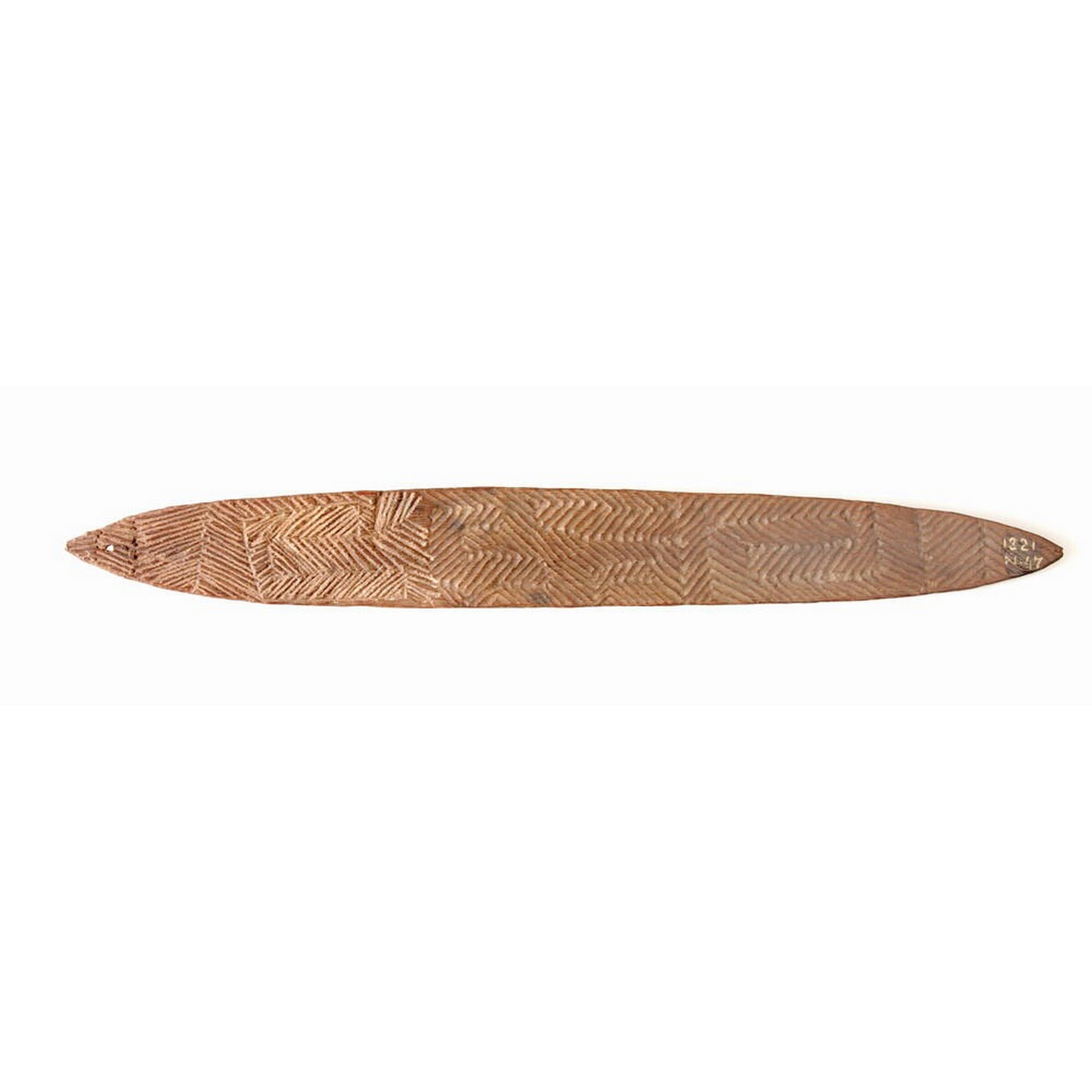
boonangharry / burnangarra
Source term: bull-roarer
boonangharry / burnangarra / banangari: the Pilbara (Ngayarta) name for the bullroarer, glossed devil-scarer by Clement; recorded for Cossack's own Ngarluma by Bates (Roebourne vocabulary).
Somewhere between Cossack and the foot of the Hamersley Range, a wooden bullroarer entered the British Museum before 1896 as simply 'bull-roarer of wood' — the bare label is nearly the whole record. The register's phrase is, almost word for word, the country Emile Clement collected through in the 1890s, and he wrote down what the blades there were for: set in motion over the sick while the doctor circled the patient, swung at a death to drive away the djuno who caused it, and swung through the camp at the circumcision gathering. He called them cora or bonangharry, devil-scarers, and a Ngarluma man of Roebourne gave Daisy Bates the same word, burnangarra, for the small sacred board.
Found/Acquired: Cossack, 'Between Cossack and foot of the Hammersley Range'. (?)
British Museum collection record, museum number Oc1896,-.1066, findspot field
- Object
- A wooden bullroarer recorded by the British Museum before 1896. No dimensions, cord, decoration, or image accompany the record on the museum's catalogue page.
- Source
- British Museum, museum number Oc1896,-.1066, object type "bullroarer", description "Bull-roarer of wood.", production date "19thC (before 1896)", materials wood; both are reproduced as found; No collector, donor, ethnic attribution, dimensions or local name appear on the record
- Source location
- British Museum Oc1896,-.1066
- Source confidence
- low to medium Cossack townsite on the Pilbara coast, chosen as the anchor because it is the more specific of the two findspots the museum records and because the register phrase, "Between Cossack and foot of the Hammersley Range", runs inland from it. Both findspots carry the museum's question mark, so this is the more specific of two uncertain readings rather than a located findspot.
- Initiation rite
- Death and rebirth