No. MUS2026-040
Purliwarna of the Birdarra Law
Pilbara · Western Australia
Restricted
purliwarna
Source term: bull-roarer
bullroarer (swung)
Etymology. purliwarna is glossed plainly as 'bullroarer' in Wordick's Yindjibarndi dictionary; the entry cross-refers to parnangarri ('animal horn') but gives no transparent word-for-word derivation. A separate small decorated form, the ornamental kilirr, is distinguished, and the earlier museum tag 'churinga' — an Arrernte loanword absent from Yindjibarndi — is rejected.
Purliwarna: a bull-roarer of the Yindjibarndi of the Fortescue River valley in Western Australia's Pilbara, accessioned by the Pitt Rivers Museum in Oxford in 1924 and classed as a ceremonial object. Such instruments belong to the restricted men's law of the region — for the Yindjibarndi, the Birdarra Law, the annual ceremony in which uninitiated boys are put "through the law" and the Burndud song-cycle is danced and sung in a language no longer spoken in the Pilbara. When the people pressed their native-title claim in the Federal Court, a portion of that ceremony was given as secret men's evidence in a closed session at Bangkangarra; the participants explained its significance in the confidential hearing, but the public reasons set out only that it had been performed, not its content.
the Yindjibarndi observe the defining ritual of making uninitiated (mostly young) males pass formally into manhood by “going through the [Birdarra] law” in an annual ceremony. The secret men’s evidence given at Bangkangarra during the hearing comprised a portion of that ceremony.
Rares J, Warrie (on behalf of the Yindjibarndi People) v State of Western Australia [2017] FCA 803, at [39], quoted in Davies 2021:31
Particulars
- Object
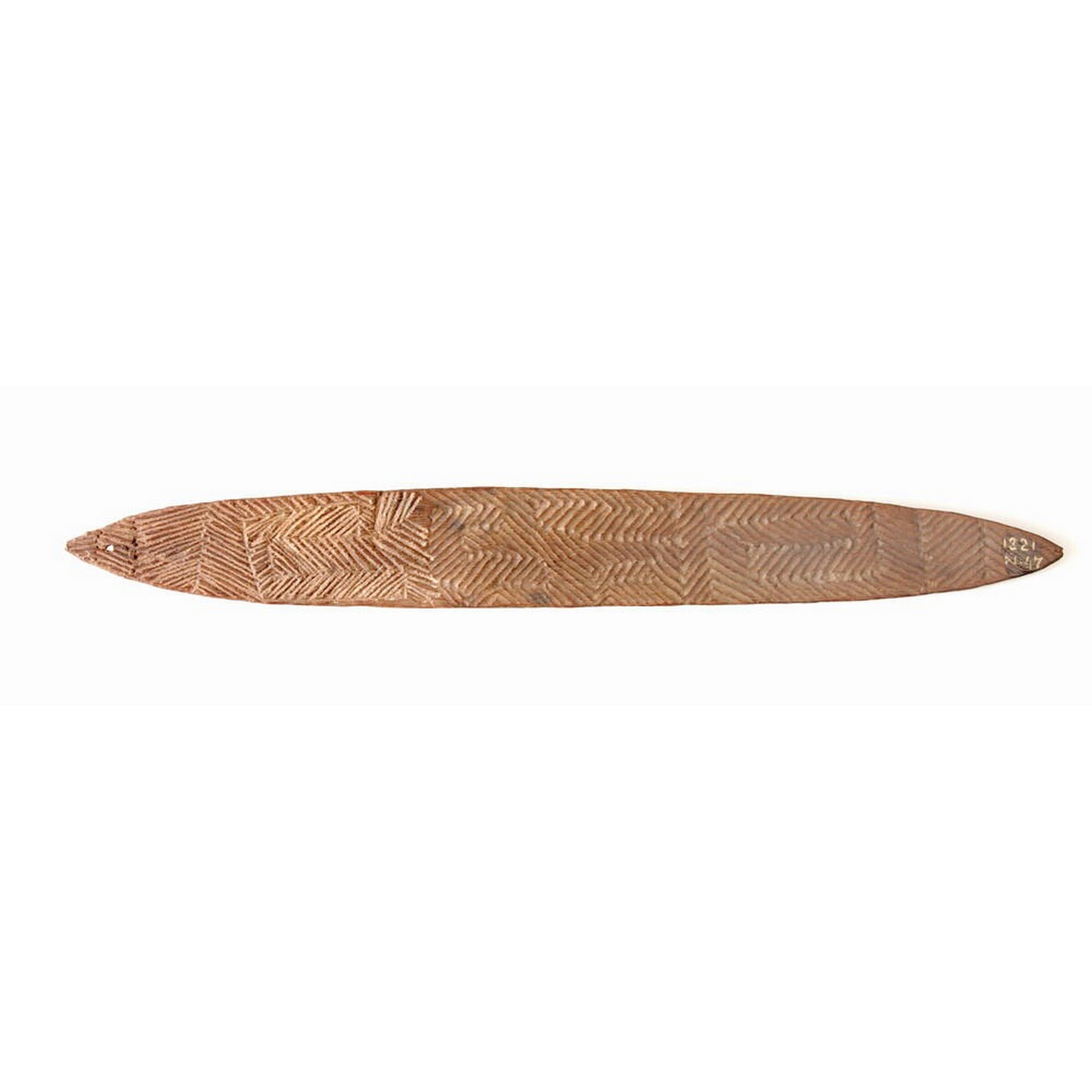
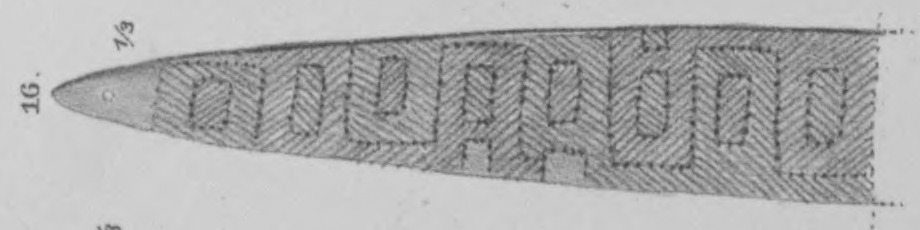
- Yindjibarndi bullroarers include PRM 1924.63.20 and exact Wereldmuseum RV-1321-47, a 33 x 4 cm incised wooden slat acquired in 1901 with one terminal hole. Its pair in the Clement collection at Leiden, inv. 1321/48, is a forty-one-centimetre blade cut with a meander and rectangles set into the bends; Clement drew it as figure 16 of his plate and names it among the boonangharries swung over the sick. Two more incised blades came to Oxford in the same 1924 purchase from Clement's collecting: 1924.63.21, broad, 37.3 by 5.3 centimetres, and 1924.63.22, a narrow strip 16.7 by 2.6.
- Function
- Restricted Birdarra Law instrument; the Wereldmuseum record also documents healing, driving away dangerous djuno after death, circumcision sounding, and an approach warning so young women and children could hide.
Sources
- Pitt Rivers Museum, Oxford, object 1924.63.20 View · archived
- Pitt Rivers Museum, Oxford, objects 1924.63.21 and 1924.63.22
- Wereldmuseum, object RV-1321-47
- Rares J, Warrie (on behalf of the Yindjibarndi People) v State of Western Australia [2017] FCA 803, [39], quoted in Davies (2021), p. 31
- Davies (2021), p. 31, quoting Warrie [2017] FCA 803, [39]