No. AUSMAIN-033
Iliaura (Alyawarre)
Upper Sandover River region, north-east of the MacDonnell Ranges, Northern Territory (Iliaura · Alyawarre country, immediately north of the Arunta) · Central Australia
Restricted
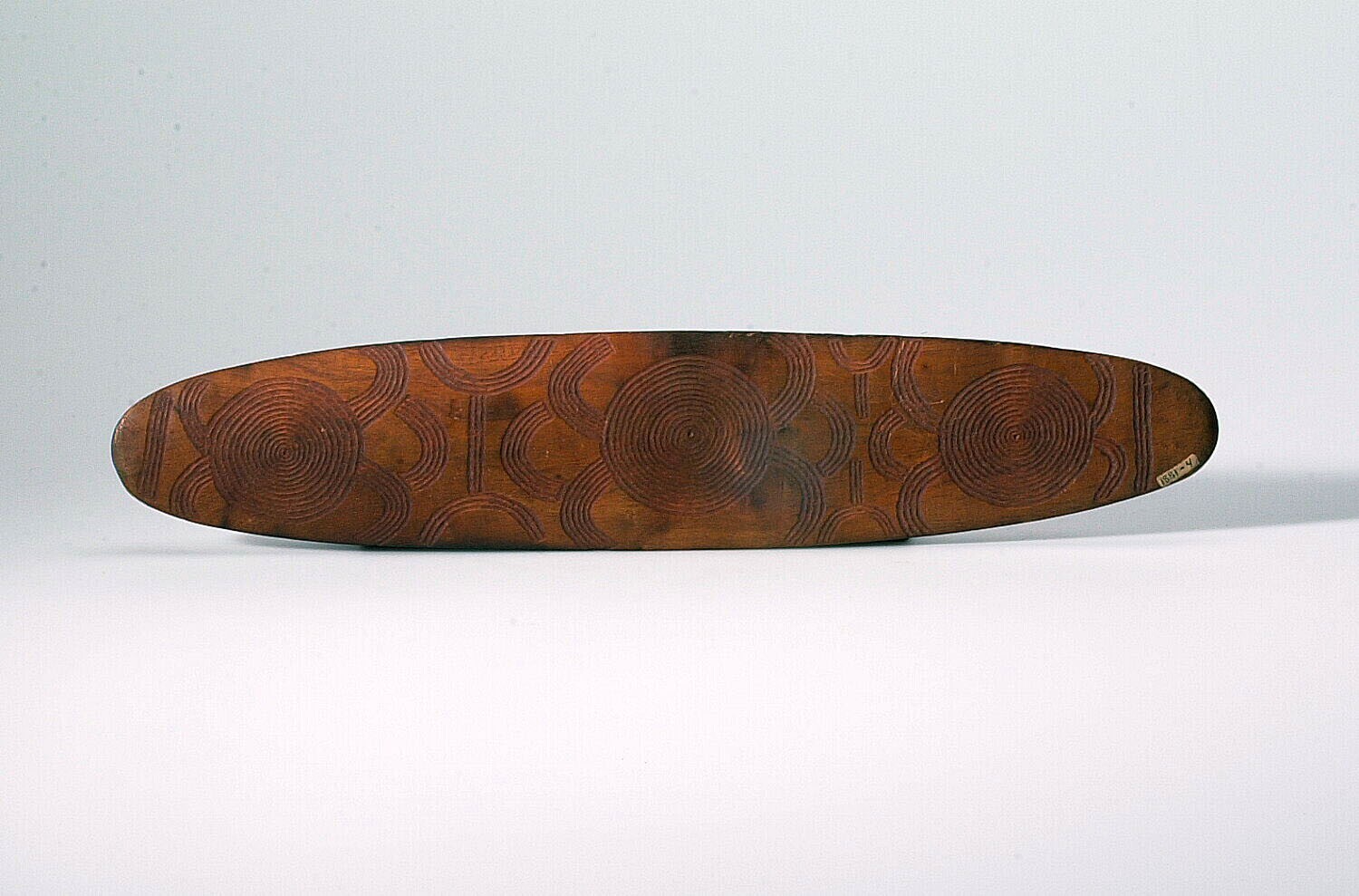
churinga
Source term: Churinga
Churinga: the Arandic name for the sacred slab whirled as a bull-roarer, "the equivalent of the bull-roarer or whirler of other authors"; each churinga is also the resting-place of an ancestral spirit-part.
Etymology. Churinga means 'sacred' or 'secret': as a noun it denotes a sacred emblem -- the whirled stone or wooden slab -- and as a qualifier it marks sanctity (aritna churinga, a man's 'sacred name'). It is a term of secret-sacred status, not a sound- or weather-word.
In the heart of the continent, Spencer and Gillen placed the Iliaura — the people now known as Alyawarre, on the upper Sandover country north of the MacDonnell Ranges — among the four tribes whose sacred churinga they called the very "home of the Churinga." These wooden and stone slabs, the smaller "popularly spoken of as bull-roarers," were pierced and whirled on a hair-string to roar during the making of men. The women were taught the sound was the voice of the spirit Twanyirika, who carried the boy off into the bush after the operation and gave him back an initiated man; to look on a churinga at all was forbidden them on pain of death. The two ethnographers, working a generation before the Sandover was mapped, listed the Iliaura with the Arunta, Ilpirra, and Unmatjera as sharing one deeply guarded complex.
The very central part of the continent occupied by the Arunta, Ilpirra, Iliaura, and Unmatjera tribes may be described as the home of the Churinga and of the beliefs which cluster round this sacred object.
Spencer, B. & Gillen, F.J. (1904), The Northern Tribes of Central Australia, p. 257.
Particulars
- Object
- A wooden (and, among the southern heartland groups, stone) slab of churinga form, pierced at one end and whirled on a hair-string cord so that it rotates and roars; Spencer and Gillen describe the smaller of these objects as "popularly spoken of as bull-roarers" and gloss churinga as "the equivalent of the bull-roarer or whirler of other authors." Among the neighbouring Warramunga the bull-roarer-shaped wooden churinga is separately named murtu-murtu.
- Function
- Whirled as the voice of the spirit Twanyirika during male initiation; the women are taught the roar is the spirit who takes the boy into the bush after the operation and returns him an initiated man.
Source
Spencer, B. & Gillen, F.J. (1904). The Northern Tribes of Central Australia; London: Macmillan; Ch. VIII "Churinga and Allied Objects," pp. 257-258, 275-276, 281. Background: Spencer & Gillen (1899), The Native Tribes of Central Australia, Ch. V "The Churinga or Bull Roarers of the Arunta and Other Tribes," pp. 123-124 (churinga = bull-roarer/whirler; whirled-slat mechanism; women-taboo on penalty of death) and Ch. VII pp. 246-249 (the Twanyirika spirit-voice and death-rebirth belief, naming the Arunta, Iliaura and Luritcha)