No. EXH2026-048
Yaraikanna (umbalako)
Australia · Cape York tip (Somerset hinterland), Queensland · Cape York Peninsula
Restricted
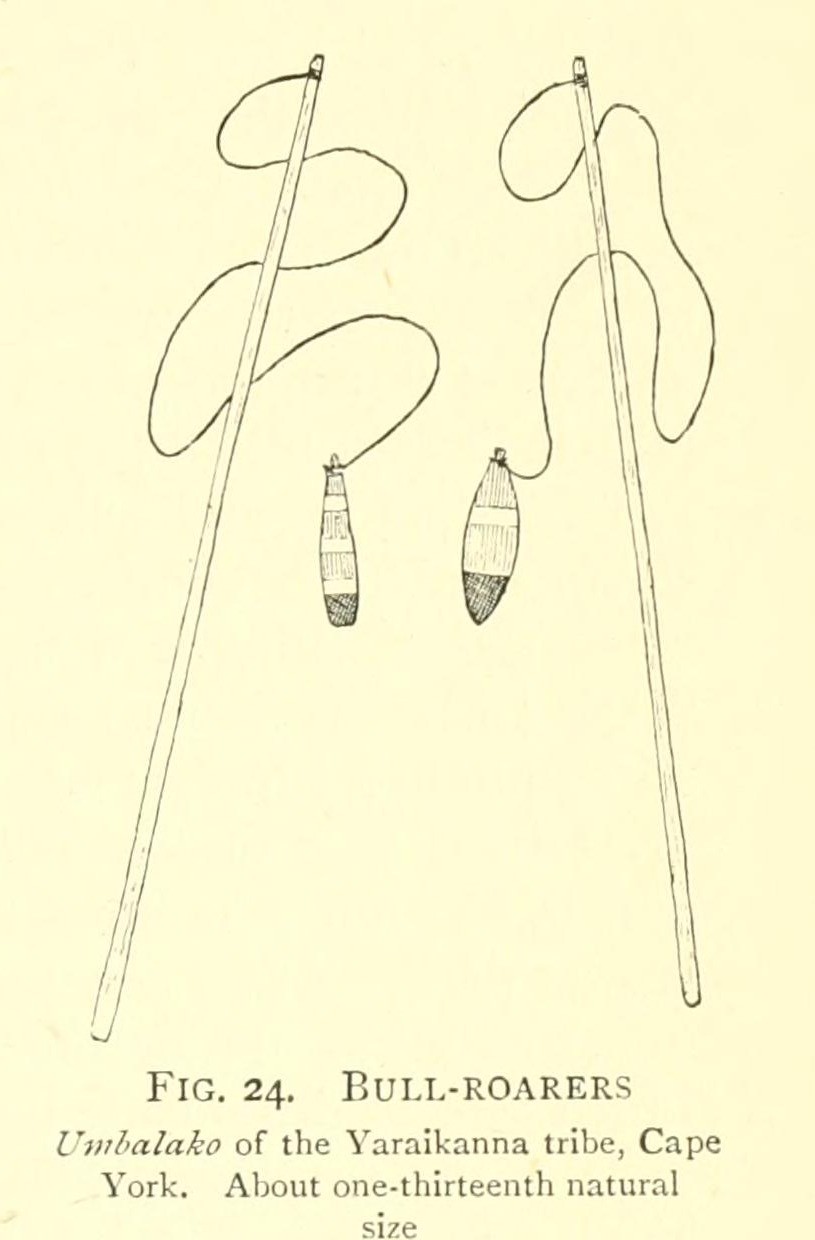
umbalako / iwaika (large); maumata (small)
Source term: umbalako (bull-roarer)
umbalako (also iwaika): the Yaraikanna name for the bull-roarer; a small one is maumata.
Etymology. umbalako, also iwaika, is the Yaraikanna name for the bull-roarer of the Cape York tip, recorded by Haddon from tribesmen in 1898: the large instrument of the old men was called umbalako or iwaika, the small one shown to the langa (novices) maumata. No literal meaning is recorded for any of the three names.
When Sarah the waitress carried out a cup of afternoon tea, the four Yaraikanna men deftly hid their bull-roarers; for a woman to see one would be a terrible sacrilege, and there was evident relief when she left. They had come to Thursday Island on a shelling boat in November 1898 and were sent to Haddon and Seligmann by Jimmy Matauri, a Thursday Island policeman of their own tribe. They called the instrument umbalako, promised to make some, and returned with examples 5 1/4 inches long, painted red, black, and white; having brought no sticks to swing them from, they were handed a broken box-lid, a tomahawk, and a knife to finish them. After dark, behind some sheds and not far from a steam merry-go-round grinding away for the Prince of Wales' birthday, they painted themselves and swung the bull-roarers, producing first the ordinary buzzing and then, with a sudden backward-and-forward turn of the hand, a penetrating yelping "Bow-wow!" they said no white man had ever seen before. The instrument was swung for the langa, the secluded initiates, before a front tooth was loosened with a kangaroo bone and a stone and tapped out, the names of the lad's mother's countries called with each blow, the one named as the tooth broke away becoming the land he would belong to. Haddon's later report distinguished a large form for the old men, umbalako or iwaika, from a small one, maumata, for the boys.
After the food-throwing ceremony the bull-roarers are whirled and shown to the langa in the day-time and the latter hang their heads.
Haddon 1904, Reports of the Cambridge Anthropological Expedition to Torres Straits, vol. V, p. 220
Particulars
- Object
- Two size-classes: a large one for the old men (umbalako or iwaika) and a small one (maumata) for the boys.
- Function
- Swung before the novices at initiation, ahead of the knocking-out of a front tooth; no women or children were allowed to witness it.
Source
A. C. Haddon (ed.), Reports of the Cambridge Anthropological Expedition to Torres Straits, vol. V (1904), p. 220; A. C. Haddon, Head-Hunters: Black, White and Brown (1901), p. 191 and fig. 24