No. PNG38
Astrolabe Bay
Papua New Guinea · Madang · Oceania · Sahul
Restricted
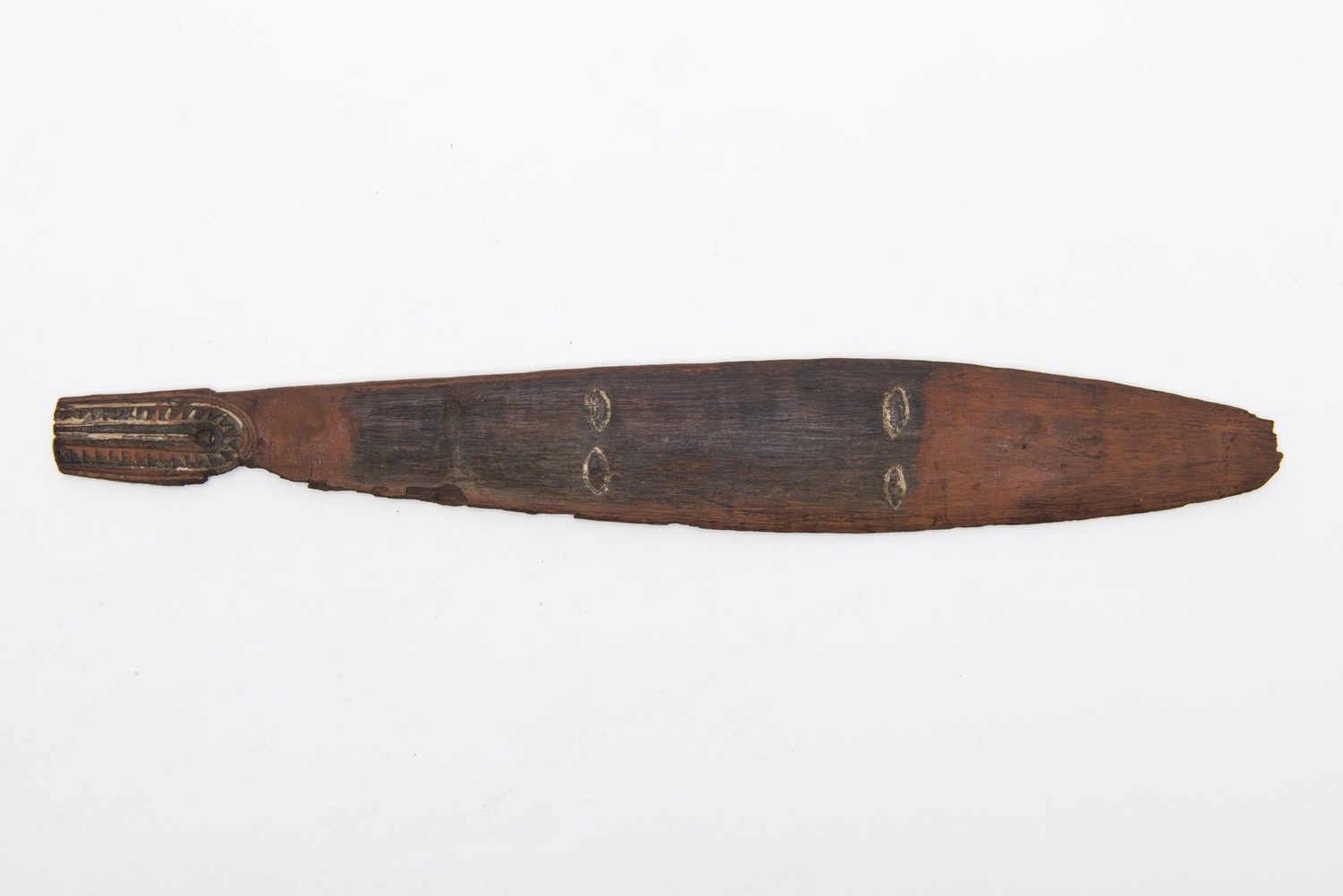
Tonde
On the coast of Astrolabe Bay, where the Russian Nikolai Miklouho-Maclay landed in September 1871, learned the Bongu language, and became the first European to do extended fieldwork in the region, the men voiced spirits through sound. Adult men blew paired long bamboo flutes, one male and one female, to make the cries of spirits for ceremonies in the coastal villages near the Ramu River, alongside the garamut slit-gong, shell rattles, and hourglass hand drums. Maclay's own list of Bongu instruments named the signal gong barum, the hourglass hand drum okam, the signal seashell, and the bamboo flute. The ritual life of the coast centered on carved ancestral figures called telum, monumental images of male and female forebears that each bore a name, were displayed at ceremonial feasts, kept in the men's meeting houses, and figured in the initiation of boys. Otto Finsch took the bay's bullroarers, the tonde, for lime spatulas; the circumcision festival showed what they were for — to keep the women from the ceremonial ground, hidden from their eyes in the bush.
Auf Bilia waren diese Spatel, sorgfältig in Tapa gehüllt, im Versammlungshaus verwahrt; die Eingeborenen schienen sie mit einer tabu-artigen Scheu zu betrachten und erlaubten Keinem das Anfassen.
At Bilia these spatulas were kept in the assembly house, carefully wrapped in tapa; the natives seemed to regard them with a taboo-like awe and allowed no one to touch them.
Otto Finsch, quoted in J. D. E. Schmeltz, "Das Schwirrholz. Versuch einer Monographie" (1896), p. 104
Particulars
- Object
- SMVK 1901.21.0431 is a bundle of five wooden Balom bullroarers from Astrolabe Bay, each a cord-through-one-end free-air blade, stored with a leaf bundle and wooden sistrum.
- Function
- Swung at the circumcision festival to keep women away from the ceremonies.
Sources
- K. A. Gourlay, Sound-Producing Instruments in Traditional Society: A Study of Esoteric Instruments and Their Role in Male-Female Relations, New Guinea Research Bulletin 60 (1975), table 1, entry 38 View
- Museum of Ethnography, Stockholm / SMVK, object 1901.21.0431; catalogue (1901), p. 136
- J. D. E. Schmeltz, "Das Schwirrholz. Versuch einer Monographie" (1896), p. 104, quoting Otto Finsch