No. HEIDER1970-001
Dugum Dani aneivu-aneivu toy bullroarer
Indonesia · Grand Valley of the Balim River, West New Guinea · West Irian · Oceania
Play / practical
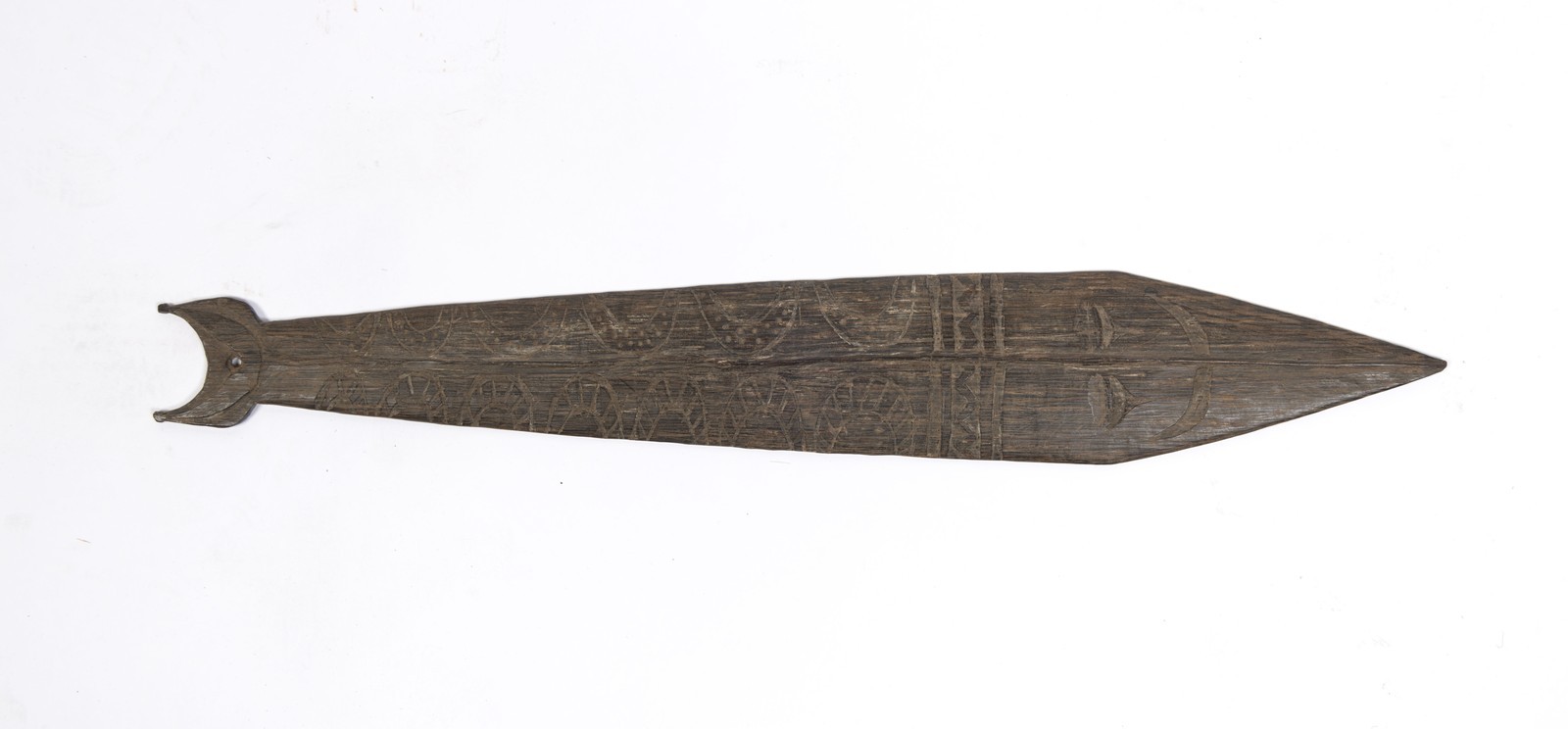
aneivu-aneivu
Source term: bull-roarer
aneivu-aneivu: Heider glosses ane as voice/noise and ivu as imitative; aneivu was also the term used for airplane.
Etymology. Heider analyses the name as ane, voice or noise, plus ivu, apparently an imitation of the noise — a reduplicated 'noise-imitator' for a boy's whirring toy. The same word aneivu had by the 1960s become the Dani term for the airplane; informants generally denied the toy any ritual significance, though one said it was to make the boy grow larger.
In the Dugum Dani highlands, Karl Heider watched a boy thread vine through a chip of wood, knot it, and swing it around his head until it whirred. Most informants called it a noise-game with no ritual importance; one person said it made the boy grow larger.
I once observed a boy make a "bull-roarer" of a chip of wood at the end of a thin vine
Heider 1970, The Dugum Dani, p. 199
Particulars
- Object
- A boy-made chip of wood with a thin vine threaded through a hole and knotted; whirled around the head to produce a whirring sound.
- Function
- Observed children's noise game / toy bullroarer; informants generally denied ritual significance, with one growth-making explanation.
Source
Karl G. Heider, The Dugum Dani: A Papuan Culture in the Highlands of West New Guinea (Viking Fund Publications in Anthropology 49, 1970), chapter 6 Art and Play, noneducational noise games section