No. FRAZER1894-002
Brisbane River initiation bullroarers
Australia · Queensland · Brisbane River
Restricted
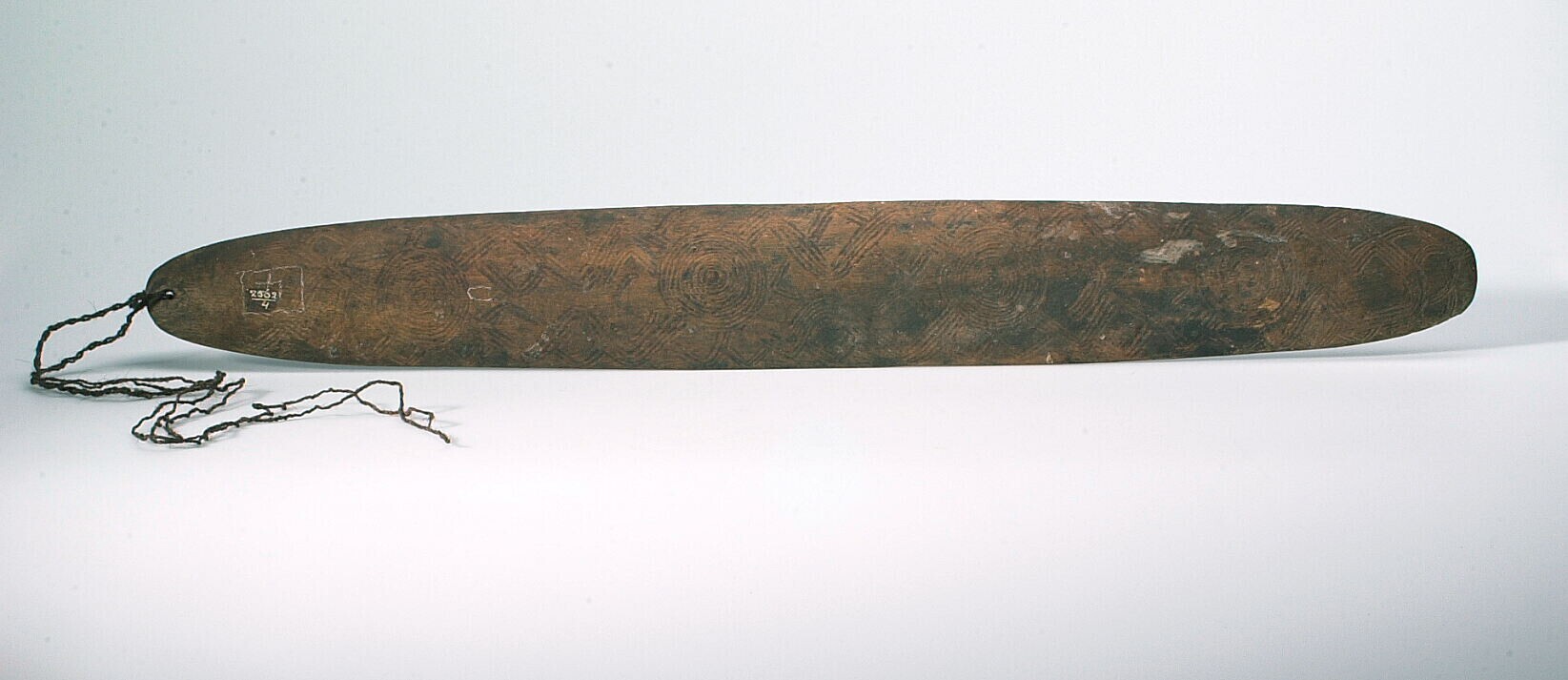
Bugerum / Wobblekum
Source term: bull-roarer
Bugerum and Wobblekum: the two Turrbal bull-roarers, Bugerum the deeper-voiced and louder, Wobblekum the smaller. In modern Yagara spelling they are bagaram, the large bullroarer, and wabalgan, the small one tethered to a whip.
Etymology. Among the neighbouring Chepara, Howitt glosses Bugerum as 'the medicine-man.' The larger Turrbal roarer bore the same name, and the women and children heard in its roar the medicine-men swallowing the novices.
In the Turrbal Kurbin-aii initiation on the Brisbane River, the women and children were told that the unearthly droning carried out of the bush was the sound of the medicine-men swallowing the novices. Two bull-roarers produced it. The larger, Bugerum, made a louder and deeper-sounding roar; the smaller, Wobblekum, was about four inches long by an inch wide and perforated. The rite ran for never less than three weeks and often much longer, and a woman who tried to spy on it would certainly have been killed. The boys who passed through it were afterward called Kippur, a word that white settlers later took up for any young Aboriginal man. A. W. Howitt recorded the account in The Native Tribes of South-East Australia in 1904.
The unearthly sounds made by the bull-roarers were believed by the women and children to be made by the medicine-men when swallowing the novices during the ceremonies.
Howitt 1904:596 (The Native Tribes of South-East Australia)
Particulars
- Function
- Restricted initiation sound identified with a death-and-return drama.
Sources
- A. W. Howitt, The Native Tribes of South-East Australia (1904), pp. 596-597, account from Cyrus E. Doyle View
- A. W. Howitt, 'On Australian Medicine Men,' Journal of the Anthropological Institute 16 (1887), pp. 47ff., cited by Frazer
- J. G. Frazer, The Golden Bough (1894), vol. II, p. 344
- J. G. Frazer, Balder the Beautiful (1913), p. 233