No. WILLIAMS1936-002
Gambadi thowatti, Kwavaru
Papua New Guinea · Western · Oceania · Sahul
Restricted
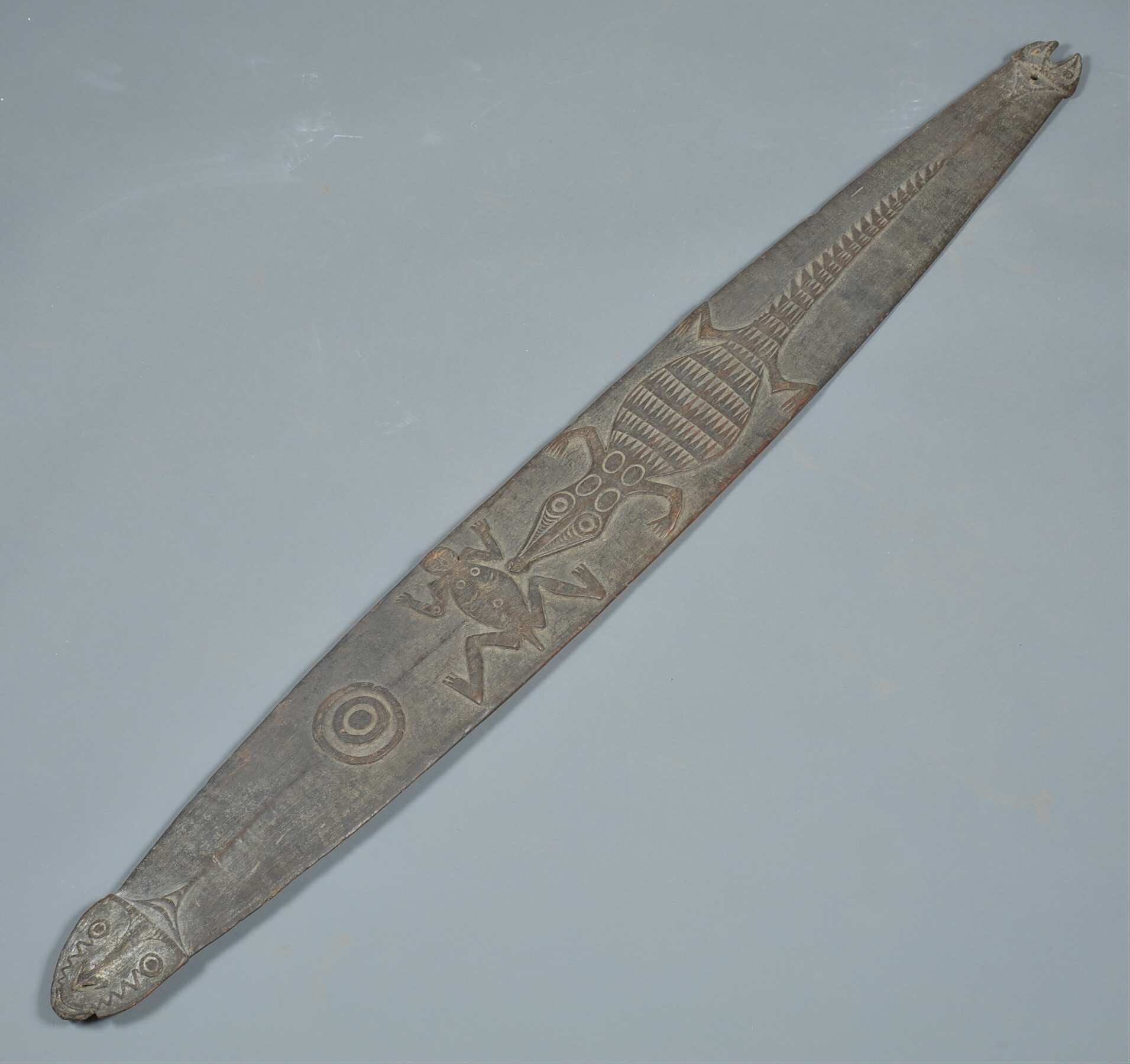
thowatti
Source term: bull-roarer
thowatti — the Gambadi word for the bull-roarer, glossed by Williams in the telling of its birth; cf. Keraki moiank and, at Setavi, sosa.
At Kwavaru — the place the Gambadi also call Kau, on the coast just east of the mouth of the Morehead — the bullroarer was not made but born. Tiv'r the Originator came from the west with his wife Engu, whose body would not admit him; his attempts left her pregnant all the same, not with a child but with the thowatti, which sounded faintly whenever she moved. He asked her again and again what the noise was, and she put him off — his dogs howling in the bush, she said — until he sent bird after bird in after it, and at last the little bird Serekute, threatened with death if he failed. Tiv'r stood by and shouted at his wife to sweep harder; as Engu bent, the point of the bullroarer showed, and Serekute swooped and tore it from her. She was left screaming on her back in her first menstrual blood while the bird carried the thing to its master, and Tiv'r hugged it to his breast and said that from then on it would belong to men alone. What follows in the telling is the search for a fibre strong enough to swing it, and then the first initiation, when he showed it to his son.
Among the Keraki this story retains the essential point that the bull-roarer (moiank) was taken from the woman's vagina.
F. E. Williams, Papuans of the Trans-Fly (1936), p. 308
Particulars
- Object
- The bull-roarer of the Gambadi, thowatti, swung on a fibre string.
- Function
- Charter myth of the male cult: the bull-roarer is born from the Originator's wife and taken from her body by a bird sent by her husband; the telling closes with the first initiation, at which Tiv'r shows it to his son. The same act draws the first menstrual blood, so one story charters both the men's cult and the origin of menstruation.
Source
F. E. Williams, Papuans of the Trans-Fly (Oxford: Clarendon Press, 1936), ch. XVI, 'Keraki Myths', pp. 307–308, and ch. XI, p. 181ff