No. FRAZER1913-011
Urabunna chimbaliri bullroarer
Central Australia · Lake Eyre region
Restricted
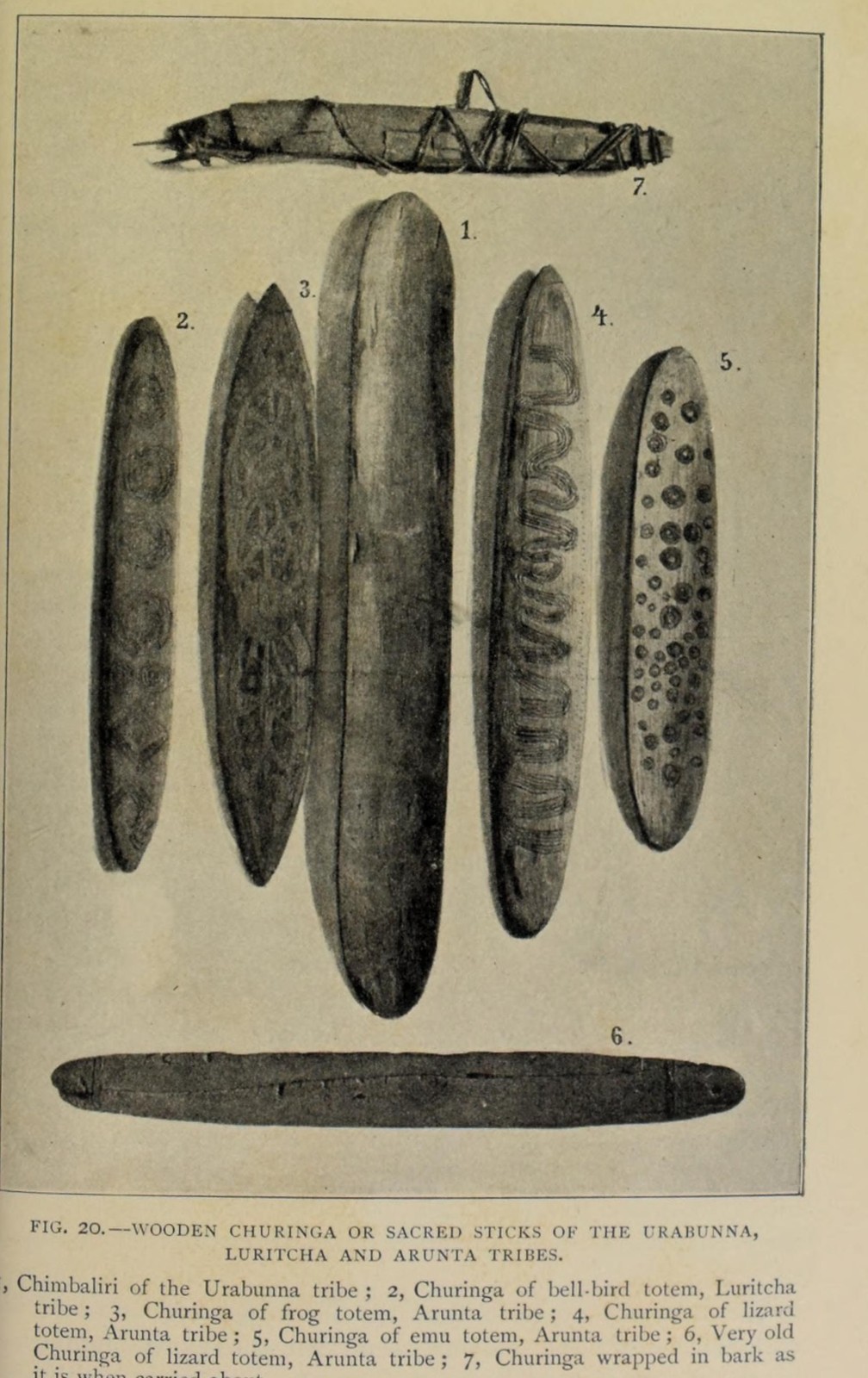
chimbaliri / tjimbaliri
Source term: sacred stick / Churinga / bull-roarer
Urabunna name for the sacred initiation stick or bull-roarer.
Etymology. A men's word. The women had their own name for the roar, Witurna — the name of the spirit they were taught was making it.
Among the Urabunna of the Lake Eyre country, the women and children were taught that the droning of the bull-roarer was the voice of a spirit called Witurna, who carried the boys off into the bush, cut out all of their insides, gave them new ones, and brought them back as initiated men. When Spencer recorded the belief at Old Peake Station in 1903, he noted that the women did not know the secret word for the stick; they were simply told it was "debil debil." The stick itself, the chimbaliri, was a plain piece of wood rounded at each end so that it had the general form of a wooden churinga, but with a quite plain surface, never incised or red-ochred. The Northern Urabunna made none of their own, borrowing them from the Southern Arunta or sending south for one, since they believed that if they made and sounded bull-roarers themselves the Arunta would be angry and ask why they made churinga when they had none of their own. After the initiation ordeal a youth was given a chimbaliri to carry about until his wound had healed.
The boy is told that he must on no account allow a woman or child to see the stick, or else he and his mother and sisters will tumble down as dead as stones.
Baldwin Spencer and F. J. Gillen, The Northern Tribes of Central Australia (Macmillan, 1904), p. 498.
Particulars
- Function
- Restricted initiation spirit-voice bullroarer with death/remaking myth.
Source
Baldwin Spencer and F. J. Gillen, The Northern Tribes of Central Australia (London: Macmillan, 1904), pp. 257-258 and 498