No. NGUINEA-017
Boazi (Boadzi / Kuni / Zimakani)
Papua New Guinea · Lake Murray and its central · northern shores plus the middle reaches of the Fly River, Western Province (southern lowlands) · Oceania
Restricted
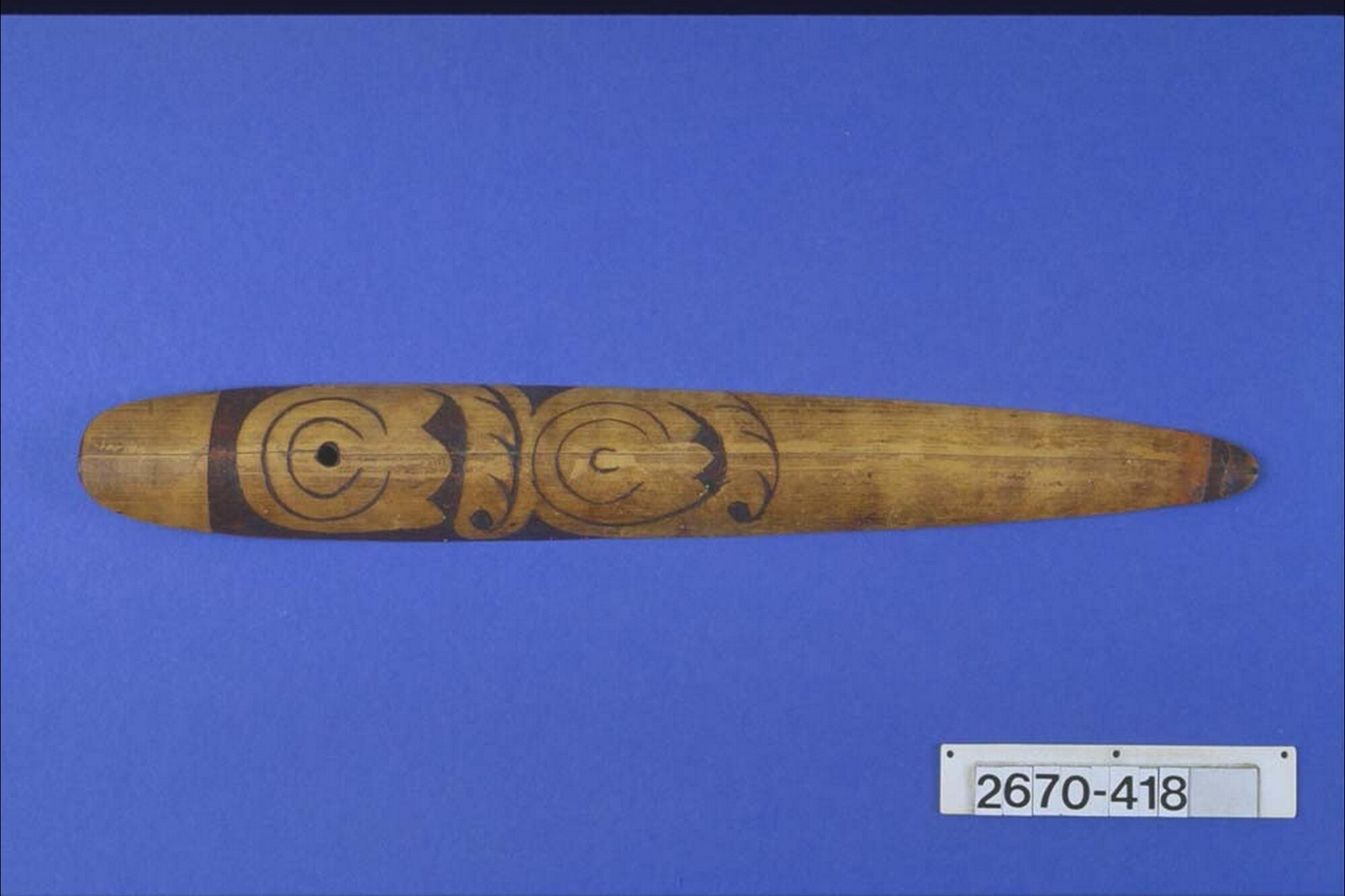
aut
Source term: aut (atu gisagaru)
cult name atu gisagaru, "voice of the old woman"
Etymology. aut is the Boadzi word for the bullroarer; the atu of the fuller cult name is the supernatural old-woman figure of the gomai initiation cult.
Among the Boazi of Lake Murray and the middle Fly River, initiation itself had an inventor. The culture hero Nggiw, who had shaped the first people and divided them into clans, wanted to make a feast: he tried a mouse, but the mouse fled; he tried a wallaby, but the wallaby made too much noise; at last he carved a fish-shaped piece of wood, the faroch, set it up high in the ceremonial house, and so contrived the first initiation ceremony. The bullroarer belongs to that founding order: van Baal lists it among the implements of the gomai, the old Boazi secret cult, performed on Nggiw's instructions, sounded by night only, its voice that of "the atu, the old woman" — the same instrument that among the coastal Marind sounds for Sosom, the giant who swallows and disgorges the novices. In the gomai the old woman herself is killed, in the guise of two coconuts, and buried with due respect in a mound made to resemble a scrub-hen's nest. Every Boazi village kept a men's house set apart from the dwellings, the repository of the central objects of the men's secret cult; male initiation here was bound up with head-hunting, and lapsed with the raids. The ethnographer Mark Busse lists the bullroarer plainly beside the great hourglass drum among Boazi instruments.
Musical instruments include large hourglass drums and bullroarers.
Mark Busse, "Boazi," Encyclopedia of World Cultures, Vol. II: Oceania (1991), "Religion and Expressive Culture."
Particulars
- Object
- A bullroarer swung from a cord tied to a long rod, listed among Boazi instruments alongside large hourglass drums.
Source
Mark Busse, "Boazi," in Encyclopedia of World Cultures, Vol. II: Oceania, ed. Terence E. Hays (Boston: G.K. Hall / Macmillan, 1991); J. van Baal (with J. Verschueren), Dema: Description and Analysis of Marind-anim Culture (South New Guinea) (The Hague: Martinus Nijhoff, 1966), pp. 106-107, 588-590, 596-600