No. MUS2026-064
Kanim with its nostril and mouth
Papua New Guinea · Western Province (Muyu · Ok Tedi · Oceania · Sahul
Restricted
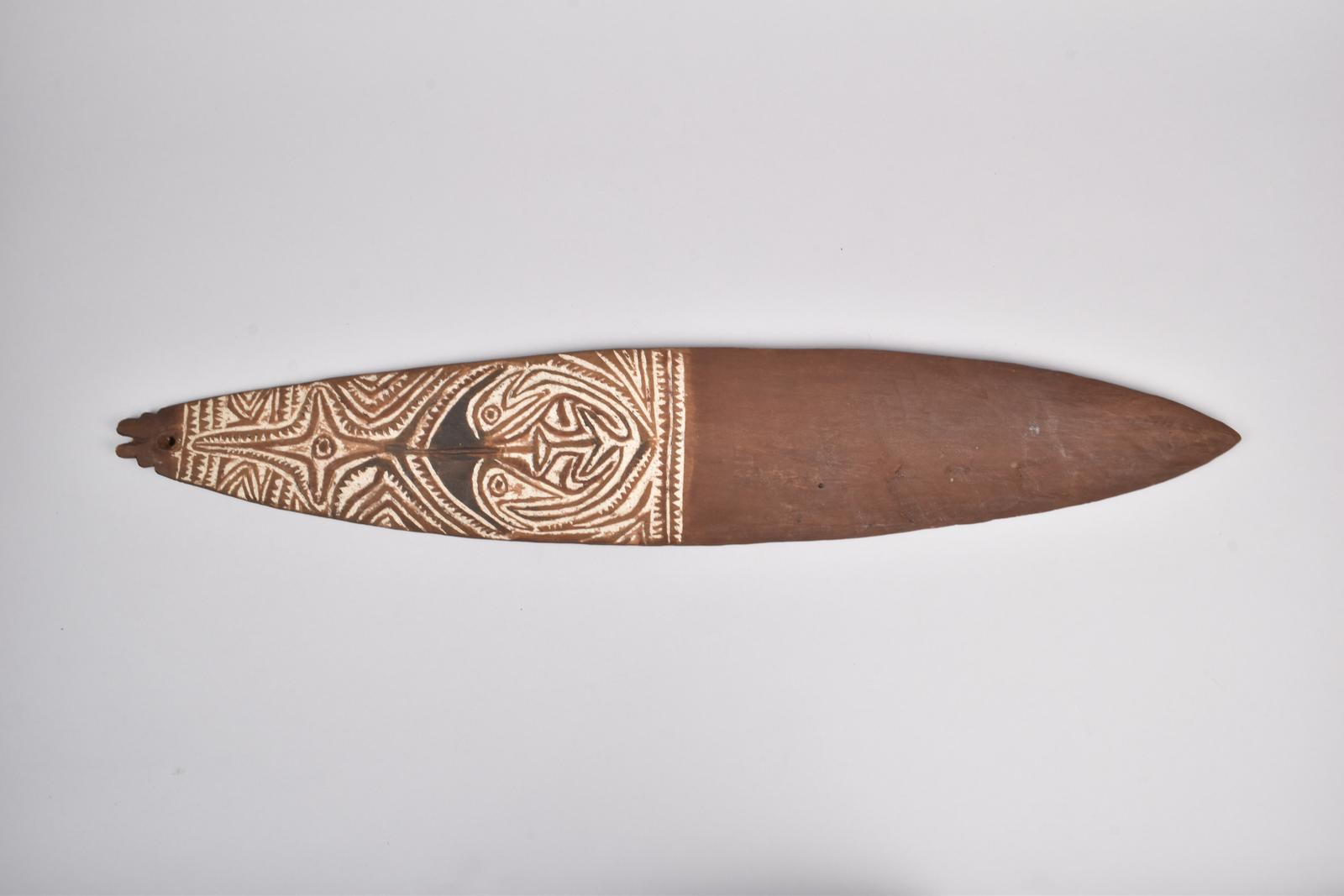
kanim / watmung yawat
kanim is the wooden bull-roarer; watmung ("fly") yawat buzzes like flies; diap ("cassowary") yawat mimics a cassowary's call. Yawat is the male cult itself.
Etymology. Watmung means flies - specifically the blue-bottle flies of corpses left to decay on exposure platforms, hence a death-omen - and yawat is the male initiation cult; the small bow-shaped bull-roarer is so named because it sounds like buzzing flies.
Three Yonggom bull-roarers in the Penn Museum carry a standing instruction from the men who made them: women must never see them. They belong to the yawat male cult of the upper Fly-Digul plateau, where a fresh one is made in the forest for each initiation and discarded once the rite is done. The wooden example, called kanim, has a hole for the whirling cord its makers call the "nostril" and a notch at one end called the "mouth"; tied to a wand about a meter and a half long, it is swung at two speeds to produce two different sounds. The other two are named for the voice they imitate: diap yawat, made of wild pandanus, gives the call of a cassowary; watmung yawat, built from a twig, a strip of leaf and split cane, buzzes like flies. All three were collected in 1989 by the anthropologist Stuart Kirsch from their named makers: the kanim from Agus of Ninati village in Irian Jaya, the diap yawat from Kutem Buru of the Namanggo clan at Dome, the watmung yawat from Kibinok Keret of the Miripki clan, also at Dome. Kirsch was himself put through the cult: marched under an arch of palm fronds with the bull-roarer whirring overhead and hands pushing him forward through a crowd of strange and tangled bodies.
This is a sacred object, Yonggom men do not want Yonggom women to see it. No photographing or publication of details of this object without permission from collector or curator.
Penn Museum, object record 89-17-104 (Yonggom bull-roarer, cultural restriction notice)
Particulars
- Object
- Three Yonggom bull-roarers in the Penn Museum (89-17-102/103/104): a wooden kanim by Agus, a wild-pandanus diap yawat by Kutem Buru (Namanggo clan), and a twig-and-leaf watmung yawat by Kibinok Keret (Miripki clan).
- Function
- Sacred noisemaker of the yawat male-initiation cycle; women are forbidden to see it and the piece is discarded after the ceremony. Sound likened to a cassowary call or buzzing flies (kanim / watmung yawat in Yonggom).
Source
Penn Museum, acc. 89-17-104