Daramulun’s voice, the summons and the making of men
From the south coast and Monaro to Wiradjuri and Kamilaroi ceremonial country, Daramulun’s voice joins the bullroarer to initiation. Messengers bear the instrument, novices hear it approach, and elders reveal it beside ancestral images. The being’s name connects rites whose instrument-names and performances remain local.
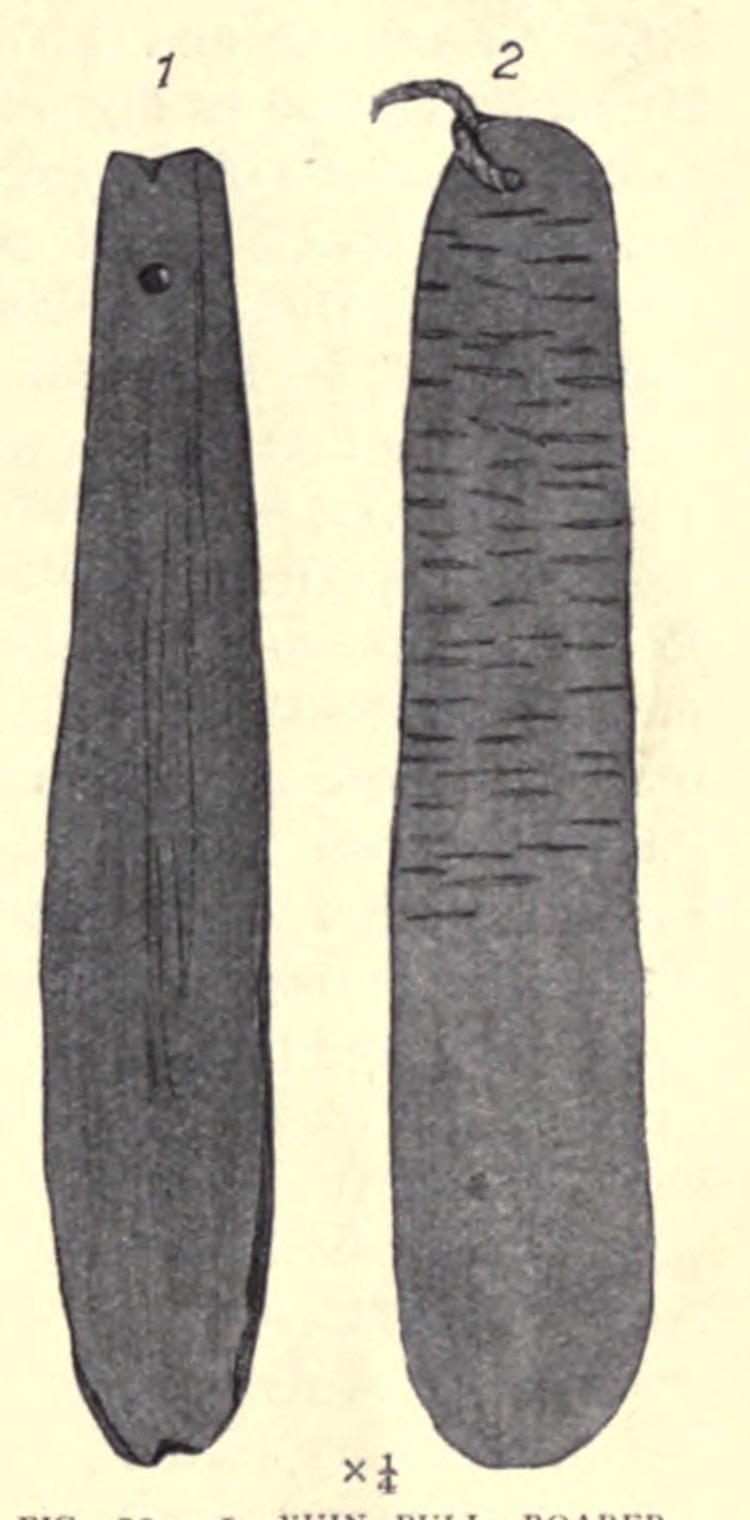
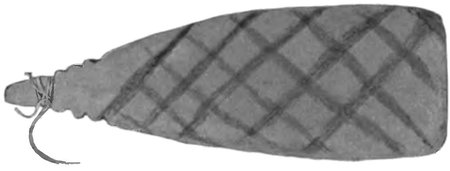
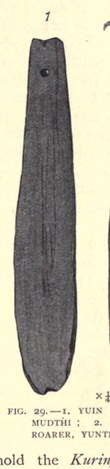
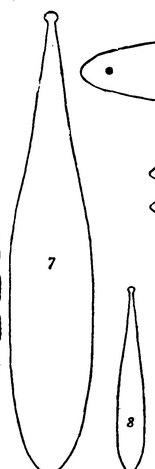
Coast MurringHowitt’s fig. 29: Yuin mudthi beside a Dieri yuntha.A. W. Howitt, The Native Tribes of South-East Australia (1904), fig. 29 · Public domainKamilaroiMathews’s Plate 9, figs. 5–6: Kamilaroi murrawan from the Weir River.R. H. Mathews, Notes on the Aborigines of New South Wales, 1907, Plate 9 figs. 5-6 · Public domainShoalhaven and southeast coast tribesMathews’s Plate 9, fig. 11: Shoalhaven mooroonga bullroarer.R. H. Mathews, Notes on the Aborigines of New South Wales, 1907, Plate 9 fig. 11 · Public domain
A boy kneels at a ceremonial ground while the thunder-voice approaches from the scrub. For the Yuin, this is Daramulun: the being who instituted Kuringal and made its sacred boards. For Kamilaroi novices, the roar is Dhurramoolan coming to take them away. Across these networks the instrument carries a named ancestral authority, first heard, then seen, then entrusted to the young men. 1, 2
The Yuin mudthi voices more than a frightening visitor. Umbara, the bard who explained it to Howitt, linked its rumble to thunder and thunder to Daramulun calling for rain and new growth. Daramulun instituted the initiation and instructed the fathers to continue it. The ceremony therefore renews an ancestral command: the sound that helps make a young man also belongs to the force that makes country grow. 1
At Calga, Darkinjung and Guringai knowledge holders identify a particular sandstone amphitheatre as Daramulan’s place of emergence. A one-legged engraved figure belongs to that landscape of initiation and ancestral authority. The custodial account makes his thundering voice the call separating boys from their mothers and bringing them to the Law. Here the being who is heard in the instrument is also located in country. 3
The network forms before the initiation starts. A messenger chosen for his ability to speak takes a bullroarer from the head Gommera, wrapped with a fur-string belt, arm bands and a forehead band. He opens the bundle among the initiated men and recites whom he has come to summon. The Ngarigo mudji travels with weapons as a token of the same kind of authority. An instrument whose sound is sacred can carry its message while silent. 1
Howitt’s Yuin Kuringal assembled people from Monaro, Shoalhaven and Braidwood as well as the coast. Marriage ties and ceremonial participation made a community larger than one people or language. When Wolgal singer Mragula disliked the supplied roarer’s voice, he made another from a nearby native cherry-tree. A shared rite depended on the right local sound, made by someone who knew what it should be. 1
On the Shoalhaven and southeastern coast, Mathews distinguishes the messenger’s smaller mooroonga from the great jummagong sounded near a novice as his tooth is removed. Men heap loose earth into an eight-foot figure of Dharamoolun, place a quartz crystal on its head and dance around it calling his name. At the close, they sound both instruments before the boys, explain what they have been hearing and let them try the action. 2
The Wiradjuri pair has different names: mudthega and moonibear. Farther north on the Culgoa, they become wuddoolnurran and ghidjoolkumbal, used in the same manner. On the upper Murrumbidgee, the mundjeegong bears a distinctive triangular notch. The recurring being-name and ceremonial revelation connect these instruments even while their names, timber and form vary. Such differences give the network its texture: the same ancestral authority can be sounded through recognizable local craft. 2, 1
At the Kamilaroi Bora, men shout that Dhurramoolan is coming, scatter fire into the ring and beat their weapons as the roarers sound. Mothers and children lie covered while guardians lead the boys away. Later, two men swing the murrawans in full view of the novices, who learn that these are the voices they have heard throughout the ceremonies. Threats enforce the obligation to keep the discovery from the uninitiated. Sound, staged arrival and disclosure belong to one sequence. 2
The Wiradjuri story puts the voice into the very material of the board: Baiamai makes Dhuramoolan’s cry available through trees. The living medicine-man can then sound it at Burbung, where the novice is changed and the women remain screened from the instrument. A being, timber, maker and ceremony are joined by the voice. The network’s unity lies in that specific relationship, not in treating every southeastern initiation as Daramulun’s. 1, 2
Among the Coast Murring (Yuin) of the south coast of New South Wales, the roaring of the mudji was the muttering of thunder, and thunder was the voice of Daramulun, the being who first made the Kuringal initiation and ordered the fathers to hold it, and by whom these mudthi were first made. A. W.…
A. W. Howitt, The Native Tribes of South-East Australia (1904), fig. 29 · Public domain
Among the Wolgal of the upper Murrumbidgee and the neighbouring Yuin and Ngarigo, the whirled slat was the Mudthi, and its roar was the muttering of thunder, which was the voice of Daramulun, the being who was said to have first made the Kuringal initiation and taught it to their fathers. When…
Representative — not this record’s object · Howitt’s drawing of the Yuin mudthi.
R. H. Mathews, Notes on the Aborigines of New South Wales, 1907, Plate 9 figs. 5-6 · Public domain
At the Bora ground the Kamilaroi staged the coming of Dhurramoolan for the women to hear. As the novices were led away, a headman called out "Here he comes!" and others shouted "Go away!", as if addressing the malevolent being who presides over the ceremonies; men snatched up firesticks and flung…
R. H. Mathews, Notes on the Aborigines of New South Wales, 1907, Plate 9 fig. 11 · Public domain
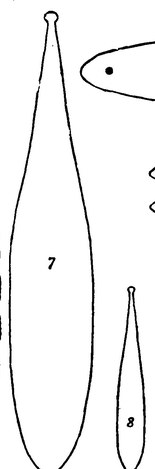
The mooroonga of the tribes along the Shoalhaven River and the south-east coast of New South Wales was the smaller of two bull-roarers: it mustered the tribes and was worked near the women's camp, carried by the ceremonial messenger in his bag beside a quartz crystal, while the great jummagong was…
R. H. Mathews, Notes on the Aborigines of New South Wales, 1907, Plate 9 figs. 7-8 · Public domain
On the upper Murrumbidgee the Wiradthuri bull-roarer was the mundjeegong, the instrument R. H. Mathews knew by the triangular notch cut into its broad end. Mathews and Howitt together show what that wood carried. In the Wiradjuri Burbung the roarer the messenger called Mudjigang summoned the camps…
A. W. Howitt, The Native Tribes of South-East Australia (1904), Fig. 40 · Public domain
At Calga on the Peats Ridge songline, boys were called to initiation by the bullroarer, its sound the thundering voice of Daramulan. Darkinjung and Guringai knowledge holders hold this sandstone amphitheatre to be the very place where Daramulan came into being: the one-legged son of Baiame, the…
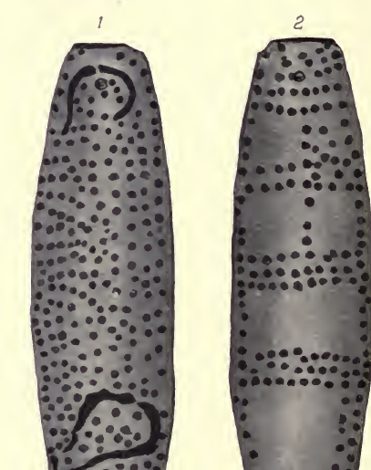
Representative — not this record’s object · Narrang-ga (Narungga) bull-roarer, both sides.
Chapters VII, IX and XI; pp. 494–496, 538, 565, 583–586, 628–632, 687, 700–701. Howitt witnessed Yuin and Kurnai ceremonies; other passages identify named correspondents. Haddon and Loeb restate these accounts and are not extra witnesses.
Journal of the Anthropological Institute 27, pp. 52–60, plate VI; supplemented by his Bunan (1896), Wiradthuri Burbung (1896) and later Notes on the Aborigines of New South Wales (1907). Instrument, deity and ceremony-names kept distinct.
State Heritage Register description and historical notes, 2018: Darkinjung and Guringai custodial interpretation of Daramulan’s place of emergence and ceremonial call.