No. HAYS1986-013
Gende children's toy bullroarer
Papua New Guinea · Bismarck Ranges · Oceania · Sahul
Play / practical
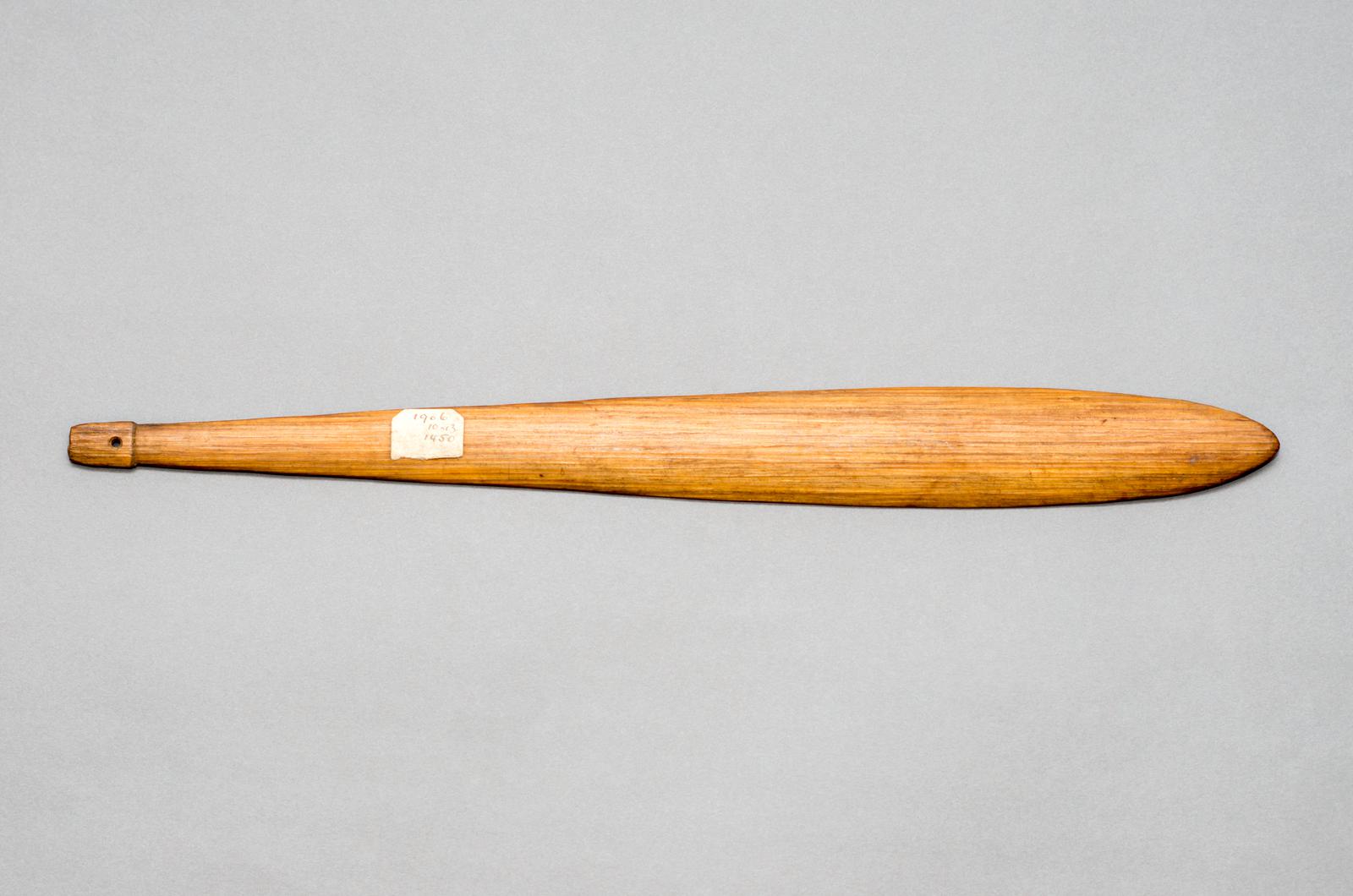
Source term: bullroarer
Almost everywhere else in the Highlands the bullroarer was an object women and children were forbidden even to see. Among the Gende, in the Bismarck Ranges at the northern rim of the region, children played with one. The Gende sacred instruments were the flutes — nakai, each pair given the name of a particular bird, watched over by a guardian spirit who sent sickness or death to any woman or child who saw them. Hays, who took the Gende case from Heinrich Aufenanger's long account of the people, noticed that this casual use — shared only with the Kuman of Chimbu — sat near the western terminus of the bullroarer's Highlands distribution, where the instrument more usually stood for monsters that had to be appeased with pigs if they were not to devour the young.
In the Highlands, only in Gende (Aufenanger 1979: 83) and Kuman Chimbu (Bergmann 1971/2: 194) did bullroarers have a non-sacred status, viz., that of children's toy.
Hays 1986:439 (Anthropos 81), citing Aufenanger 1979:83
Particulars
- Object
- A bullroarer used by Gende children as a plaything, without sacred status; no size, form or local name is recorded.
- Function
- A children's toy — one of only two Highlands cases Hays found in which the bullroarer had no sacred standing.
Source
Hays 1986 p. 439, citing Aufenanger 1979:83