No. EXH2026-034
Yimar (Korowori)
Papua New Guinea · Upper Korowori (Karawari) River, East Sepik · Oceania
Restricted
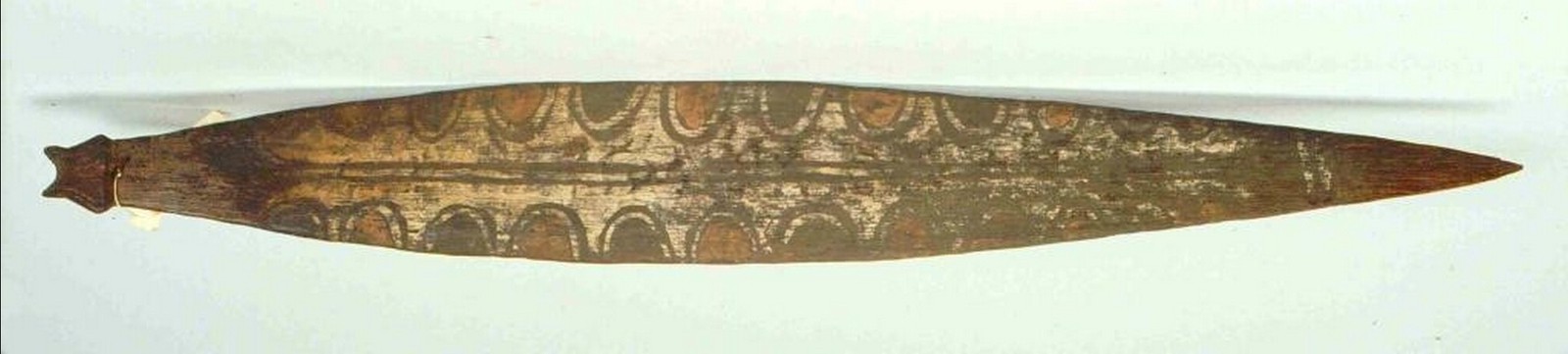
irimundur
Source term: Schwirrholz
irimundur — the Yimar (upper Korowori River) name for the bullroarer, recorded by Haberland and Seyfarth among the instruments of the men's sphere.
Among the Yimar of the upper Korowori River in the East Sepik, the bullroarer belonged to the men alone. Eike Haberland and Siegfried Seyfarth, in their 1974 monograph on the group, set it among the gear of a sphere closed to women and children — the same male world that produced the carved one-legged hunting-spirit figures kept in the men's house and, when their owners died, carried up to the limestone caves of the hills. They recorded its Yimar name as irimundur.
Particulars
- Object
- A Yimar bullroarer.
- Function
- Part of Yimar men's-cult equipment, restricted to a sphere closed to women and children.
Source
Eike Haberland & Siegfried Seyfarth, Die Yimar am oberen Korowori (Neuguinea), Studien zur Kulturkunde 36 (Wiesbaden: Franz Steiner, 1974), pp. 190-222, esp. p. 196 and Abb. 62, p. 197