No. MUS2026-055
Akwi-ó of the nose-piercing rite
Papua New Guinea · Morobe–Gulf fringe (Anga) · Oceania · Sahul
Restricted
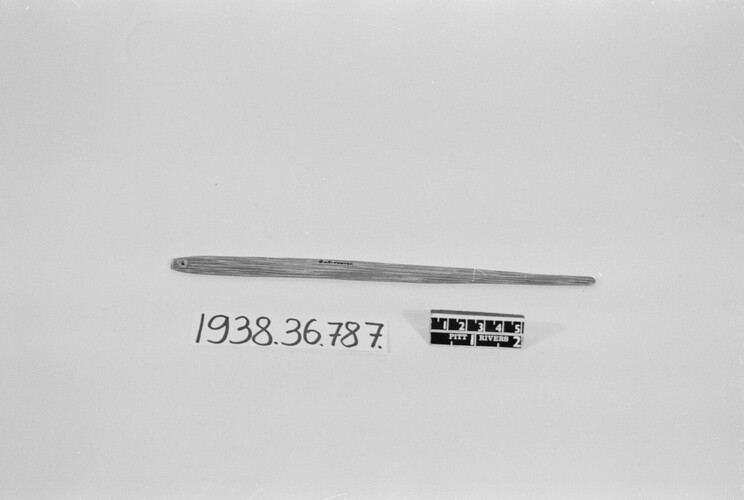
akwi-ó
Source term: bull-roarer
The Anga (Kukukuku) word for the bullroarer, recorded by Blackwood in the Upper Watut.
Among the Anga, or Kukukuku, of the Upper Watut, Beatrice Blackwood photographed the bull-roarer swung from the high seat during a boy's nose-piercing initiation, the novice waiting and the piercer beside him. She collected this plain wooden example, tapered to a point and undecorated, on the same 1936-37 expedition into the then-unadministered country above the Papuan Gulf - one of more than two thousand objects that became the basis of her monograph The Kukukuku of the Upper Watut. The rite itself she set down in photograph after photograph.
Particulars
- Object
- An undecorated Anga bull-roarer of light-coloured wood, 247 millimetres long and 13 wide, shaped to a point at one end and slightly tapered at the hole end; Pitt Rivers Museum, Oxford, 1938.36.787.
- Function
- Sounded over Anga boys at their nose-piercing initiation.