No. PNG105
Keraki
Papua New Guinea · Western · Oceania · Sahul
Restricted
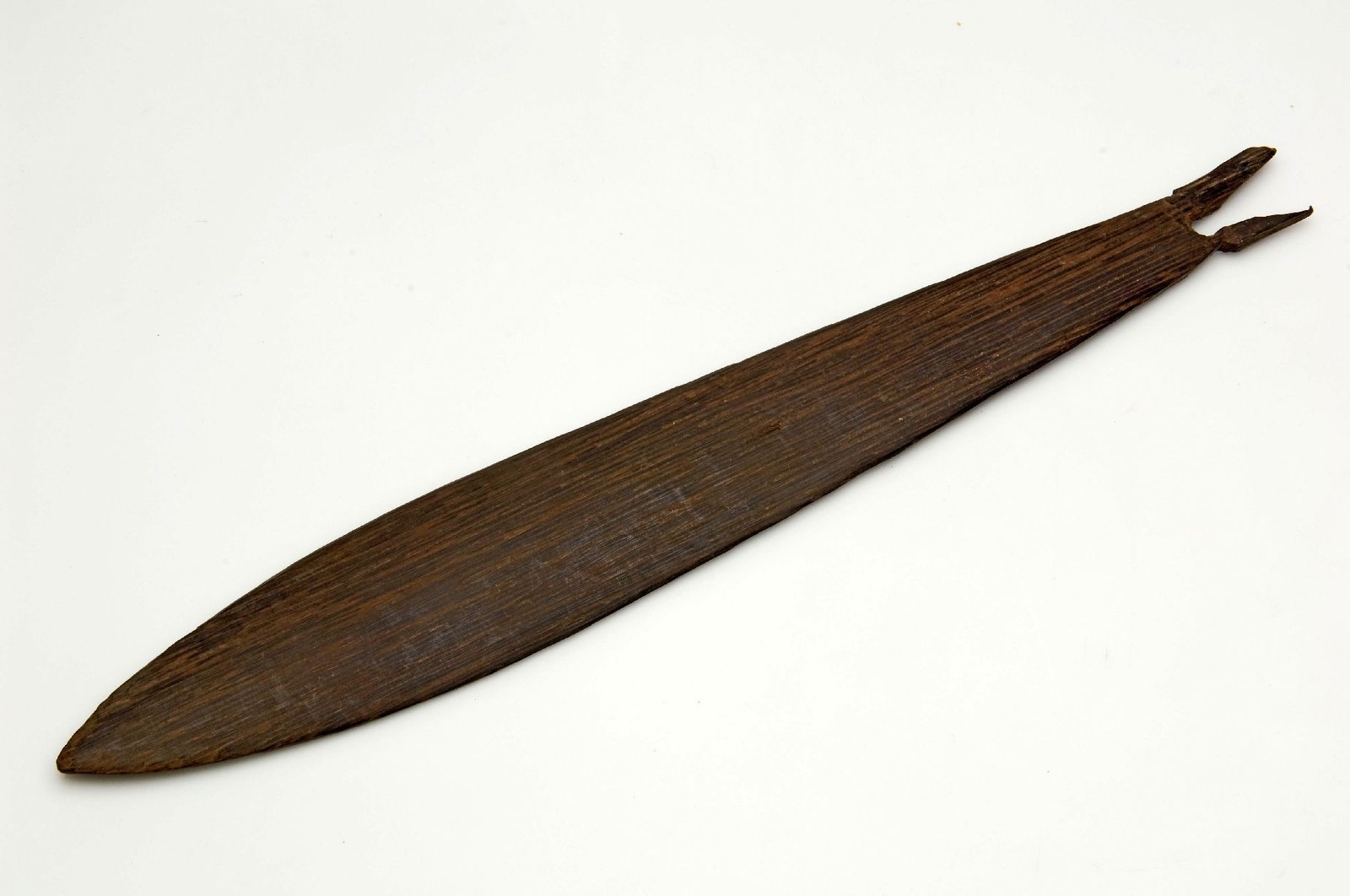
moiank
moiank — the Keraki word for the bullroarer. At Setavi, in the north of the neighbouring Semariji country, it is called sosa, which Haddon, in his Introduction to Williams’s own volume (pp. xxviii–xxix), sets beside the Marind name Sosom; the Gambadi word is thowatti. In Nmbo, the Kerake language today, the word is mwyang; the Nen of Bimadbn say meyang.
Etymology. Sosa, the name for the bullroarer at Setavi in the neighbouring Semariji country, is the local cognate of the Marind-Anim sosom — the proper name of the dema/giant whose voice the bullroarer is during the sosom cult, rather than a word with a literal meaning.
The Keraki of the Morehead River trace the world to the sky-being Kambel, who cut down a palm and heard voices inside it — the first people — and watched a shining thing slip from his hands and rise from the palm to become the moon. The bullroarer, their moiank, entered the world through his household: it sounded first for his wife Yuma, until Kambel came on her from behind and snatched it away, and it has belonged to the men ever since; in the neighbouring Gambadi telling at Kwavaru, where a bird is sent in after it, the theft draws the first menstrual blood. Keraki secrecy sat lightly even so — the woman of the myth simply tells her husband, and Williams noted 'there is some fun about it.' In the rite the secret still ruled. A boy met the moiank at initiation 'and not earlier, for he could not then be trusted to keep the secret from his mother'; his sponsor pressed hands over his eyes until the moment of revelation, and in the months of seclusion that followed, the initiates' 'main business, it would seem, is to grow' — growth the Keraki held to be worked by the ritual sodomy of the initiates, chartered by the myth of Kambel's stunted son Gufa. The Keraki explained the voice itself as the monstrous snake or crocodile, Bugal and Wanger — relics of the gainjan, the before-time when all creatures were gigantic, said to haunt the bush and the water and to strike with fatal illness anyone who saw them.
Among the Keraki this story retains the essential point that the bull-roarer (moiank) was taken from the woman's vagina.
F. E. Williams, Papuans of the Trans-Fly (Oxford, 1936), p. 308
Particulars
- Object
- Keraki moiank: thin spatulate pieces of palm wood, commonly about 10 inches long by 1 inch broad, well polished and pointed at the wider end (gonugo, head — the same word Williams gives for a skull), with a hole through the narrower tapering end (pombu, tail) for the string. Minor moiank are numerous and unnamed; major moiank are much larger, decorated (one carries the feathers of sixteen named birds from head to tail) and bear personal names such as Tofujenjeni. Sacred flutes and slit-gongs are also present in the complex.
- Function
- Central secret of male initiation: revealed to boys at the waramongo seclusion hut, kept from women and children; its origin myth gives it first to Kambel's wife before the men's theft
Source
K. A. Gourlay, Sound-Producing Instruments in Traditional Society: A Study of Esoteric Instruments and Their Role in Male-Female Relations (New Guinea Research Bulletin 60; Canberra and Port Moresby, 1975), Table 1, entry 105; Gourlay, pp. 70-71; F. E. Williams, Papuans of the Trans-Fly (Oxford, 1936), pp. 184, 205 and 308