No. AUSIN-004
The bull-roarer that came last
Australia · Cape York Peninsula · Queensland
Restricted
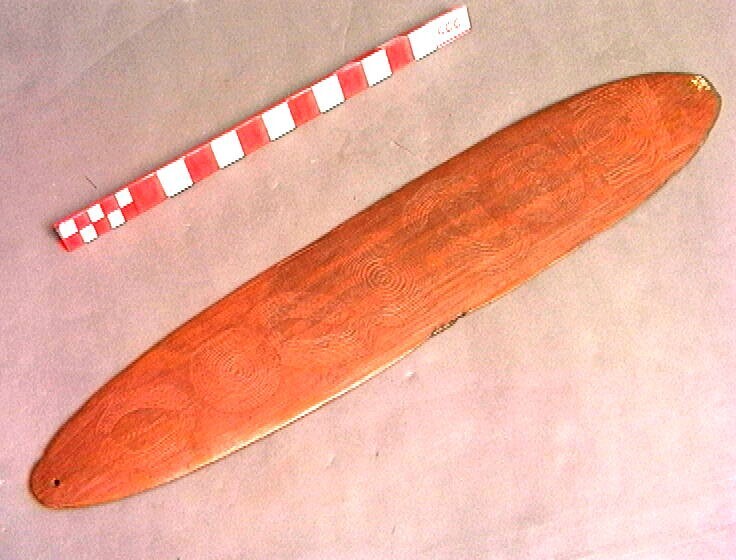
Source term: bull-roarers
On the Bloomfield River, on Cape York Peninsula, Walter Roth recorded an initiation in which the bull-roarer came last, not first. When a good season and food-supply let enough people gather, the boys to be initiated were taken to a lean-to of branches well removed from the women, covered head to foot with Grevillea-bark charcoal by a father or mother's brother, the ashes spat on and rubbed in by hand, then led to an oval ring scooped in the sand "within sight or sound of which no woman or other uninitiated males dare to be present." There, in relays that could run four days without sleep and on little food, the elders danced a whole series of birds and animals while each boy's father or mother's brother explained the meaning of each. Only afterward — past the long lifting of food taboos, past the nose-piercing by an attendant called the pi-wal — were the young men taught the use of the bull-roarers. Roth notes that a man need not have been through the rite even before marriage; the women went through none of it at all.
It is only subsequently to the initiation that the young men are taught the use of the bull-roarers. Females go through none of these initiation rites.
Roth 1909, North Queensland Ethnography Bulletin 12, "On certain initiation ceremonies," Records of the Australian Museum 7(3):177
Particulars
- Function
- Young men are taught bullroarer use after initiation; women and uninitiated excluded from rites
Source
W. E. Roth, 'North Queensland Ethnography. Bulletin No. 12. On certain initiation ceremonies,' Records of the Australian Museum 7(3) (1909), pp. 176-177