No. BPHED2026-001
Burgess Point / Port Hedland Complex bullroarer motif
Western Australia · Pilbara · Port Hedland · Burgess Point
Function not recorded
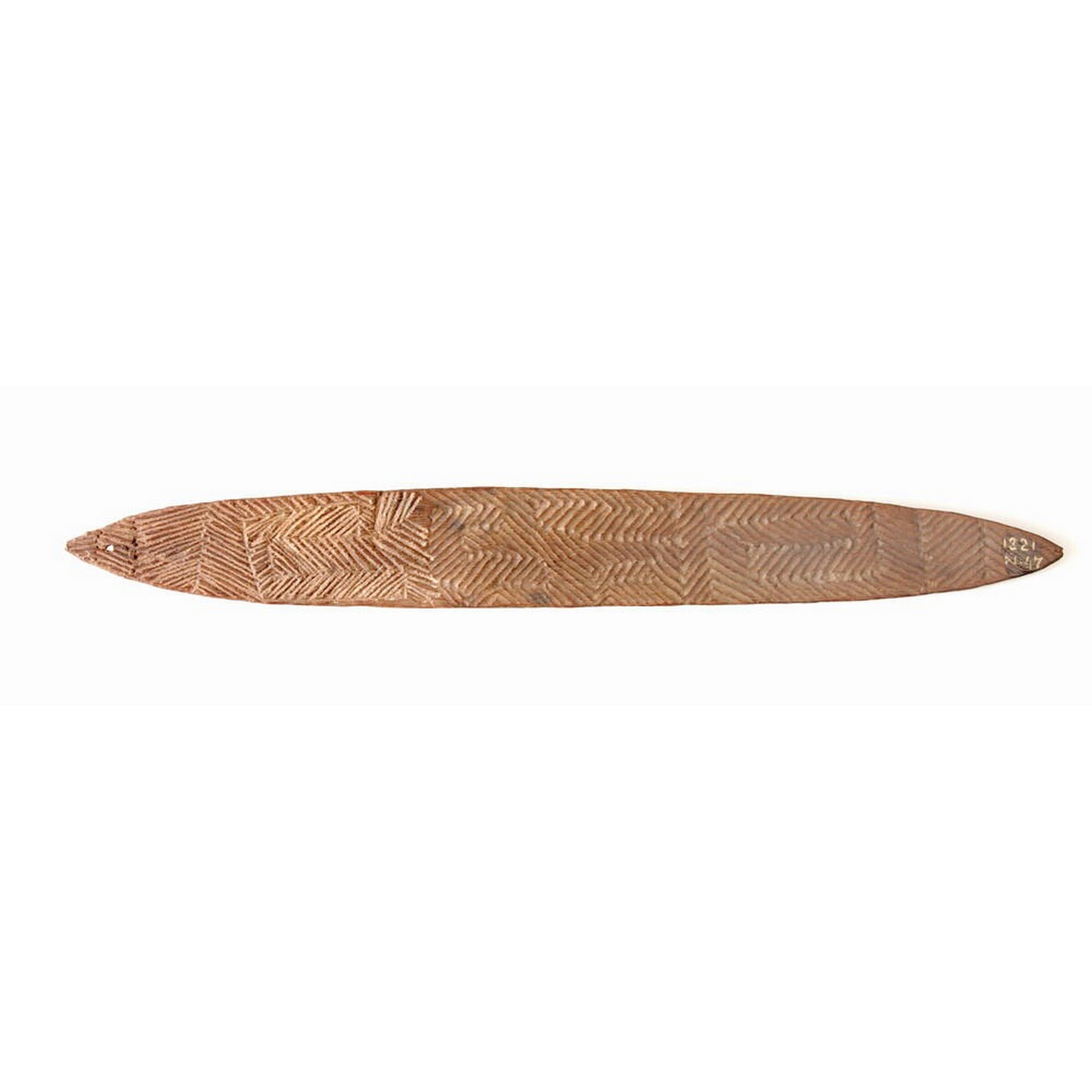
Source term: bullroarer
Almost every bullroarer is a thing swung to make a voice; this one was carved into stone and stays silent. At Burgess Point, a low limestone shelf ringed by mangrove mudflats at Marapikurrinya (Port Hedland), Kariyarra people pecked more than five hundred motifs across some seven thousand years: animal tracks, marine creatures, boomerangs and shields, and the upside-down-U Minjiburu ancestor-spirits from whom the Kariyarra descend. Among them sits a single engraved bullroarer. What rite that outline belonged to, the stone does not record.
produced semi-continuously over the last 7000 years, from the point of sea-level stabilisation
Sam Harper 2025, "Tracking Change in Rock Art Vocabularies and Styles at Marapikurrinya," Arts 14(5):123, abstract/introduction.
Particulars
- Object
- An engraved bullroarer among the motifs of the Burgess Point limestone engraving complex.
- Function
- Not recorded.
Source
Centre for Rock Art Research and Management, UWA, Rock Art Thematic Study (DCCEEW, 2016), pp. 36-37 and 124-126; Sam Harper, "Tracking Change in Rock Art Vocabularies and Styles at Marapikurrinya (Port Hedland, Northwest Australia)," Arts 14(5):123 (2025)