No. PNG41
Ngaing
Papua New Guinea · Madang · Oceania · Sahul
Restricted
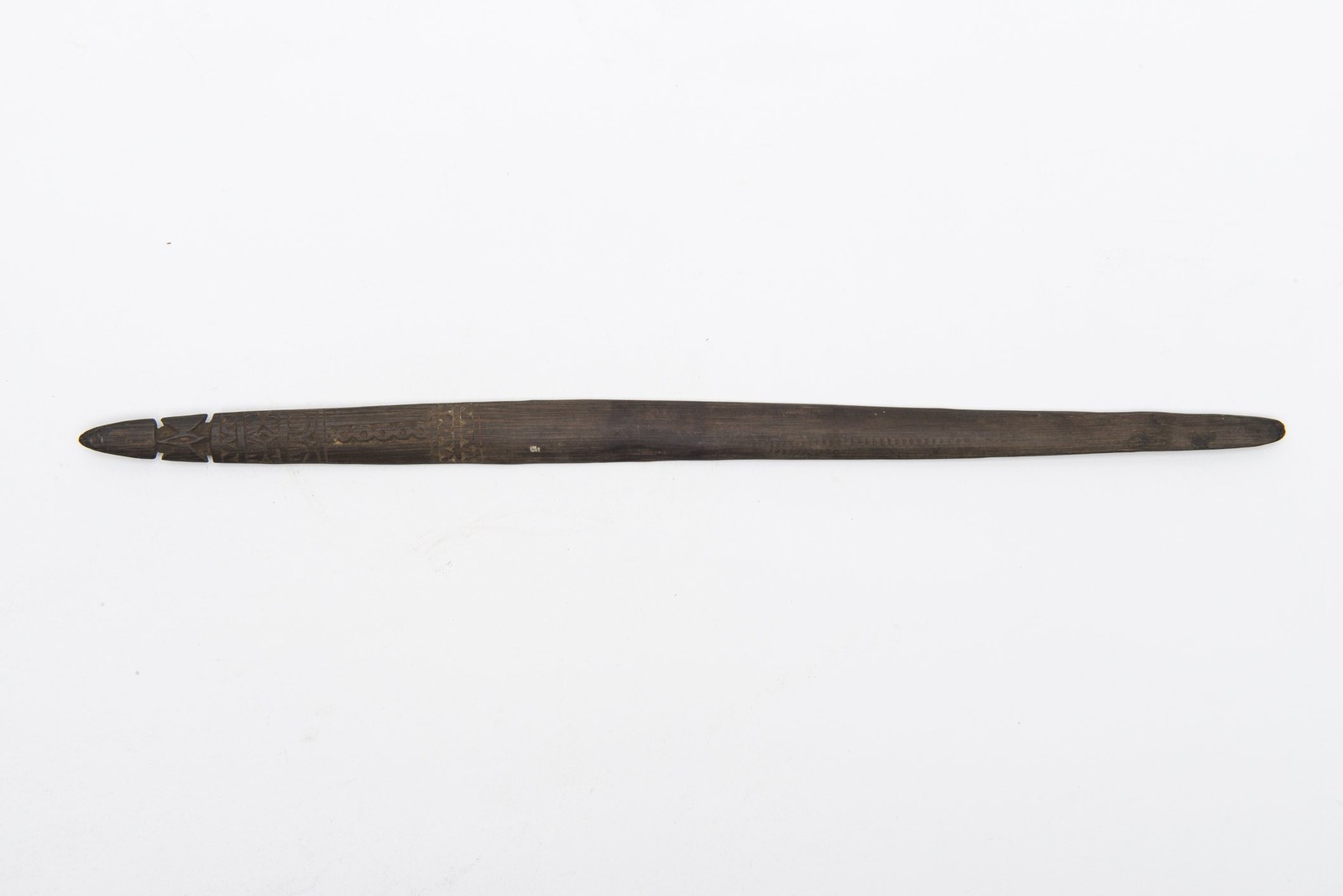
A Ngaing hunting party took its dead kinsmen's relics into the bush: locks of hair or fingerbones tied to bullroarers. The leader breathed a spell over his instrument and swung it out of sight of women and children, calling on a deity to drive the game towards the hunters. For hunts supplying feasts in honour of the dead, the instrument travelled in a netbag as a talisman and must never be swung. Parambik stood at the head of the Ngaing religious world, but the bullroarer was the work of the deity Gab'me, who first hid one in an old woman's net-bag. She failed at every attempt to make it speak. He taught the secret instead to her grandson, in a dream, and from that division women kept only the right to see the unstrung wood — a plain piece of black palm — never to see or hear it swung.
Particulars
- Object
- Both the bullroarer and the slit-gong are in use here.
- Function
- Hunting magic: swung with a spell to bring the game, or carried unsounded as a talisman when the hunt fed a feast for the dead.
Source
K. A. Gourlay, Sound-Producing Instruments in Traditional Society: A Study of Esoteric Instruments and Their Role in Male-Female Relations, New Guinea Research Bulletin 60 (Canberra, 1975), Table 1, entry 41, and pp. 55, 81; Peter Lawrence, Road Belong Cargo (Manchester, 1964), pp. 17–18; Peter Lawrence, "The Ngaing of the Rai Coast," in P. Lawrence and M. J. Meggitt (eds.), Gods, Ghosts and Men in Melanesia (Melbourne, 1965), pp. 205, 209