No. PNG56
Tami
Papua New Guinea · Morobe · Oceania · Sahul
Restricted
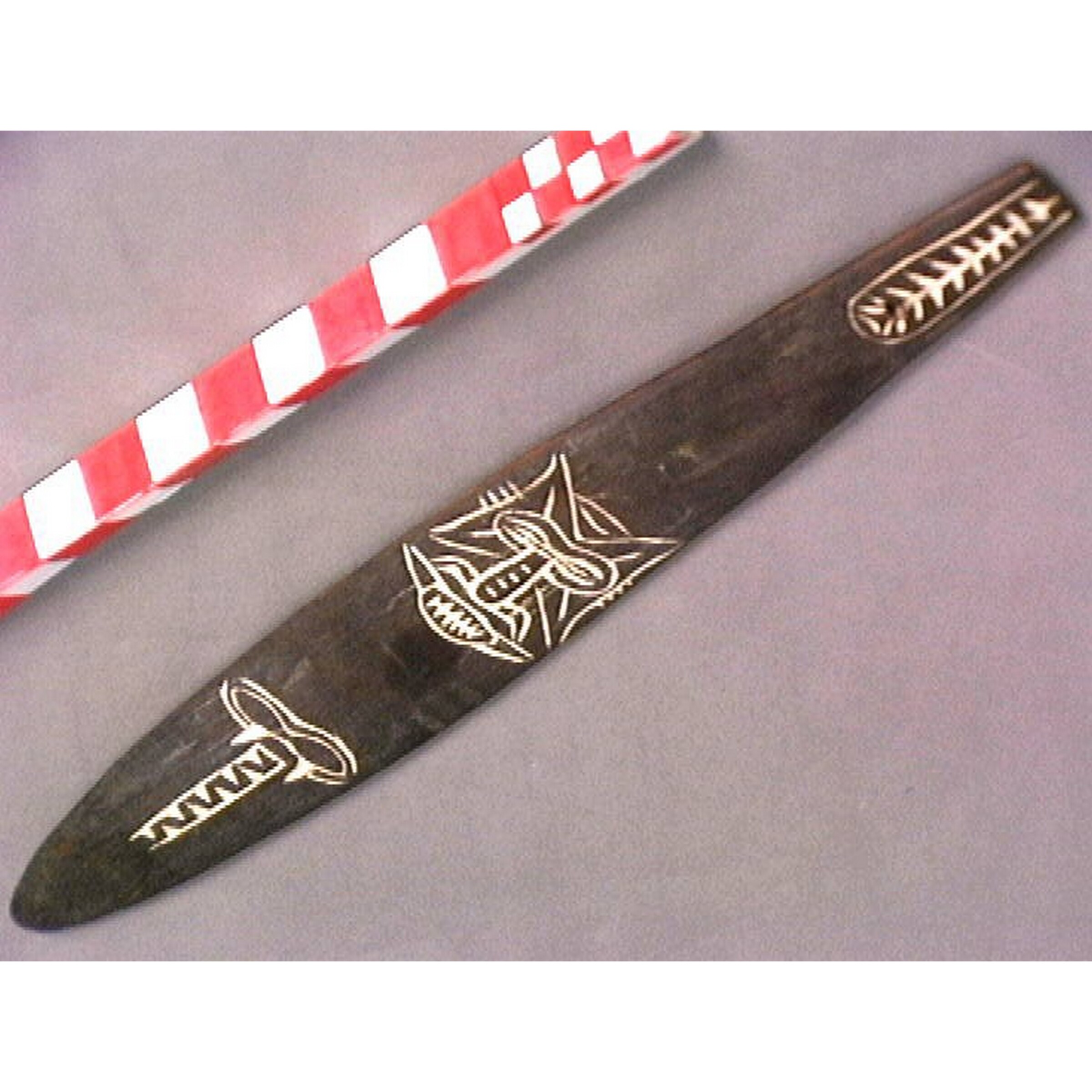
kani
spirits/souls of the dead; the same word names the bullroarer and the swallowing monster
Etymology. Kani primarily means the souls of the dead, the objects of Tami ancestor worship. The same word is extended to the bullroarer and to the monster who swallows the lads at circumcision, binding instrument, ghost, and monster into one.
On the Tami Islands of the Huon Gulf, the hum of the bullroarer was the voice of a monster that swallowed boys at their initiation and disgorged them as men, and the women wept for joy and strewed boiled field-fruits along the returning boys' path. The Tami were one of four neighbouring peoples of northern New Guinea — with the Yabim, Bukaua, and Kai — who staged circumcision as a passage through this creature's body, and who used one word for both the swung instrument and the monster it spoke for; among the Yabim and Bukaua that word was balum. Frazer noted that in three of the four languages the same word meant also a ghost or spirit of the dead, while in the fourth, the Kai tongue, it signified 'grandfather.' Where the Kai made the novices file under a scaffold past a man who gulped water as each one passed, the Tami enacted the swallowing by marching the candidates past a row of men who held bullroarers swinging over their heads. The kani came to the Tami, they say, out of a woman's hands. On Boang Island a woman chopping firewood sent up a splinter that whirred as it flew; she took it home and showed her husband as a joke, he showed it to the men, and the men put a spell on her so that she died, and found him another wife. On Tami itself the find is washed ashore instead — a small piece of wood with a string still attached, picked out of floating driftwood. Bamler, who recorded both, thought the story no more than 150 years old and reshaped to fit Tami practice, and held that the kani cult itself had come from much further afield than Boang.
The bull-roarers … are swung at the ceremony in such numbers and with such force that in still weather the booming sound may be heard across the sea for many miles.
J. G. Frazer, The Belief in Immortality and the Worship of the Dead, vol. I (1913), p. 301
Particulars
- Object
- A Tami Islands carved wooden bullroarer with lime designs, collected before 1889, 37 x 5.5 x 0.5 cm.
- Function
- Initiation instrument tied to boys' upbringing and ritual; sounded in numbers as the voice of the initiation monster kani.
Source
J. G. Frazer, The Belief in Immortality and the Worship of the Dead, vol. I (London, 1913), pp. 301–302; K. A. Gourlay, Sound-Producing Instruments in Traditional Society: A Study of Esoteric Instruments and Their Role in Male-Female Relations, New Guinea Research Bulletin 60 (Canberra, 1975), Table 1, entry 56, and p. 70; Wereldmuseum, RV-746-38